

420
CHAPTER 44
44.73
44.74
Evaluate
for the ball SI of Problem 44.65.
By spherical symmetry,
so
Find the mass of a plate in the form of a right triangle $1 with legs a and b, if the density (mass per unit area) is
numerically equal to the sum of the distances from the legs.
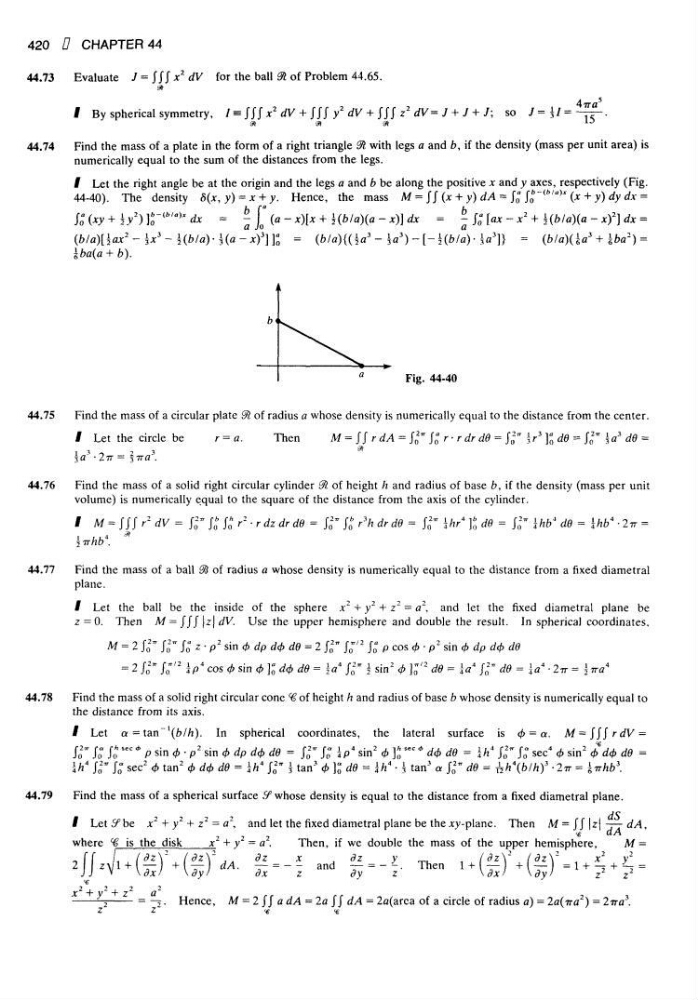
Let the right angle be at the origin and the legs a and b be along the positive x and y axes, respectively (Fig.
44-40). The density
Hence, the mass
Fig. 44-40
44.75
44.76
44.77
Find the mass of a circular plate &l of radius a whose density is numerically equal to the distance from the center.
Let the circle be
Then
Find the mass of a solid right circular cylinder 31 of height h and radius of base £>, if the density (mass per unit
volume) is numerically equal to the square of the distance from the axis of the cylinder.
Find the mass of a ball 3ft of radius a whose density is numerically equal to the distance from a fixed diametral
plane.
and let the fixed diametral plane be
Use the upper hemisphere and double the result. In spherical coordinates.
Then
44.78
Find the mass of a solid right circular cone <€ of height h and radius of base b whose density is numerically equal to
the distance from its axis.
Let
In spherical coordinates, the lateral surface is
44.79
Find the mass of a spherical surface y whose density is equal to the distance from a fixed diametral plane.
Let
and let the fixed diametral plane be the ry-plane. Then
Let the ball be the inside of the sphere
Then, if we double the mass of the upper hemisphere,
Hence,
where <€ is the disk
(area of a circle of radius a)
and
Then
CHAPTER 44
44.73
44.74
Evaluate
for the ball SI of Problem 44.65.
By spherical symmetry,
so
Find the mass of a plate in the form of a right triangle $1 with legs a and b, if the density (mass per unit area) is
numerically equal to the sum of the distances from the legs.
Let the right angle be at the origin and the legs a and b be along the positive x and y axes, respectively (Fig.
44-40). The density
Hence, the mass
Fig. 44-40
44.75
44.76
44.77
Find the mass of a circular plate &l of radius a whose density is numerically equal to the distance from the center.
Let the circle be
Then
Find the mass of a solid right circular cylinder 31 of height h and radius of base £>, if the density (mass per unit
volume) is numerically equal to the square of the distance from the axis of the cylinder.
Find the mass of a ball 3ft of radius a whose density is numerically equal to the distance from a fixed diametral
plane.
and let the fixed diametral plane be
Use the upper hemisphere and double the result. In spherical coordinates.
Then
44.78
Find the mass of a solid right circular cone <€ of height h and radius of base b whose density is numerically equal to
the distance from its axis.
Let
In spherical coordinates, the lateral surface is
44.79
Find the mass of a spherical surface y whose density is equal to the distance from a fixed diametral plane.
Let
and let the fixed diametral plane be the ry-plane. Then
Let the ball be the inside of the sphere
Then, if we double the mass of the upper hemisphere,
Hence,
where <€ is the disk
(area of a circle of radius a)
and
Then