

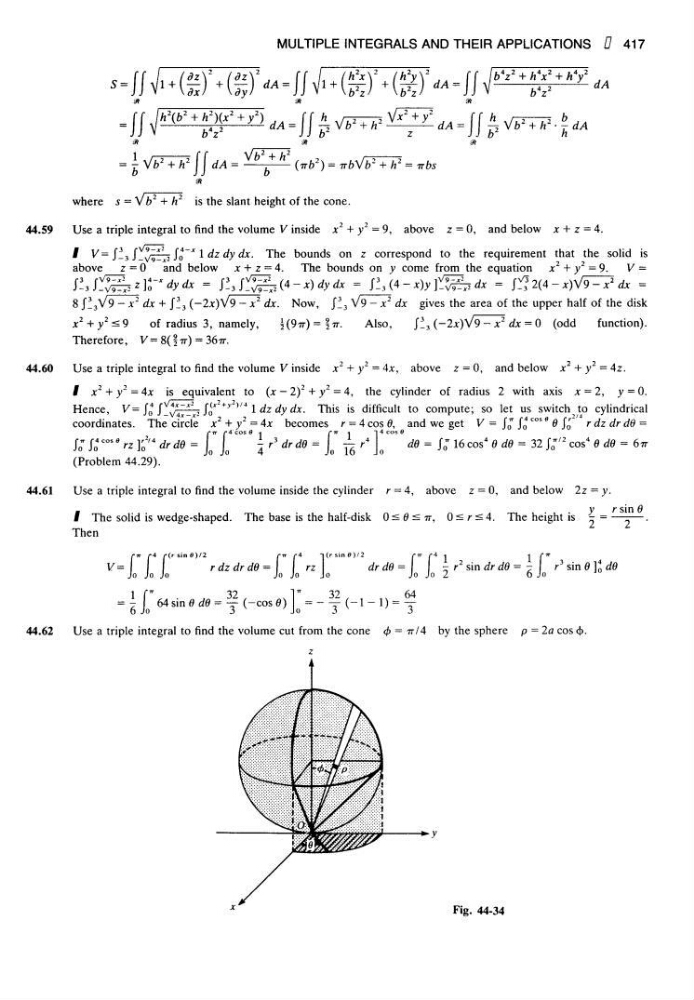
Fig. 44-34
44.62
Use a triple integral to find the volume cut from the cone 4> = 77/4 by the sphere p = 2a cos <|>.
The solid is wedge-shaped. The base is the half-disk 0 < 0 < TT, 0 s r < 4. The height is
Then
44.61
Use a triple integral to find the volume inside the cylinder r = 4, above z = 0, and below 2z = y.
44.60
MULTIPLE INTEGRALS AND THEIR APPLICATIONS
417
where 5 = Vb
2 + h
2
is the slant height of the cone.
44.59
Use a triple integral to find the volume V inside x
2 + y
2 = 9, above z = 0, and below x + z = 4.
The bounds on z correspond to the requirement that the solid is
above
z = 0 and below x + z = 4. The bounds on y come from the equation
x
2 + y
2 = 9.
Now,
gives the area of the upper half of the disk
Also,
(odd
function).
x
2 + y
2 =£ 9
of radius 3, namely,
Therefore,
Use a triple integral to find the volume V inside x
2 + y
2 = 4x, above z = 0, and below x
2 + y
2 = 4z.
x
2 + y
2 = 4x is equivalent to (x — 2)
2 + y
2 = 4, the cylinder of radius 2 with axis x = 2, y = 0.
This is difficult to compute; so let us switch to cylindrical
Hence,
coordinates. The circle x
2 + y
2 = 4x becomes r = 4 cos 6, and we get
(Problem 44.29).
Download
from Wow! eBook
44.62
Use a triple integral to find the volume cut from the cone 4> = 77/4 by the sphere p = 2a cos <|>.
The solid is wedge-shaped. The base is the half-disk 0 < 0 < TT, 0 s r < 4. The height is
Then
44.61
Use a triple integral to find the volume inside the cylinder r = 4, above z = 0, and below 2z = y.
44.60
MULTIPLE INTEGRALS AND THEIR APPLICATIONS
417
where 5 = Vb
2 + h
2
is the slant height of the cone.
44.59
Use a triple integral to find the volume V inside x
2 + y
2 = 9, above z = 0, and below x + z = 4.
The bounds on z correspond to the requirement that the solid is
above
z = 0 and below x + z = 4. The bounds on y come from the equation
x
2 + y
2 = 9.
Now,
gives the area of the upper half of the disk
Also,
(odd
function).
x
2 + y
2 =£ 9
of radius 3, namely,
Therefore,
Use a triple integral to find the volume V inside x
2 + y
2 = 4x, above z = 0, and below x
2 + y
2 = 4z.
x
2 + y
2 = 4x is equivalent to (x — 2)
2 + y
2 = 4, the cylinder of radius 2 with axis x = 2, y = 0.
This is difficult to compute; so let us switch to cylindrical
Hence,
coordinates. The circle x
2 + y
2 = 4x becomes r = 4 cos 6, and we get
(Problem 44.29).
Download
from Wow! eBook