

CHAPTER 6
Limits
6.1
6.2
6.3
6.4
6.5
Define Km f(x) = L.
Intuitively, this means that, as x gets closer and closer to a, f(x) gets closer and closer to L. We can state this
in more precise language as follows: For any e >0, there exists 8>0 such that, if |*-a|<5, then
\f(x)-L\0, there exists at least one x in the domain off(x) such that
\x-a\<8.
Find
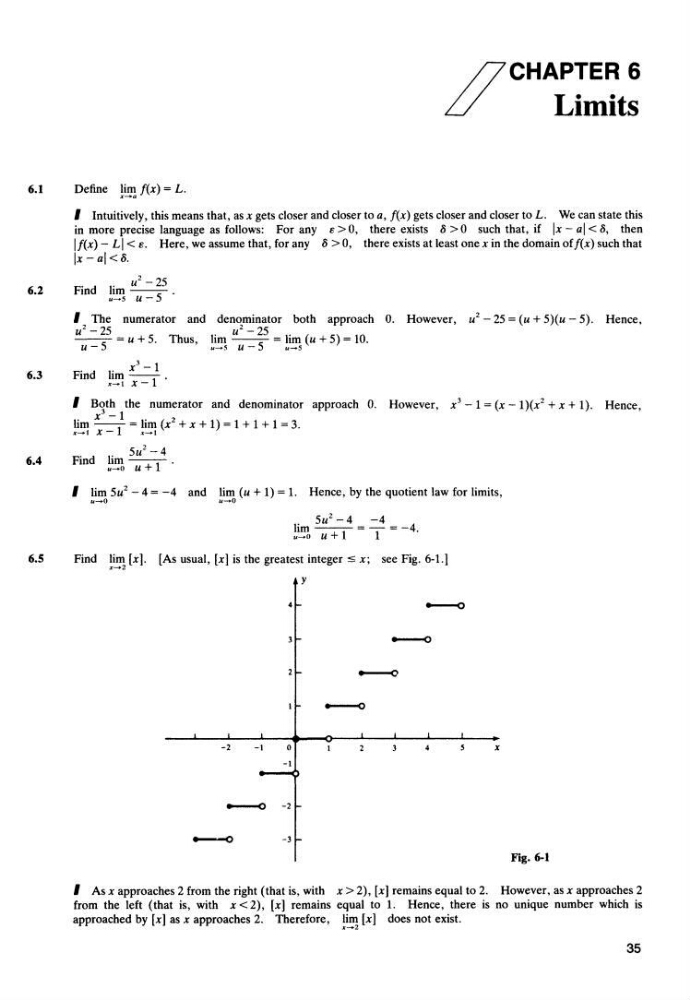
Find lim [x]. [As usual, [x] is the greatest integer s x; see Fig. 6-1.]
Fig. 6-1
As x approaches 2 from the right (that is, with * > 2), [x] remains equal to 2. However, as x approaches 2
from the left (that is, with x<2), [x] remains equal to 1. Hence, there is no unique number which is
approached by [x] as x approaches 2. Therefore, lim [x] does not exist.
35
The numerator and denominator both approach 0. However, u
2 — 25 = (u + 5)(u — 5). Hence,
Thus,
Find
Both the numerator and denominator approach 0. However, x3 - 1 = (x - V)(x2 + x + 1). Hence,Both the numerator and denominator approach 0. However, x3 - 1 = (x - V)(x2 + x + 1). Hence,
Find
and
Hence, by the quotient law for limits,
Limits
6.1
6.2
6.3
6.4
6.5
Define Km f(x) = L.
Intuitively, this means that, as x gets closer and closer to a, f(x) gets closer and closer to L. We can state this
in more precise language as follows: For any e >0, there exists 8>0 such that, if |*-a|<5, then
\f(x)-L\
\x-a\<8.
Find
Find lim [x]. [As usual, [x] is the greatest integer s x; see Fig. 6-1.]
Fig. 6-1
As x approaches 2 from the right (that is, with * > 2), [x] remains equal to 2. However, as x approaches 2
from the left (that is, with x<2), [x] remains equal to 1. Hence, there is no unique number which is
approached by [x] as x approaches 2. Therefore, lim [x] does not exist.
35
The numerator and denominator both approach 0. However, u
2 — 25 = (u + 5)(u — 5). Hence,
Thus,
Find
Both the numerator and denominator approach 0. However, x3 - 1 = (x - V)(x2 + x + 1). Hence,Both the numerator and denominator approach 0. However, x3 - 1 = (x - V)(x2 + x + 1). Hence,
Find
and
Hence, by the quotient law for limits,