

DIRECTIONAL DERIVATIVES AND THE GRADIENT
393
43.9
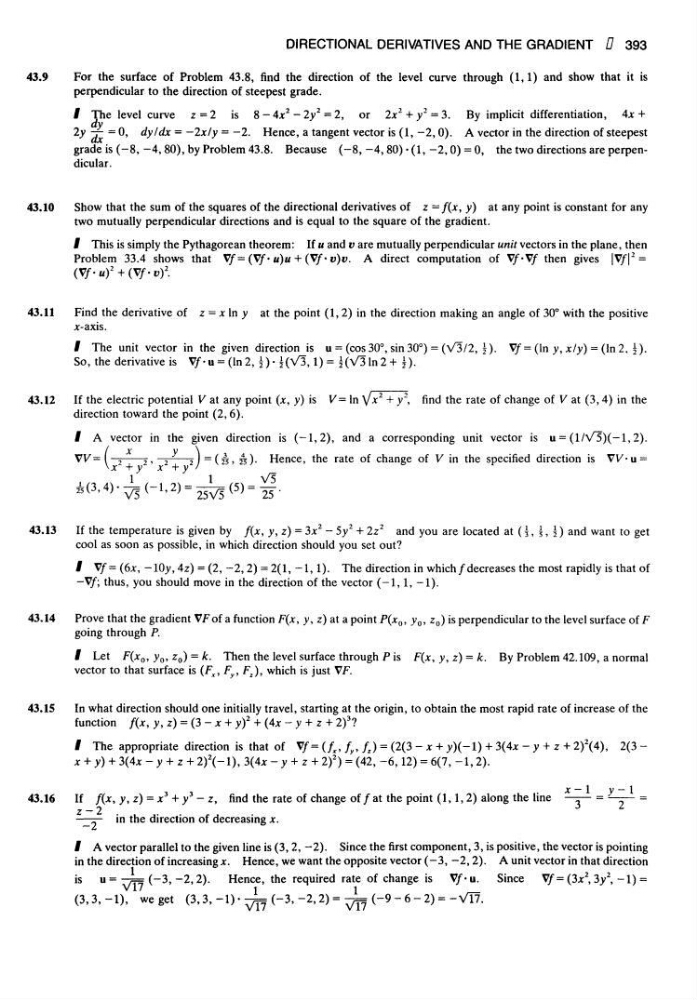
For the surface of Problem 43.8, find the direction of the level curve through (1,1) and show that it is
perpendicular to the direction of steepest grade.
The level curve z = 2 is 8 - 4x
2 - 2v
2 = 2, or 2x
2 + y
2 = 3. By implicit differentiation, 4jc +
dyldx = -2x/y = -2. Hence, a tangent vector is (1, -2,0). A vector in the direction of steepest
grade is (-8,-4,80), by Problem 43.8. Because (-8,-4, 80) •(!,-2,0) = 0, the two directions are perpendicular.
43.10
Show that the sum of the squares of the directional derivatives of z =/(*, y) at any point is constant for any
two mutually perpendicular directions and is equal to the square of the gradient.
This is simply the Pythagorean theorem: If u and v are mutually perpendicular unit vectors in the plane, then
Problem 33.4 shows that Vf=(Vf-u)u + (Vf-v)v. A direct computation of Vf'Vf then gives |V/|
2 =
(Vf-u)2 + (Vf-v)2.
43.11
Find the derivative of z = x In v at the point (1, 2) in the direction making an angle of 30° with the positive
x-axis.
The unit vector in the given direction is
So, the derivative is
43.12 If the electric potential V at any point (x, y) is V= In
direction toward the point (2,6).
find the rate of change of V at (3,4) in the
A vector in the given direction is (—1,2), and a corresponding unit vector is
Hence, the rate of change of V in the specified direction is
43.13
If the temperature is given by f(x, y, z) = 3x
2 - 5y
2 + 2z
2
and you are located at (3, |, |) and want to get
cool as soon as possible, in which direction should you set out?
V/= (6*, -Wy, 4z) = (2, -2, 2) = 2(1, -1,1). The direction in which/decreases the most rapidly is that of
-V/; thus, you should move in the direction of the vector (-1,1, -1).
43.14
Prove that the gradient VFof a function F(x, y, z) at a point P(x 0 , y 0 , z 0 ) is perpendicular to the level surface of F
going through P.
Let F(x 0 , y 0 , z 0 ) = k. Then the level surface through P is F(x, y, z) = k. By Problem 42.109, a normal
vector to that surface is (F x , F y , F 2 ), which is just VF.
43.15
In what direction should one initially travel, starting at the origin, to obtain the most rapid rate of increase of the
function f(x, y, z) = (3 - x + y)
2 + (4x - y + z + 2)
3
?
The appropriate direction is that of V/= (/,, fy, f:) = (2(3 - x + y)(-l) + 3(4* - y + z + 2)2(4), 2(3 -
x + y) + 3(4* -y + z + 2)
2 (-1), 3(4* - v + z + 2)
2 ) = (42, -6,12) = 6(7, -1,2).
43.16
If fix, y, z) = jc
3 + y
3 - z, find the rate of change of/at the point (1,1, 2) along the line
in the direction of decreasing x.
A vector parallel to the given line is (3,2, -2). Since the first component, 3, is positive, the vector is pointing
in the direction of increasing x. Hence, we want the opposite vector (-3, -2,2). A unit vector in that direction
is
Hence, the required rate of change is
we get
Since
393
43.9
For the surface of Problem 43.8, find the direction of the level curve through (1,1) and show that it is
perpendicular to the direction of steepest grade.
The level curve z = 2 is 8 - 4x
2 - 2v
2 = 2, or 2x
2 + y
2 = 3. By implicit differentiation, 4jc +
dyldx = -2x/y = -2. Hence, a tangent vector is (1, -2,0). A vector in the direction of steepest
grade is (-8,-4,80), by Problem 43.8. Because (-8,-4, 80) •(!,-2,0) = 0, the two directions are perpendicular.
43.10
Show that the sum of the squares of the directional derivatives of z =/(*, y) at any point is constant for any
two mutually perpendicular directions and is equal to the square of the gradient.
This is simply the Pythagorean theorem: If u and v are mutually perpendicular unit vectors in the plane, then
Problem 33.4 shows that Vf=(Vf-u)u + (Vf-v)v. A direct computation of Vf'Vf then gives |V/|
2 =
(Vf-u)2 + (Vf-v)2.
43.11
Find the derivative of z = x In v at the point (1, 2) in the direction making an angle of 30° with the positive
x-axis.
The unit vector in the given direction is
So, the derivative is
43.12 If the electric potential V at any point (x, y) is V= In
direction toward the point (2,6).
find the rate of change of V at (3,4) in the
A vector in the given direction is (—1,2), and a corresponding unit vector is
Hence, the rate of change of V in the specified direction is
43.13
If the temperature is given by f(x, y, z) = 3x
2 - 5y
2 + 2z
2
and you are located at (3, |, |) and want to get
cool as soon as possible, in which direction should you set out?
V/= (6*, -Wy, 4z) = (2, -2, 2) = 2(1, -1,1). The direction in which/decreases the most rapidly is that of
-V/; thus, you should move in the direction of the vector (-1,1, -1).
43.14
Prove that the gradient VFof a function F(x, y, z) at a point P(x 0 , y 0 , z 0 ) is perpendicular to the level surface of F
going through P.
Let F(x 0 , y 0 , z 0 ) = k. Then the level surface through P is F(x, y, z) = k. By Problem 42.109, a normal
vector to that surface is (F x , F y , F 2 ), which is just VF.
43.15
In what direction should one initially travel, starting at the origin, to obtain the most rapid rate of increase of the
function f(x, y, z) = (3 - x + y)
2 + (4x - y + z + 2)
3
?
The appropriate direction is that of V/= (/,, fy, f:) = (2(3 - x + y)(-l) + 3(4* - y + z + 2)2(4), 2(3 -
x + y) + 3(4* -y + z + 2)
2 (-1), 3(4* - v + z + 2)
2 ) = (42, -6,12) = 6(7, -1,2).
43.16
If fix, y, z) = jc
3 + y
3 - z, find the rate of change of/at the point (1,1, 2) along the line
in the direction of decreasing x.
A vector parallel to the given line is (3,2, -2). Since the first component, 3, is positive, the vector is pointing
in the direction of increasing x. Hence, we want the opposite vector (-3, -2,2). A unit vector in that direction
is
Hence, the required rate of change is
we get
Since