

FUNCTIONS AND THEIR GRAPHS
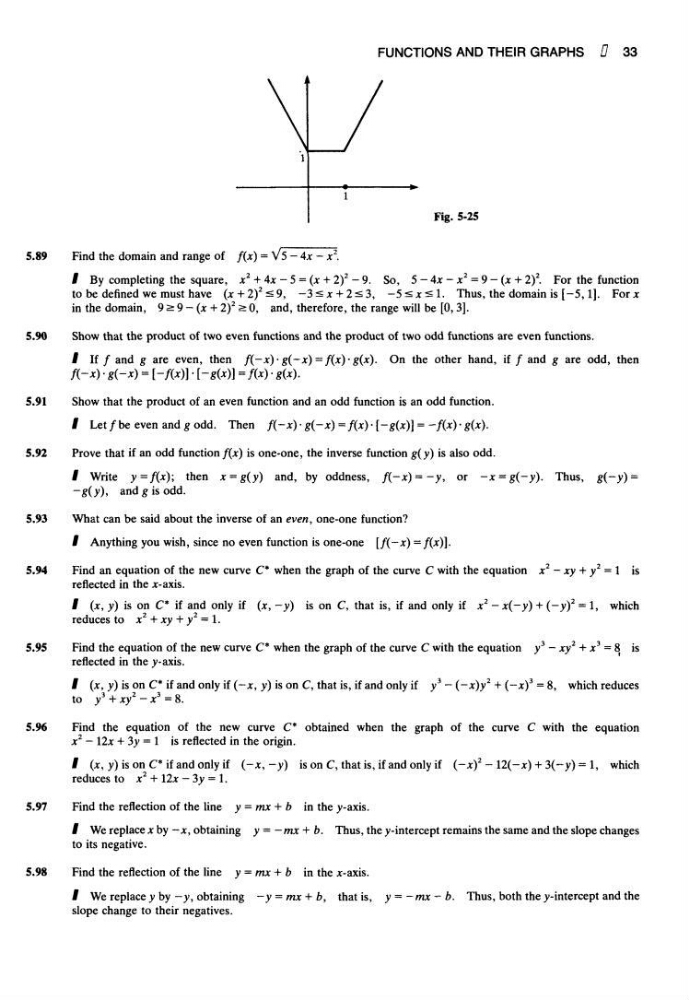
Fig. 5-25
Find the domain and range of f(x) = V5 — 4x - x
2 .
ompleting the square, x2 + 4x - 5 = (x + 2)2 - 9. So, 5 - 4x - x2 = 9 - (x + 2)2. For the functionI By completing the square, x2 + 4x - 5 = (x + 2)2 - 9. So, 5 - 4x - x2 = 9 - (x + 2)2. For the function
to be defined we must have (x + 2)
2 s9, -3==* +2s3, -5<*sl. Thus, the domain is [-5,1]. For*
in the domain, 9 > 9 - (x + 2)
2 > 0, and, therefore, the range will be [0,3].
Show that the product of two even functions and the product of two odd functions are even functions.
If / and g are even, then f(~x)-g(-x) = f(x)-g(x).
On the other hand, if / and g are odd, then
/(-*) • g(-x) = [-/(*)] • [-«<*)] = /W • gMShow that the product of an even function and an odd function is an odd function.
Let /be even and g odd. Then f(-x)-g(-x) =/(*)• [-g«] = -f(x)-g(x).
Prove that if an odd function f(x) is one-one, the inverse function g(y) is also odd.
Write y
= f(*)', then * = g(}') and, by oddness, f(~x)=—y, or —x — g(—y). Thus, g(—y) =
-g(y), and g is odd.
5.93
5.94
5.95
5.%
5.97
5.98
What can be said about the inverse of an even, one-one function?
Anything you wish, since no even function is one-one [/(-*) =/(*)]•
Find an equation of the new curve C* when the graph of the curve C with the equation x
2 - xy + y
2 = 1 is
reflected in the x-axis.
(x, y) is on C* if and only if (x, —y) is on C, that is, if and only if x
2 — x(—y) + (—y)
2 — 1, which
reduces to x
2 + xy + y
2 = 1.
Find the equation of the new curve C* when the graph of the curve C with the equation y
3 — xy
2 + x
3 = 8 is
reflected in the y-axis.
is on C* if and only if (-x, y) is on C, that is, if and only if y3 - (~x)y2 + (-x)3 = 8, which reducesI (x, y) is on C* if and only if (-x, y) is on C, that is, if and only if y3 - (~x)y2 + (-x)3 = 8, which reduces
to y
3 + xy
2 - x
3 = 8.
Find the equation of the new curve C* obtained when the graph of the curve C with the equation
x
2 - 12x + 3y = 1 is reflected in the origin.
(x, y) is on C* if and only if (-x, -y) is on C, that is, if and only if (-x)
2 - 12(-x) + 3(-y) = 1, which
reduces to x
2 + 12x — 3y = 1.
Find the reflection of the line y = mx + b in the y-axis.
We replace x by —AC, obtaining y = — mx + b. Thus, the y-intercept remains the same and the slope changes
to its negative.
Find the reflection of the line y = mx + b in the x-axis.
We replace y by -y , obtaining -y = mx + b, that is, y = - mx ~ b. Thus, both the y-intercept and the
slope change to their negatives.
5.89
5.90
5.91
5.92
33
Fig. 5-25
Find the domain and range of f(x) = V5 — 4x - x
2 .
ompleting the square, x2 + 4x - 5 = (x + 2)2 - 9. So, 5 - 4x - x2 = 9 - (x + 2)2. For the functionI By completing the square, x2 + 4x - 5 = (x + 2)2 - 9. So, 5 - 4x - x2 = 9 - (x + 2)2. For the function
to be defined we must have (x + 2)
2 s9, -3==* +2s3, -5<*sl. Thus, the domain is [-5,1]. For*
in the domain, 9 > 9 - (x + 2)
2 > 0, and, therefore, the range will be [0,3].
Show that the product of two even functions and the product of two odd functions are even functions.
If / and g are even, then f(~x)-g(-x) = f(x)-g(x).
On the other hand, if / and g are odd, then
/(-*) • g(-x) = [-/(*)] • [-«<*)] = /W • gMShow that the product of an even function and an odd function is an odd function.
Let /be even and g odd. Then f(-x)-g(-x) =/(*)• [-g«] = -f(x)-g(x).
Prove that if an odd function f(x) is one-one, the inverse function g(y) is also odd.
Write y
= f(*)', then * = g(}') and, by oddness, f(~x)=—y, or —x — g(—y). Thus, g(—y) =
-g(y), and g is odd.
5.93
5.94
5.95
5.%
5.97
5.98
What can be said about the inverse of an even, one-one function?
Anything you wish, since no even function is one-one [/(-*) =/(*)]•
Find an equation of the new curve C* when the graph of the curve C with the equation x
2 - xy + y
2 = 1 is
reflected in the x-axis.
(x, y) is on C* if and only if (x, —y) is on C, that is, if and only if x
2 — x(—y) + (—y)
2 — 1, which
reduces to x
2 + xy + y
2 = 1.
Find the equation of the new curve C* when the graph of the curve C with the equation y
3 — xy
2 + x
3 = 8 is
reflected in the y-axis.
is on C* if and only if (-x, y) is on C, that is, if and only if y3 - (~x)y2 + (-x)3 = 8, which reducesI (x, y) is on C* if and only if (-x, y) is on C, that is, if and only if y3 - (~x)y2 + (-x)3 = 8, which reduces
to y
3 + xy
2 - x
3 = 8.
Find the equation of the new curve C* obtained when the graph of the curve C with the equation
x
2 - 12x + 3y = 1 is reflected in the origin.
(x, y) is on C* if and only if (-x, -y) is on C, that is, if and only if (-x)
2 - 12(-x) + 3(-y) = 1, which
reduces to x
2 + 12x — 3y = 1.
Find the reflection of the line y = mx + b in the y-axis.
We replace x by —AC, obtaining y = — mx + b. Thus, the y-intercept remains the same and the slope changes
to its negative.
Find the reflection of the line y = mx + b in the x-axis.
We replace y by -y , obtaining -y = mx + b, that is, y = - mx ~ b. Thus, both the y-intercept and the
slope change to their negatives.
5.89
5.90
5.91
5.92
33