

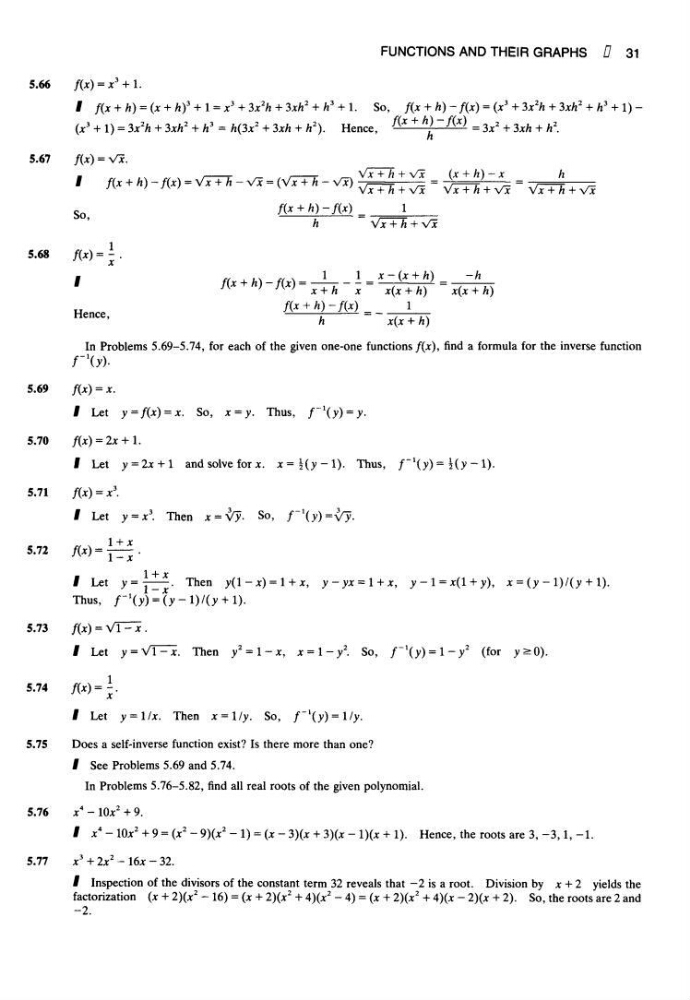
5.72
Does a self-inverse function exist? Is there more than one?
See Problems 5.69 and 5.74.
In Problems 5.76-5.82, find all real roots of the given polynomial.
x
4 - 10x
2 + 9.
x
4 - Wx
2 + 9=(x
2 - 9)(x
2 -!) = (*- 3)(* + 3)(x - l)(x + 1). Hence, the roots are 3, -3,1, -1.
x3 + 2x2 - 16x - 32.
Inspection of the divisors of the constant term 32 reveals that -2 is a root. Division by x + 2 yields the
factorization (x + 2)(x2 - 16) = (x + 2)(x2 + 4)(x2 - 4) = (x + 2)(x2 + 4)(* - 2)(x + 2). So, the roots are 2 andfactorization (x + 2)(x2 - 16) = (x + 2)(x2 + 4)(x2 - 4) = (x + 2)(x2 + 4)(* - 2)(x + 2). So, the roots are 2 and
_2
FUNCTIONS AND THEIR GRAPHS
31
5.66
5.67
f(x) =f(x) =
X
3 + l.
f(x + h) = (x + h)3 + l = x3 + 3x2h + 3xh2 + h3 + l. So, f(x + h) - f(x) = (x3 + 3x2h + 3xh2 + h3 + 1) -
(x3 + l) = 3x2h + 3xh2 + h3 = h(3x2 + 3xh + h2).
f(x) = Vx.
5.68
Hence.
In Problems 5.69-5.74, for each of the given one-one functions f(x), find a formula for the inverse function
r\y).
f(x) = x.
Let >>=/(*) = *. So, x = y. Thus, f~\y) = y.
f(x) = 2x + l.
Let y = 2x + l and solve for x. x=\(y-\). Thus, f~\y) = \(y - 1).
f(x) = x
3 .
Let y = x3. Then x = \/y. So, f~\y)=^/J.
5.69
5.70
5.71
Thus, r
l (y) = (y-l)/(y + l).
5.73
5.74
Then
So
5.75
5.76
5.77
So,
Hence,
= 3x2 + 3xh + h2.
Let y = l/x. Then x = \ly. So, f~\y) = l/y.
I Let
I Let
Then y(\ - x) = 1 + x, y-yx = l + x, y - 1 = x(\ + y), x = (y -l)/(y + 1).
for
Does a self-inverse function exist? Is there more than one?
See Problems 5.69 and 5.74.
In Problems 5.76-5.82, find all real roots of the given polynomial.
x
4 - 10x
2 + 9.
x
4 - Wx
2 + 9=(x
2 - 9)(x
2 -!) = (*- 3)(* + 3)(x - l)(x + 1). Hence, the roots are 3, -3,1, -1.
x3 + 2x2 - 16x - 32.
Inspection of the divisors of the constant term 32 reveals that -2 is a root. Division by x + 2 yields the
factorization (x + 2)(x2 - 16) = (x + 2)(x2 + 4)(x2 - 4) = (x + 2)(x2 + 4)(* - 2)(x + 2). So, the roots are 2 andfactorization (x + 2)(x2 - 16) = (x + 2)(x2 + 4)(x2 - 4) = (x + 2)(x2 + 4)(* - 2)(x + 2). So, the roots are 2 and
_2
FUNCTIONS AND THEIR GRAPHS
31
5.66
5.67
f(x) =f(x) =
X
3 + l.
f(x + h) = (x + h)3 + l = x3 + 3x2h + 3xh2 + h3 + l. So, f(x + h) - f(x) = (x3 + 3x2h + 3xh2 + h3 + 1) -
(x3 + l) = 3x2h + 3xh2 + h3 = h(3x2 + 3xh + h2).
f(x) = Vx.
5.68
Hence.
In Problems 5.69-5.74, for each of the given one-one functions f(x), find a formula for the inverse function
r\y).
f(x) = x.
Let >>=/(*) = *. So, x = y. Thus, f~\y) = y.
f(x) = 2x + l.
Let y = 2x + l and solve for x. x=\(y-\). Thus, f~\y) = \(y - 1).
f(x) = x
3 .
Let y = x3. Then x = \/y. So, f~\y)=^/J.
5.69
5.70
5.71
Thus, r
l (y) = (y-l)/(y + l).
5.73
5.74
Then
So
5.75
5.76
5.77
So,
Hence,
= 3x2 + 3xh + h2.
Let y = l/x. Then x = \ly. So, f~\y) = l/y.
I Let
I Let
Then y(\ - x) = 1 + x, y-yx = l + x, y - 1 = x(\ + y), x = (y -l)/(y + 1).
for