

366
CHAPTER 41
The two equations x
2 + 3y
2 - z
2 + 3x = 0 and 2x
2 + 6y
2 - 2z
2 - 4y = 3 together determine the curve in
which the corresponding surfaces intersect. Show that this curve lies in a plane.
41.28
41.29
41.30
41.31
Fig. 41-16
Eliminate z by multiplying the first equation by 2 and subtracting the result from the second equation:
6jt + 4y = -3. Hence, all points of the curve lie in the plane 6* + 4y = -3.
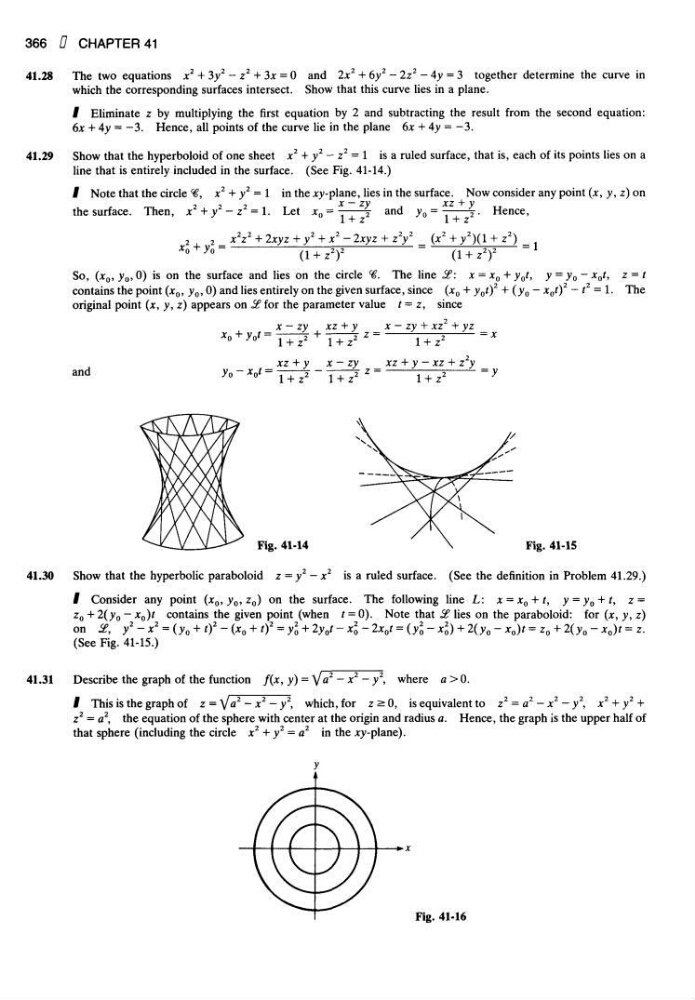
Show that the hyperboloid of one sheet x
2 + y
2 — z
2 = 1 is a ruled surface, that is, each of its points lies on a
line that is entirely included in the surface. (See Fig. 41-14.)
Note that the circle <<£, x
2 + y
2 = 1 in the ry-plane, lies in the surface. Now consider any point (x, y, z) on
the surface. Then, x
2 + y
2 -z
2 = l. Let
and
Hence,
So, (x 0 ,y a ,0) is on the surface and lies on the circle <€. The line ££: x = x 0 + y 0 t, y = y 0 ~x 0 t, z = t
contains the point (A: O , y a , 0) and lies entirely on the given surface, since (x 0 + y 0 t)
2 + (y 0 — x 0 t)
2 - t
2 = 1. The
original point (x, y, z) appears on «$? for the parameter value t = z, since
and
Fig. 41-14
Fig. 41-15
Show that the hyperbolic paraboloid z = y
2 — x
2
is a ruled surface. (See the definition in Problem 41.29.)
Consider any point (x 0 , y 0 , z 0 ) on the surface. The following line L: x = x 0 + t, y = y 0 + t, z =
z a + 2(y 0 — x 0 )t contains the given point (when t = 0). Note that ,$? lies on the paraboloid: for (x, y, z)
on S£, y
2 -x
2 = (y 0 + t)
2 - (x 0 + t)
2 = y
2
0 + 2y 0 t -x
2
0 - 2x 0 t = (y
2
0 - x
2 ) + 2(y 0 - x 0 )t = z 0 + 2(y 0 - x 0 )t = z.
(See Fig. 41-15.)
Describe the graph of the function f(x, y) =
where a > 0.
This is the graph of z =
which, for z a 0, is equivalent to z
2 = a
2 — x — y , x + y +
z = a , the equation of the sphere with center at the origin and radius a. Hence, the graph is the upper half of
that sphere (including the circle x
2 + y
2 = a
2 in the xy-plane).
CHAPTER 41
The two equations x
2 + 3y
2 - z
2 + 3x = 0 and 2x
2 + 6y
2 - 2z
2 - 4y = 3 together determine the curve in
which the corresponding surfaces intersect. Show that this curve lies in a plane.
41.28
41.29
41.30
41.31
Fig. 41-16
Eliminate z by multiplying the first equation by 2 and subtracting the result from the second equation:
6jt + 4y = -3. Hence, all points of the curve lie in the plane 6* + 4y = -3.
Show that the hyperboloid of one sheet x
2 + y
2 — z
2 = 1 is a ruled surface, that is, each of its points lies on a
line that is entirely included in the surface. (See Fig. 41-14.)
Note that the circle <<£, x
2 + y
2 = 1 in the ry-plane, lies in the surface. Now consider any point (x, y, z) on
the surface. Then, x
2 + y
2 -z
2 = l. Let
and
Hence,
So, (x 0 ,y a ,0) is on the surface and lies on the circle <€. The line ££: x = x 0 + y 0 t, y = y 0 ~x 0 t, z = t
contains the point (A: O , y a , 0) and lies entirely on the given surface, since (x 0 + y 0 t)
2 + (y 0 — x 0 t)
2 - t
2 = 1. The
original point (x, y, z) appears on «$? for the parameter value t = z, since
and
Fig. 41-14
Fig. 41-15
Show that the hyperbolic paraboloid z = y
2 — x
2
is a ruled surface. (See the definition in Problem 41.29.)
Consider any point (x 0 , y 0 , z 0 ) on the surface. The following line L: x = x 0 + t, y = y 0 + t, z =
z a + 2(y 0 — x 0 )t contains the given point (when t = 0). Note that ,$? lies on the paraboloid: for (x, y, z)
on S£, y
2 -x
2 = (y 0 + t)
2 - (x 0 + t)
2 = y
2
0 + 2y 0 t -x
2
0 - 2x 0 t = (y
2
0 - x
2 ) + 2(y 0 - x 0 )t = z 0 + 2(y 0 - x 0 )t = z.
(See Fig. 41-15.)
Describe the graph of the function f(x, y) =
where a > 0.
This is the graph of z =
which, for z a 0, is equivalent to z
2 = a
2 — x — y , x + y +
z = a , the equation of the sphere with center at the origin and radius a. Hence, the graph is the upper half of
that sphere (including the circle x
2 + y
2 = a
2 in the xy-plane).