

360
CHAPTER 40
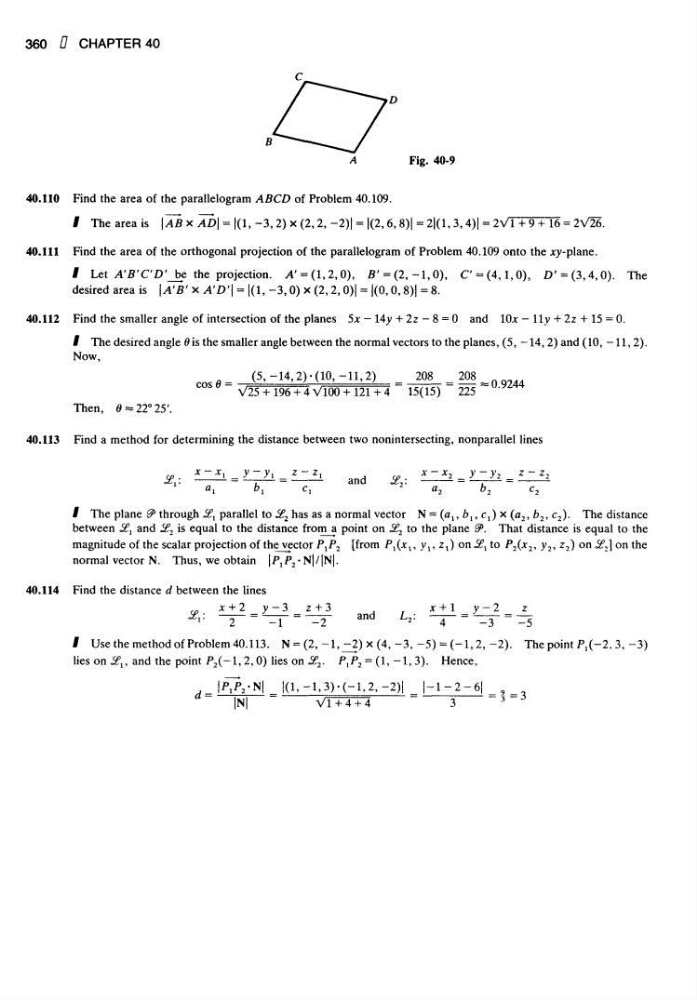
Fig. 40-9
40.110 Find the area of the parallelogram ABCD of Problem 40.109.
The area is \AB x AD\ = |(1, -3,2) x (2,2, -2)| = |(2,6,8)| = 2|(1, 3,4)| = 2V1+9+16 = 2V26.
40.111 Find the area of the orthogonal projection of the parallelogram of Problem 40.109 onto the ry-plane.
be the projection. A'= (1,2,0), B' = (2,-l,0), C" = (4,l,0), D' = (3,4,0). The
desired area is \A'B' x A'D'\ = |(1, -3,0) x (2, 2,0)| = |(0,0,8)| = 8.
40.112 Find the smaller angle of intersection of the planes 5* - 14_y + 2z - 8 = 0 and 10* - lly + 2z + 15 = 0
The desired angle 9 is the smaller angle between the normal vectors to the planes, (5, —14, 2) and (10, —11, 2).
Now,
Then,
40.113 Find a method for determining the distance between two nonintersecting, nonparallel lines
and
The plane & through .2?, parallel to 2£ 2 has as a normal vector N = (a l , b l , Cj) x (a 2 , b 2 , c 2 ). The distance
between «S?, and Jz?, is equal to the distance from a point on 2£ 2 to the plane 0>. That distance is equal to the
magnitude of the scalar projection of the vector P1P2 [from Pl(xl, yl, z,) on .Sf, to P2(x2, y2-> zz) on ^>] on tne
normal vector N. Thus, we obtain I^P^Nl/lN]
40.114 Find the distance d between the lines
and
Use the method of Problem 40.113. N = (2, -l,j-2)x (4, -3, -5) = (-1,2, -2). Thepoint F,(-2. 3, -3)
lies on .#,, and the point F 2 (-l, 2,0) lies on £ 2 . P t P 2 = (1, -1, 3). Hence,
Let A'B'C'D'
CHAPTER 40
Fig. 40-9
40.110 Find the area of the parallelogram ABCD of Problem 40.109.
The area is \AB x AD\ = |(1, -3,2) x (2,2, -2)| = |(2,6,8)| = 2|(1, 3,4)| = 2V1+9+16 = 2V26.
40.111 Find the area of the orthogonal projection of the parallelogram of Problem 40.109 onto the ry-plane.
be the projection. A'= (1,2,0), B' = (2,-l,0), C" = (4,l,0), D' = (3,4,0). The
desired area is \A'B' x A'D'\ = |(1, -3,0) x (2, 2,0)| = |(0,0,8)| = 8.
40.112 Find the smaller angle of intersection of the planes 5* - 14_y + 2z - 8 = 0 and 10* - lly + 2z + 15 = 0
The desired angle 9 is the smaller angle between the normal vectors to the planes, (5, —14, 2) and (10, —11, 2).
Now,
Then,
40.113 Find a method for determining the distance between two nonintersecting, nonparallel lines
and
The plane & through .2?, parallel to 2£ 2 has as a normal vector N = (a l , b l , Cj) x (a 2 , b 2 , c 2 ). The distance
between «S?, and Jz?, is equal to the distance from a point on 2£ 2 to the plane 0>. That distance is equal to the
magnitude of the scalar projection of the vector P1P2 [from Pl(xl, yl, z,) on .Sf, to P2(x2, y2-> zz) on ^>] on tne
normal vector N. Thus, we obtain I^P^Nl/lN]
40.114 Find the distance d between the lines
and
Use the method of Problem 40.113. N = (2, -l,j-2)x (4, -3, -5) = (-1,2, -2). Thepoint F,(-2. 3, -3)
lies on .#,, and the point F 2 (-l, 2,0) lies on £ 2 . P t P 2 = (1, -1, 3). Hence,
Let A'B'C'D'