

VECTORS IN SPACE. LINES AND PLANES
355
40.73
40.74
40.75
40.76
40.77
40.78
40.79
Write parametric equations for the line through (—1,4,2) and parallel to the line
The given line is parallel to the vector (4, 5,3). Hence, the desired equations are x = — 1 + 4t, y = 4 4- 5t,
z = 2 + 3t.
Show that the lines 2£ t : x^Xg + at, y = y a + bt, z = z a + ct and ,S? 2 : x = x t + At, y = y, + Bt, z =
2, + Ct are parallel if and only if a, b, c are proportional to A, B, C.
.2", is parallel to the vector (a, b, c). Jrf, is parallel to the vector (A, B, C). Therefore, .$?, is parallel to % 2 if
and only if (a, b, c) is parallel to (A, B, C), that is, if and only if (a, b, c) = \(A, B, C) for some A. The
latter condition means that a, b, c are proportional to A, B, C.
Show that the lines 3? t : x = x 0 + at, y = y 0 + bt, z = z 0 + ct and £ 2 : x = x a + At, y = y 0 + Bt, z =
z n + Ct are perpendicular if and only if aA + bB + cC = 0.
«2", is parallel to the vector (a, b, c). 2£ 2 is parallel to the vector (A, B, C). <$?, and !£ 2 have a common point
(x g , y 0 , z 0 ). Hence, «$?, is perpendicular to Z£ 2 if and only if (a, b, c) J_ (A, B, C), which is equivalent to
(a,b,c)-(A,B,C) = Q, or aA + bB + cC = Q.
Show that the lines x = 1 + t, y = 2t, z = 1 +3t and x = 3s, y = 2s, z = 2 + s intersect, and find their
point of intersection.
Assume (x, y, z) is a point of intersection. Then 2t = y = 2s. So, t = s. From l + t = x = 3s, we
then have 1 + s = 3s, 2s = 1, s=|. So, s = t=\. Note that l + 3f = l + 3(j)=f and 2 + 5 = 2 +
I = |. Thus, the equations for z are compatible. The intersection point is (|, 1, f).
By the methods of calculus, find the point P t (x, y, z) on the line x = 3 + t, y = 2 + t, z = 1 + t that is
closest to the point P 0 (l,2,1), and verify that P 0 P, is perpendicular to the line.
The distance from P 0 (l, 2,1) to (x, y, z) is
It suffices to minimize 3r + 4i' + 4.
Note that P 0 P t
Hence,
to the line. The distance from P, to the line is
is
and/>„/>.-(1,1,1) = 0. Hence, P 0 P l is perpendicular
So,
Describe a method based on vectors for finding the distance from a point P 0 to a line x = x 0 + at, y =
v,, + bt. z = z n + ct that does not contain P.
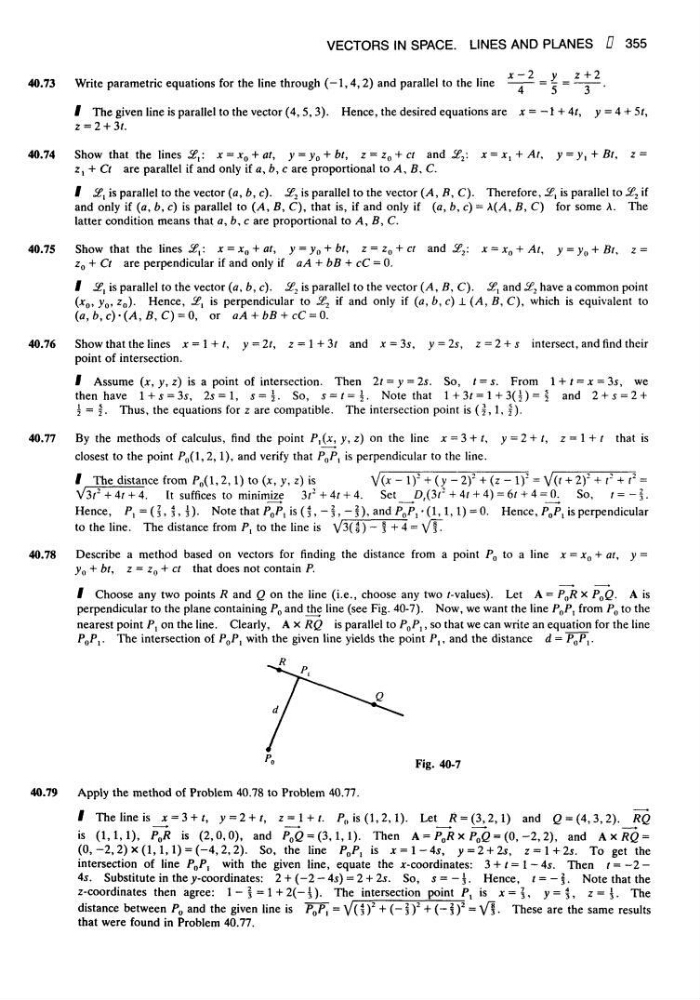
Choose any two points R and Q on the line (i.e., choose any two /-values). Let A = P 0 R x P 0 Q. A is
perpendicular to the plane containing P 0 and the line (see Fig. 40-7). Now, we want the line P 0 P, from P 0 to the
nearest point P l on the line. Clearly, A x RQ is parallel to P n P,, so that we can write an equation for the line
P 0 P l . The intersection of P 0 Pi with the given line yields the point /",, and the distance d = P 0 P l .
Fig. 40-7
Apply the method of Problem 40.78 to Problem 40.77.
The line is x = 3 + t, y = 2 + t, z = 1 + t. P.. is (1, 2,1). Let £ = (3,2,1) and Q = (4, 3,2). RQ
is (1,1,1), P 0 R is (2,0,0), and P n Q = (3,1,1). Then A = P n R x P n Q = (0, -2, 2), and A x RQ =
intersection of line P 0 P l with the given line, equate the ^-coordinates: 3 + t = 1 - 4s. Then t = -2 -
(0,-2,2) x (1,1,1) = (-4,2,2). So, the line P 0 P, is * = l-4s, y = 2 + 2s, z = l + 2s. To get the
distance between P 0 and the given line is
that were found in Problem 40.77.
4s. Substitute in the ^-coordinates: 2 + (-2 -4s) = 2 + 2s. So, s=-j.
z-coordinates then agree: 1-1=1 + 2(- 4).The intersection point is x=l, y=$, z = |.The
These are the same results
Note that the
Hence, /=— §.
Set D,(3r + 4f + 4) = 6f+ 4 = 0.
355
40.73
40.74
40.75
40.76
40.77
40.78
40.79
Write parametric equations for the line through (—1,4,2) and parallel to the line
The given line is parallel to the vector (4, 5,3). Hence, the desired equations are x = — 1 + 4t, y = 4 4- 5t,
z = 2 + 3t.
Show that the lines 2£ t : x^Xg + at, y = y a + bt, z = z a + ct and ,S? 2 : x = x t + At, y = y, + Bt, z =
2, + Ct are parallel if and only if a, b, c are proportional to A, B, C.
.2", is parallel to the vector (a, b, c). Jrf, is parallel to the vector (A, B, C). Therefore, .$?, is parallel to % 2 if
and only if (a, b, c) is parallel to (A, B, C), that is, if and only if (a, b, c) = \(A, B, C) for some A. The
latter condition means that a, b, c are proportional to A, B, C.
Show that the lines 3? t : x = x 0 + at, y = y 0 + bt, z = z 0 + ct and £ 2 : x = x a + At, y = y 0 + Bt, z =
z n + Ct are perpendicular if and only if aA + bB + cC = 0.
«2", is parallel to the vector (a, b, c). 2£ 2 is parallel to the vector (A, B, C). <$?, and !£ 2 have a common point
(x g , y 0 , z 0 ). Hence, «$?, is perpendicular to Z£ 2 if and only if (a, b, c) J_ (A, B, C), which is equivalent to
(a,b,c)-(A,B,C) = Q, or aA + bB + cC = Q.
Show that the lines x = 1 + t, y = 2t, z = 1 +3t and x = 3s, y = 2s, z = 2 + s intersect, and find their
point of intersection.
Assume (x, y, z) is a point of intersection. Then 2t = y = 2s. So, t = s. From l + t = x = 3s, we
then have 1 + s = 3s, 2s = 1, s=|. So, s = t=\. Note that l + 3f = l + 3(j)=f and 2 + 5 = 2 +
I = |. Thus, the equations for z are compatible. The intersection point is (|, 1, f).
By the methods of calculus, find the point P t (x, y, z) on the line x = 3 + t, y = 2 + t, z = 1 + t that is
closest to the point P 0 (l,2,1), and verify that P 0 P, is perpendicular to the line.
The distance from P 0 (l, 2,1) to (x, y, z) is
It suffices to minimize 3r + 4i' + 4.
Note that P 0 P t
Hence,
to the line. The distance from P, to the line is
is
and/>„/>.-(1,1,1) = 0. Hence, P 0 P l is perpendicular
So,
Describe a method based on vectors for finding the distance from a point P 0 to a line x = x 0 + at, y =
v,, + bt. z = z n + ct that does not contain P.
Choose any two points R and Q on the line (i.e., choose any two /-values). Let A = P 0 R x P 0 Q. A is
perpendicular to the plane containing P 0 and the line (see Fig. 40-7). Now, we want the line P 0 P, from P 0 to the
nearest point P l on the line. Clearly, A x RQ is parallel to P n P,, so that we can write an equation for the line
P 0 P l . The intersection of P 0 Pi with the given line yields the point /",, and the distance d = P 0 P l .
Fig. 40-7
Apply the method of Problem 40.78 to Problem 40.77.
The line is x = 3 + t, y = 2 + t, z = 1 + t. P.. is (1, 2,1). Let £ = (3,2,1) and Q = (4, 3,2). RQ
is (1,1,1), P 0 R is (2,0,0), and P n Q = (3,1,1). Then A = P n R x P n Q = (0, -2, 2), and A x RQ =
intersection of line P 0 P l with the given line, equate the ^-coordinates: 3 + t = 1 - 4s. Then t = -2 -
(0,-2,2) x (1,1,1) = (-4,2,2). So, the line P 0 P, is * = l-4s, y = 2 + 2s, z = l + 2s. To get the
distance between P 0 and the given line is
that were found in Problem 40.77.
4s. Substitute in the ^-coordinates: 2 + (-2 -4s) = 2 + 2s. So, s=-j.
z-coordinates then agree: 1-1=1 + 2(- 4).The intersection point is x=l, y=$, z = |.The
These are the same results
Note that the
Hence, /=— §.
Set D,(3r + 4f + 4) = 6f+ 4 = 0.