

INFINITE SERIES
325
Use the ratio test.
Hence, the series is absolutely convergent.
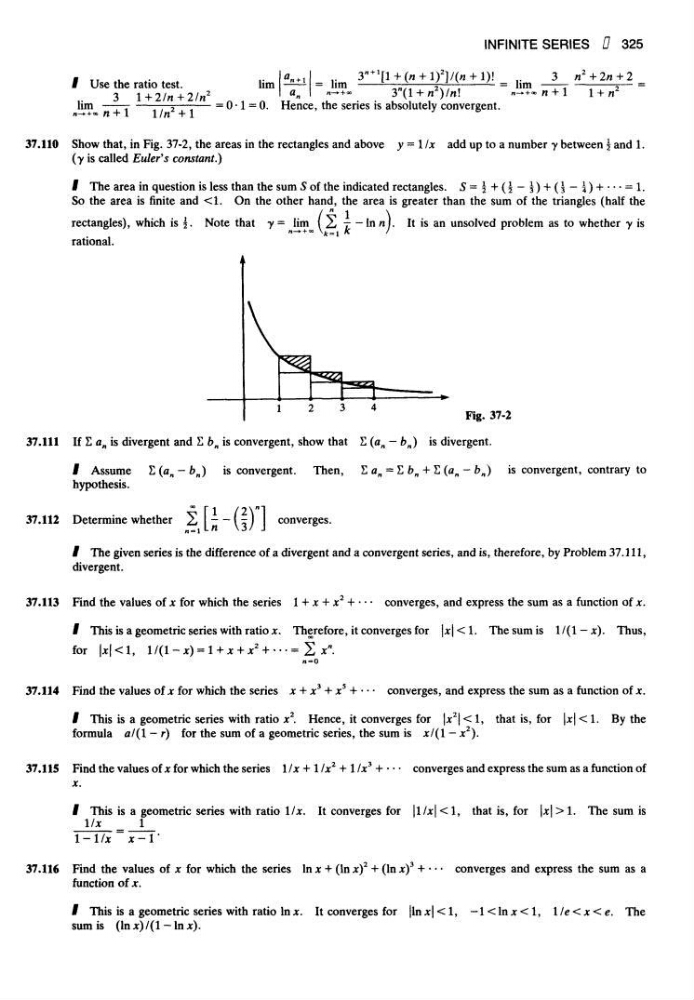
37.110 Show that, in Fig. 37-2, the areas in the rectangles and above y = \lx add up to a number y between land 1.
(•y is called Eider's constant.)
The area in question is less than the sum S of the indicated rectangles. S-\+(\-^)Jr(\-\)-\ = 1.
So the area is finite and <1. On the other hand, the area is greater than the sum of the triangles (half the
rectangles), which is
Note that
It is an unsolved problem as to whether y is
rational.
Fig. 37-2
37.111 If T, a n is divergent and E b n is convergent, show that S (a n — b n ) is divergent.
Assume £ (a n - b n ) is convergent. Then, £ a n = E b n + £ (a n - b n ) is convergent, contrary to
hypothesis
converges.
37.112 Determine whether
The given series is the difference of a divergent and a convergent series, and is, therefore, by Problem 37.111,
divergent.
37.113 Find the values of x for which the series 1 + x + x
2 + • • • converges, and express the sum as a function of x.
This is a eeometric series with ratio x. Therefore, it converses for UI<1. The sum is 1/(1 — x). Thus.
for
37.114 Find the values of x for which the series x + x
3 + x
5 + • • • converges, and express the sum as a function of x.
This is a geometric series with ratio x
2 . Hence, it converges for |*
2
| < 1, that is, for \x\ < 1. By the
formula a/(I - r) for the sum of a geometric series, the sum is x/(l — jc
2 ).
37.115 Find the values of x for which the series l/x + 1A*
2 + l/x
3 H
converges and express the sum as a function of
x.
This is a geometric series with ratio l/x. It converges for |l/jc|l. The sum is
37.116 Find the values of x for which the series In x + (In x)
2 + (In At)
3 + • • • converges and express the sum as a
function of x.
This is a geometric series with ratio In x. It converges for |ln x\ < 1, — 1 < In x < 1, 1 le < x < e. The
sum is (In x) 1(1 - In x).
325
Use the ratio test.
Hence, the series is absolutely convergent.
37.110 Show that, in Fig. 37-2, the areas in the rectangles and above y = \lx add up to a number y between land 1.
(•y is called Eider's constant.)
The area in question is less than the sum S of the indicated rectangles. S-\+(\-^)Jr(\-\)-\ = 1.
So the area is finite and <1. On the other hand, the area is greater than the sum of the triangles (half the
rectangles), which is
Note that
It is an unsolved problem as to whether y is
rational.
Fig. 37-2
37.111 If T, a n is divergent and E b n is convergent, show that S (a n — b n ) is divergent.
Assume £ (a n - b n ) is convergent. Then, £ a n = E b n + £ (a n - b n ) is convergent, contrary to
hypothesis
converges.
37.112 Determine whether
The given series is the difference of a divergent and a convergent series, and is, therefore, by Problem 37.111,
divergent.
37.113 Find the values of x for which the series 1 + x + x
2 + • • • converges, and express the sum as a function of x.
This is a eeometric series with ratio x. Therefore, it converses for UI<1. The sum is 1/(1 — x). Thus.
for
37.114 Find the values of x for which the series x + x
3 + x
5 + • • • converges, and express the sum as a function of x.
This is a geometric series with ratio x
2 . Hence, it converges for |*
2
| < 1, that is, for \x\ < 1. By the
formula a/(I - r) for the sum of a geometric series, the sum is x/(l — jc
2 ).
37.115 Find the values of x for which the series l/x + 1A*
2 + l/x
3 H
converges and express the sum as a function of
x.
This is a geometric series with ratio l/x. It converges for |l/jc|
37.116 Find the values of x for which the series In x + (In x)
2 + (In At)
3 + • • • converges and express the sum as a
function of x.
This is a geometric series with ratio In x. It converges for |ln x\ < 1, — 1 < In x < 1, 1 le < x < e. The
sum is (In x) 1(1 - In x).