

316
CHAPTER 37
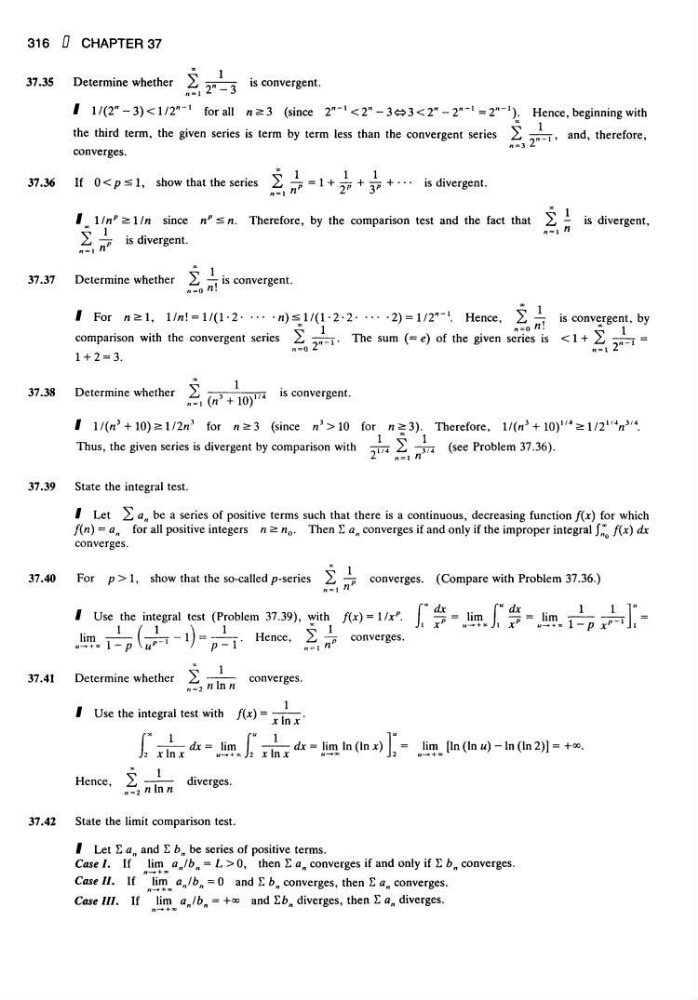
37.35 Determine whether
is convergent.
for all n 2 3 (since 2" ' <2" -33<2" - 2"~
l = 2" '). Hence, beginning with
l/(2"-3)
the third term, the given series is term by term less than the convergent series
converges.
and, therefore,
37.36
If 0
1/np>1/nsince np £ n. Therefore, by the comparison test and the fact that is divergent,
is divergent.
Determine whether
37.37
is convergent.
For n>l, l/n! = l/(l-2
n)
is convergent, by
comparison with the convergent series
ine sum (= e) of the given series is
1 + 2 = 3.
37.38 Determine whether
is convergent.
I/O
3 + \G)zll2n* for n>3 (since n
3 > 10 for n>3). Therefore,
Thus, the given series is divergent by comparison with
(see Problem 37.36).
37.39
State the integral test.
Let
be a series of positive terms such that there is a continuous, decreasing function f(x) for which
/(n) = a n for all positive integers n s n g . Then E a n converges if and only if the improper integral
converges.
37.40
For p>l, show that the so-called p-series
converges. (Compare with Problem 37.36.)
Use the integral test (Problem 37.39), with
f(x)=\lx
p .
converges.
Hence,
37.41
Determine whether
converges.
Use the integral test with
Hence,
diverges.
37.42
State the limit comparison test.
Let E a,, and E b be series of positive terms.
Case I. If
Case II. If
Case III. If
and E/> n diverges, then E a n diverges.
and E b n converges, then E a n converges.
then E a n converges if and only if E b n converges.
CHAPTER 37
37.35 Determine whether
is convergent.
for all n 2 3 (since 2" ' <2" -3
l = 2" '). Hence, beginning with
l/(2"-3)
the third term, the given series is term by term less than the convergent series
converges.
and, therefore,
37.36
If 0
1/np>1/nsince np £ n. Therefore, by the comparison test and the fact that is divergent,
is divergent.
Determine whether
37.37
is convergent.
For n>l, l/n! = l/(l-2
n)
is convergent, by
comparison with the convergent series
ine sum (= e) of the given series is
1 + 2 = 3.
37.38 Determine whether
is convergent.
I/O
3 + \G)zll2n* for n>3 (since n
3 > 10 for n>3). Therefore,
Thus, the given series is divergent by comparison with
(see Problem 37.36).
37.39
State the integral test.
Let
be a series of positive terms such that there is a continuous, decreasing function f(x) for which
/(n) = a n for all positive integers n s n g . Then E a n converges if and only if the improper integral
converges.
37.40
For p>l, show that the so-called p-series
converges. (Compare with Problem 37.36.)
Use the integral test (Problem 37.39), with
f(x)=\lx
p .
converges.
Hence,
37.41
Determine whether
converges.
Use the integral test with
Hence,
diverges.
37.42
State the limit comparison test.
Let E a,, and E b be series of positive terms.
Case I. If
Case II. If
Case III. If
and E/> n diverges, then E a n diverges.
and E b n converges, then E a n converges.
then E a n converges if and only if E b n converges.