

35.62
Find the area inside r = cos
2 (0/2).
POLAR COORDINATES
297
By Problem 35.45, we see that the area is swept out from 9 = 0 to 8 = 2ir. Hence, the area is
35.63
Find the area swept out by r = tan 0 from 0 = 0 to 0 = ir/4.
35.64
Find the area of one petal of the three-leaved rose r = sin 3ft
35.65
Find the area inside one petal of the eight-leaved rose r = sin 4ft
From Problem 35.48, one petal is swept out from 6=0 to 6 = ir/4. Hence, the area is
35.66
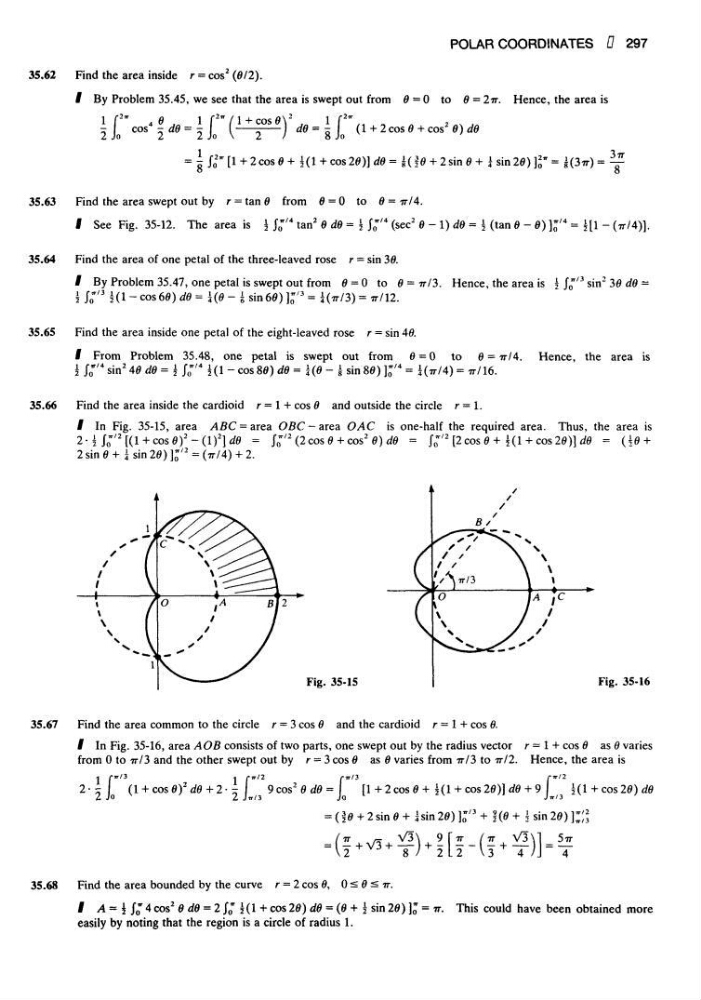
Find the area inside the cardioid r = 1 + cos 0 and outside the circle r = 1.
In Fig. 35-15, area ABC = area OBC — area OAC is one-half the required area. Thus, the area is
Fig. 35-15
Fig. 35-16
35.67
Find the area common to the circle r = 3 cos 6 and the cardioid r = 1 + cos ft
In Fig. 35-16, area AOB consists of two parts, one swept out by the radius vector r = 1 + cos 6 as 6 varies
from 0 to 7T/3 and the other swept out by r = 3 cos 0 as 0 varies from 7r/3 to 7r/2. Hence, the area is
35.68
Find the area bounded by the curve r = 2 cos 0, Q-&0 < TT.
A- = 5 Jo" 4 cos2 0 easily by noting that the region is a circle of radius 1.
By Problem 35.47, one petal is swept out from 0 = 0 to 6 = rr/3. Hence, the area is
See Fig. 35-12. The area is i |0"4 tan2 0 d0 = ^ /0"'4 (sec2 0 - 1) dO = \ (tan 0-0) ft'4 = z[l - (7T/4)J.
Find the area inside r = cos
2 (0/2).
POLAR COORDINATES
297
By Problem 35.45, we see that the area is swept out from 9 = 0 to 8 = 2ir. Hence, the area is
35.63
Find the area swept out by r = tan 0 from 0 = 0 to 0 = ir/4.
35.64
Find the area of one petal of the three-leaved rose r = sin 3ft
35.65
Find the area inside one petal of the eight-leaved rose r = sin 4ft
From Problem 35.48, one petal is swept out from 6=0 to 6 = ir/4. Hence, the area is
35.66
Find the area inside the cardioid r = 1 + cos 0 and outside the circle r = 1.
In Fig. 35-15, area ABC = area OBC — area OAC is one-half the required area. Thus, the area is
Fig. 35-15
Fig. 35-16
35.67
Find the area common to the circle r = 3 cos 6 and the cardioid r = 1 + cos ft
In Fig. 35-16, area AOB consists of two parts, one swept out by the radius vector r = 1 + cos 6 as 6 varies
from 0 to 7T/3 and the other swept out by r = 3 cos 0 as 0 varies from 7r/3 to 7r/2. Hence, the area is
35.68
Find the area bounded by the curve r = 2 cos 0, Q-&0 < TT.
A- = 5 Jo" 4 cos2 0 easily by noting that the region is a circle of radius 1.
By Problem 35.47, one petal is swept out from 0 = 0 to 6 = rr/3. Hence, the area is
See Fig. 35-12. The area is i |0"4 tan2 0 d0 = ^ /0"'4 (sec2 0 - 1) dO = \ (tan 0-0) ft'4 = z[l - (7T/4)J.