

POLAR COORDINATES
295
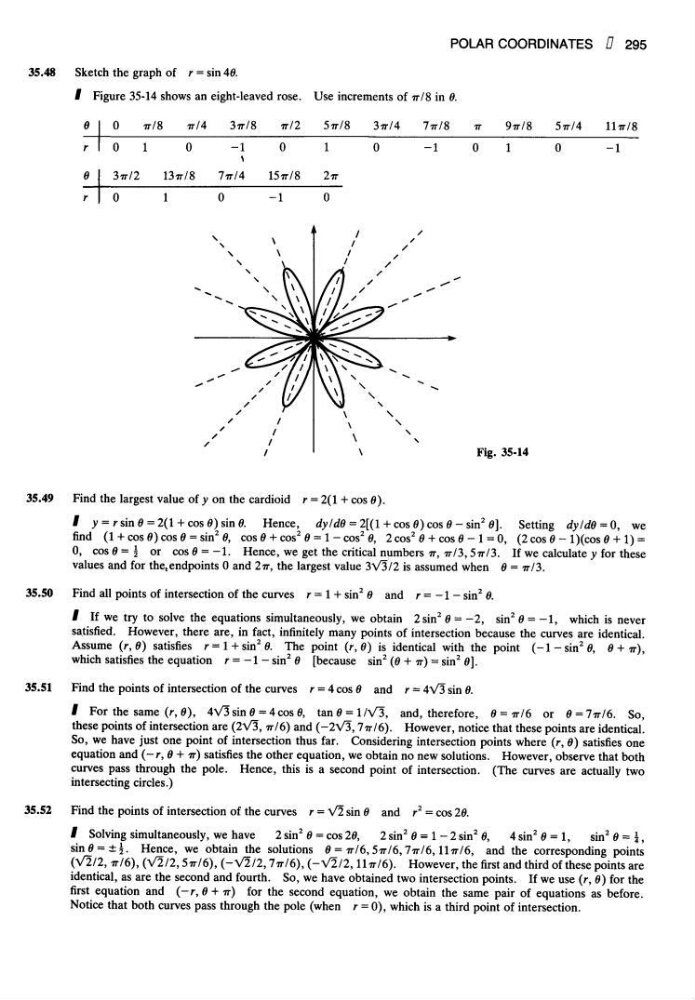
Sketch the graph of r = sin 40.
Figure 35-14 shows an eight-leaved rose. Use increments of ir/8 in 0.
Fig. 35-14
Find the largest value of y on the cardioid r = 2(1 + cos 8).
y = r sin 6 = 2(1 + cos 0) sine. Hence, dy/dO = 2[(1 + cos 0) cos 0 - sin
2 0]. Setting dy/d6 = Q, we
find (1 + cos 6) cos 6 = sin
2 6, cos 0 + cos
2 6 = 1 - cos
2 0, 2 cos
2 6 + cos 0 - 1 = 0, (2cos0 - l)(cos 0 + 1) =
0, cos 0 = \ or cos 0 = -1. Hence, we get the critical numbers it, ir/3,5ir/3. If we calculate y for these
values and for the.endpoints 0 and 2ir, the largest value 3V3/2 is assumed when 0 = ir/3.
Find all points of intersection of the curves r = I + sin
2 0 and r= —1 — sin
2 0.
If we try to solve the equations simultaneously, we obtain 2 sin
2 0 = -2, sin
2 0 = -1, which is never
satisfied. However, there are, in fact, infinitely many points of intersection because the curves are identical.
Assume (r,0) satisfies r=l+sin
2 0. The point (r, 6) is identical with the point (-l-sin
2 0, 6 + TT),
which satisfies the equation r=-l-sin
2 0 [because sin
2 (0 + IT) = sin
2 01.
Find the points of intersection of the curves r = 4 cos 0 and r = 4V5 sin 0.
For the same (r, 0), 4V3sin 0 = 4cos 0, tan0 = l/V3, and, therefore, 0 = 77/6 or 6=7ir/6. So,
these points of intersection are (2V3, trl6) and (-2V5,7ir/6). However, notice that these points are identical.
So, we have just one point of intersection thus far. Considering intersection points where (r, 0) satisfies one
equation and (-r, 0 + IT) satisfies the other equation, we obtain no new solutions. However, observe that both
curves pass through the pole. Hence, this is a second point of intersection. (The curves are actually two
intersecting circles.)
Find the points of intersection of the curves r = V2 sin 0 and r
2 = cos 20.
Solving simultaneously, we have
2 sin
2 0 = cos 20,
2 sin
2 0 = 1-2 sin
2 0,
4 sin
2 0 = 1,
sin
2 0 = J,
sin0 = ±|. Hence, we obtain the solutions 0 = 77/6,577/6,7-77/6,11 it 16, and the corresponding points
(V2/2, ir/6), (V2/2,5ir/6), (-V2/2,7ir/6), (-V2/2, llir/6). However, the first and third of these points are
identical, as are the second and fourth. So, we have obtained two intersection points. If we use (r, 0) for the
first equation and (-r, 0 + IT) for the second equation, we obtain the same pair of equations as before.
Notice that both curves pass through the pole (when r = 0), which is a third point of intersection.
35.52
35.51
35.50
35.49
35.48
e
r
e
r
0
0
3TT/2
0
IT/8
1
TT/4
0
137T/8
1
3u78
-1
\
7ir/4
0
IT/2
0
157T/8
1
57T/8
1
2ir
0
3ir/4
0
77T/8
IT
-1
0
97T/8
1
5ir/4
0
llir/8
-1
295
Sketch the graph of r = sin 40.
Figure 35-14 shows an eight-leaved rose. Use increments of ir/8 in 0.
Fig. 35-14
Find the largest value of y on the cardioid r = 2(1 + cos 8).
y = r sin 6 = 2(1 + cos 0) sine. Hence, dy/dO = 2[(1 + cos 0) cos 0 - sin
2 0]. Setting dy/d6 = Q, we
find (1 + cos 6) cos 6 = sin
2 6, cos 0 + cos
2 6 = 1 - cos
2 0, 2 cos
2 6 + cos 0 - 1 = 0, (2cos0 - l)(cos 0 + 1) =
0, cos 0 = \ or cos 0 = -1. Hence, we get the critical numbers it, ir/3,5ir/3. If we calculate y for these
values and for the.endpoints 0 and 2ir, the largest value 3V3/2 is assumed when 0 = ir/3.
Find all points of intersection of the curves r = I + sin
2 0 and r= —1 — sin
2 0.
If we try to solve the equations simultaneously, we obtain 2 sin
2 0 = -2, sin
2 0 = -1, which is never
satisfied. However, there are, in fact, infinitely many points of intersection because the curves are identical.
Assume (r,0) satisfies r=l+sin
2 0. The point (r, 6) is identical with the point (-l-sin
2 0, 6 + TT),
which satisfies the equation r=-l-sin
2 0 [because sin
2 (0 + IT) = sin
2 01.
Find the points of intersection of the curves r = 4 cos 0 and r = 4V5 sin 0.
For the same (r, 0), 4V3sin 0 = 4cos 0, tan0 = l/V3, and, therefore, 0 = 77/6 or 6=7ir/6. So,
these points of intersection are (2V3, trl6) and (-2V5,7ir/6). However, notice that these points are identical.
So, we have just one point of intersection thus far. Considering intersection points where (r, 0) satisfies one
equation and (-r, 0 + IT) satisfies the other equation, we obtain no new solutions. However, observe that both
curves pass through the pole. Hence, this is a second point of intersection. (The curves are actually two
intersecting circles.)
Find the points of intersection of the curves r = V2 sin 0 and r
2 = cos 20.
Solving simultaneously, we have
2 sin
2 0 = cos 20,
2 sin
2 0 = 1-2 sin
2 0,
4 sin
2 0 = 1,
sin
2 0 = J,
sin0 = ±|. Hence, we obtain the solutions 0 = 77/6,577/6,7-77/6,11 it 16, and the corresponding points
(V2/2, ir/6), (V2/2,5ir/6), (-V2/2,7ir/6), (-V2/2, llir/6). However, the first and third of these points are
identical, as are the second and fourth. So, we have obtained two intersection points. If we use (r, 0) for the
first equation and (-r, 0 + IT) for the second equation, we obtain the same pair of equations as before.
Notice that both curves pass through the pole (when r = 0), which is a third point of intersection.
35.52
35.51
35.50
35.49
35.48
e
r
e
r
0
0
3TT/2
0
IT/8
1
TT/4
0
137T/8
1
3u78
-1
\
7ir/4
0
IT/2
0
157T/8
1
57T/8
1
2ir
0
3ir/4
0
77T/8
IT
-1
0
97T/8
1
5ir/4
0
llir/8
-1