

276
CHAPTER 34
34.10
Sketch the curve with the parametric equations x = x 0 + at, y = y 0 + bt, where a and b are not both 0.
bx = bx a + abt, ay = ay 0 + abt. Subtracting the second equation from the first, we get bx — ay = bx 0 —
ay 0 . This is a line through the point (x 0 , y a ) and parallel to the vector (a, b), since (x, y) — (x 0 , y 0 ) = t(a, b).
See Fig. 34-10.
34.11
Find parametric equations for the ellipse
Let x = 5 cos 9, y = 12 sin 0. Then
34.12 Find parametric equations for the hyperbola
Let x = at+a/4t, y = bt-b/4t. Then (x/a)2 = t2 + \ + l/l6t2, (y/b)2 = t2 - \ + l/16t2. Hence,
(x/a)
2 — (y/b)
2 = 1. Another possibility (cf. Problem 34.6) would be x = a sec u, y — b tan «.
34.13 Find parametric equations for x
2 '
3 + y
2 '
3 = a
2 '
3 .
It suffices to have x
2 '
3 = a
2 '
3 cos
2 6 and y
213 = a
2 '
3 sin
2 ft So, let x = a cos
3 0, y = a sin
3 ft
34.14
Find parametric equations for the circle x
2 + y
2 - 4y = 0.
Complete the square: x
2 + (y -2)
2 = 4. It suffices to have x = 2cosft y-2 = 2sinft So, let x =
2 cos ft, y = 2 + 2 sin ft
34.15
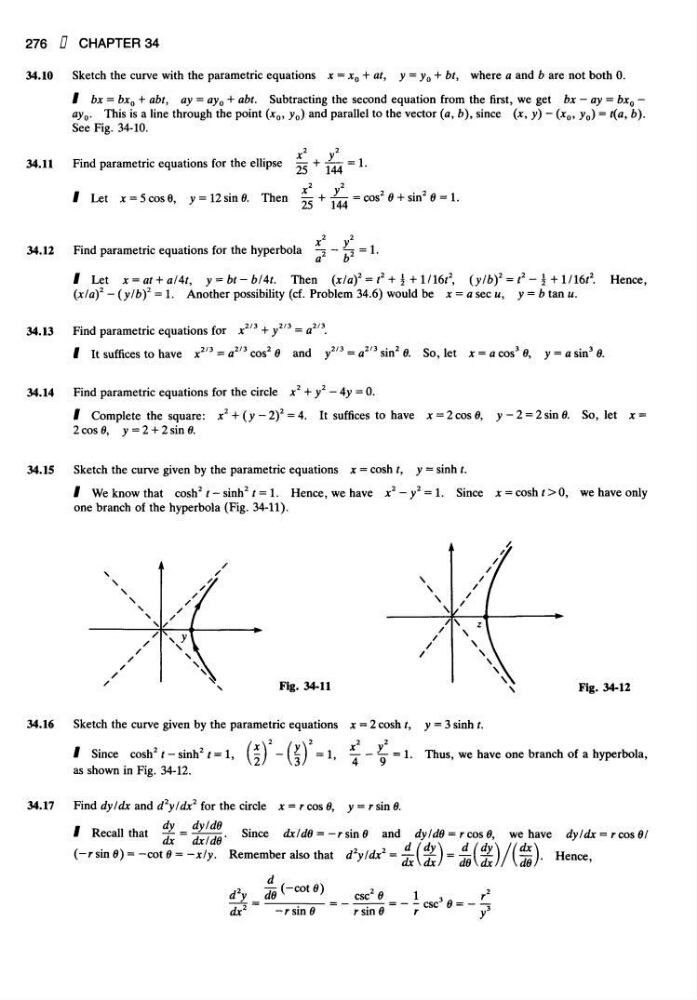
Sketch the curve given by the parametric equations x = cosh t, y = sinh t.
We know that cosh
2 1- sinh
2 1 = 1. Hence, we have x
2 -y
2 = l. Since * = coshf>0, we have only
one branch of the hyperbola (Fig. 34-11).
Fig. 34-11
Fig. 34-12
34.16
Sketch the curve given by the parametric equations x =2cosh/, y = 3sinhf.
Since cosh
2 t— sinh
2 t = 1,
= 1,
= 1. Thus, we have one branch of a hyperbola,
as shown in Fig. 34-12.
34.17
Find dy Idx and d
2 y/dx
2 for the circle x = rcosft, _y = rsinft
Recall that
Since dxldd = -rsin 9 and dy/d0 = rcos0, we have dy/dx = rcosO/
(-r sin 0) = -cot 0 = -x/y.
Remember also that d
2 y/dx
2 =
Hence,
CHAPTER 34
34.10
Sketch the curve with the parametric equations x = x 0 + at, y = y 0 + bt, where a and b are not both 0.
bx = bx a + abt, ay = ay 0 + abt. Subtracting the second equation from the first, we get bx — ay = bx 0 —
ay 0 . This is a line through the point (x 0 , y a ) and parallel to the vector (a, b), since (x, y) — (x 0 , y 0 ) = t(a, b).
See Fig. 34-10.
34.11
Find parametric equations for the ellipse
Let x = 5 cos 9, y = 12 sin 0. Then
34.12 Find parametric equations for the hyperbola
Let x = at+a/4t, y = bt-b/4t. Then (x/a)2 = t2 + \ + l/l6t2, (y/b)2 = t2 - \ + l/16t2. Hence,
(x/a)
2 — (y/b)
2 = 1. Another possibility (cf. Problem 34.6) would be x = a sec u, y — b tan «.
34.13 Find parametric equations for x
2 '
3 + y
2 '
3 = a
2 '
3 .
It suffices to have x
2 '
3 = a
2 '
3 cos
2 6 and y
213 = a
2 '
3 sin
2 ft So, let x = a cos
3 0, y = a sin
3 ft
34.14
Find parametric equations for the circle x
2 + y
2 - 4y = 0.
Complete the square: x
2 + (y -2)
2 = 4. It suffices to have x = 2cosft y-2 = 2sinft So, let x =
2 cos ft, y = 2 + 2 sin ft
34.15
Sketch the curve given by the parametric equations x = cosh t, y = sinh t.
We know that cosh
2 1- sinh
2 1 = 1. Hence, we have x
2 -y
2 = l. Since * = coshf>0, we have only
one branch of the hyperbola (Fig. 34-11).
Fig. 34-11
Fig. 34-12
34.16
Sketch the curve given by the parametric equations x =2cosh/, y = 3sinhf.
Since cosh
2 t— sinh
2 t = 1,
= 1,
= 1. Thus, we have one branch of a hyperbola,
as shown in Fig. 34-12.
34.17
Find dy Idx and d
2 y/dx
2 for the circle x = rcosft, _y = rsinft
Recall that
Since dxldd = -rsin 9 and dy/d0 = rcos0, we have dy/dx = rcosO/
(-r sin 0) = -cot 0 = -x/y.
Remember also that d
2 y/dx
2 =
Hence,