

CHAPTER 34
Parametric Equations, Vector Functions,
Curvilinear Motion
PARAMETRIC EQUATIONS OF PLANE CURVES
34.1
Sketch the curve given by the parametric equations x = a cos 6, y = a sin 6.
Note that x
2 + y
2 = a
2 cos
2 0 + a
2 sin
2 0 — a
2
(cos
2 6 + sin
2 0) = a
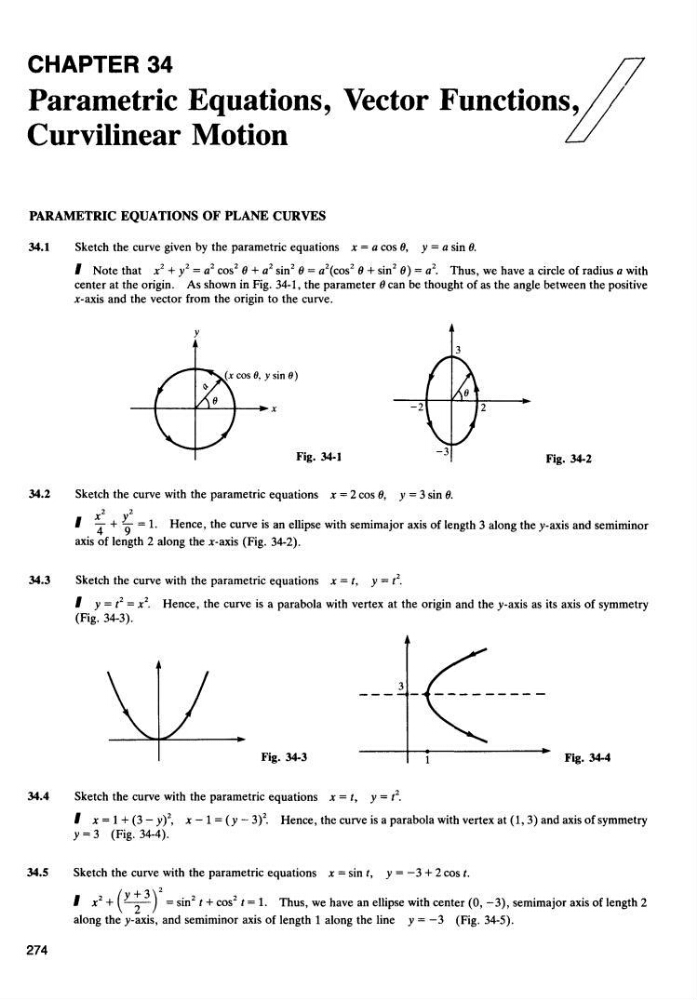
2 . Thus, we have a circle of radius a with
center at the origin. As shown in Fig. 34-1, the parameter 6 can be thought of as the angle between the positive
jc-axis and the vector from the origin to the curve.
Fig. 34-1
Fig. 34-2
34.2
Sketch the curve with the parametric equations x = 2 cos 0, y = 3 sin 6.
x
2
y
2
-T + -g - 1. Hence, the curve is an ellipse with semimajor axis of length 3 along the y-axis and semiminor
axis of length 2 along the x-axis (Fig. 34-2).
34.3
Sketch the curve with the parametric equations x = t, y = t
2 .
y = t
2 = x
2 . Hence, the curve is a parabola with vertex at the origin and the y-axis as its axis of symmetry
(Fig. 34-3).
Fig. 34-3
Fig. 34-4
34.4
Sketch the curve with the parametric equations x = t, y = t
2 .
x = 1 + (3 — y)
2 , x — l = (y - 3)
2
. Hence, the curve is a parabola with vertex at (1,3) and axis of symmetry
y = 3 (Fig. 34-4).
34.5
Sketch the curve with the parametric equations x = sin t, y = —3 + 2 cos t.
= sin
2 1 + cos
2 1 = 1. Thus, we have an ellipse with center (0, —3), semimajor axis of length 2
along the y-axis, and semiminor axis of length 1 along the line y = —3 (Fig. 34-5).
274
x
2 +
Parametric Equations, Vector Functions,
Curvilinear Motion
PARAMETRIC EQUATIONS OF PLANE CURVES
34.1
Sketch the curve given by the parametric equations x = a cos 6, y = a sin 6.
Note that x
2 + y
2 = a
2 cos
2 0 + a
2 sin
2 0 — a
2
(cos
2 6 + sin
2 0) = a
2 . Thus, we have a circle of radius a with
center at the origin. As shown in Fig. 34-1, the parameter 6 can be thought of as the angle between the positive
jc-axis and the vector from the origin to the curve.
Fig. 34-1
Fig. 34-2
34.2
Sketch the curve with the parametric equations x = 2 cos 0, y = 3 sin 6.
x
2
y
2
-T + -g - 1. Hence, the curve is an ellipse with semimajor axis of length 3 along the y-axis and semiminor
axis of length 2 along the x-axis (Fig. 34-2).
34.3
Sketch the curve with the parametric equations x = t, y = t
2 .
y = t
2 = x
2 . Hence, the curve is a parabola with vertex at the origin and the y-axis as its axis of symmetry
(Fig. 34-3).
Fig. 34-3
Fig. 34-4
34.4
Sketch the curve with the parametric equations x = t, y = t
2 .
x = 1 + (3 — y)
2 , x — l = (y - 3)
2
. Hence, the curve is a parabola with vertex at (1,3) and axis of symmetry
y = 3 (Fig. 34-4).
34.5
Sketch the curve with the parametric equations x = sin t, y = —3 + 2 cos t.
= sin
2 1 + cos
2 1 = 1. Thus, we have an ellipse with center (0, —3), semimajor axis of length 2
along the y-axis, and semiminor axis of length 1 along the line y = —3 (Fig. 34-5).
274
x
2 +