

CIRCLES
Find the standard equation of a circle with radius 13 that passes through the origin, and whose center has abscissa
-12.
Let the center be (-12, ft). The distance formula yields
144+ft
2 = 169, b
2 = 25, and b = ±5. Hence, there are two circles, with equations (x + 12)
2 + (y - 5)
2 =
169 and (jc + 12)
2 + (y + 5)
2 = 169.
Find the standard equation of the circle with center at (1, 3) and tangent to the line 5x - I2y -8 = 0.
4.20
4.21
The radius is the perpendicular distance from the center (1,3) to the line:
standard equation is (x - I)
2 + (y - 3)
2 = 9.
Find the standard equation of the circle passing through (-2, 1) and tangent to the line 3x - 2y - 6 at the point
(4,3).
Since the circle passes through (-2, 1) and (4, 3), its center (a, b) is on the perpendicular bisector of the
segment connecting those points. The center must also be on the line perpendicular to 3x-2y = 6 at (4, 3).
The equation of the perpendicular bisector of the segment is found to be 3x + y = 5. The equation of the line
perpendicular to 3* - 2y = 6 at (4, 3) turns out to be 2x + 3y = 17. Solving 3* + y = 5 and 2* + 3.y =
17 simultaneously, we find x = -$ and y = % . Then the radius
the required equation is (x + f )
2 + ( y - ^ )
2 = ^ .
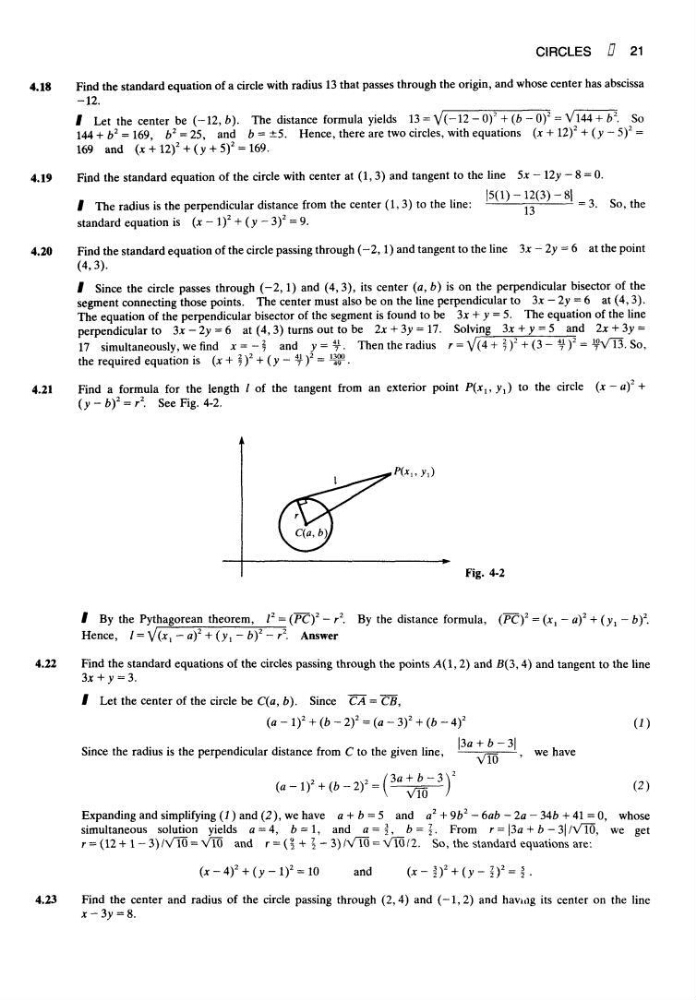
Find a formula for the length / of the tangent from an exterior point P(x l ,y l ) to the circle (x - a)
2 +
(
y-b)2 = r2. See Fig. 4-2.
Fig. 4-2
4.22
4.23
By the Pythagorean theorem, I2 = (PC)2 - r2. By the distance formula, (PC)2 = (*, - a)2 + (y1 - b)2.
Hence,
Find the standard equations of the circles passing through the points A(l, 2) and B(3, 4) and tangent to the line
3* + ? =3.
Let the center of the circle be C(a, b). Since ~CA = "CE,
Since the radius is the perpendicular distance from C to the given line,
Expanding and simplifying (1) and (2), we have a + ft = 5 and a
2 + 9b
2 — 6«ft -2a — 34ft + 41 =0, whose
simultaneous solution yields a = 4, ft = 1, and a=|, b=\. From r = |3a + ft - 3|/VT(5, we get
/• = (12+l-3)/VTO = VTO and r = (\ + \ - 3)/VTO = VlO/2. So, the standard equations are:
(x — 4)
2 + (y — I)
2 = 10
and
Find the center and radius of the circle passing through (2,4) and (-1,2) and having its center on the line
x - 3y = 8.
4.18
4.19
(«-l)
2 + (fc-2)
2 = (a-3)
2 + (fe-4)
2
So, the
we have
So
So
Answer
21
(1)
Find the standard equation of a circle with radius 13 that passes through the origin, and whose center has abscissa
-12.
Let the center be (-12, ft). The distance formula yields
144+ft
2 = 169, b
2 = 25, and b = ±5. Hence, there are two circles, with equations (x + 12)
2 + (y - 5)
2 =
169 and (jc + 12)
2 + (y + 5)
2 = 169.
Find the standard equation of the circle with center at (1, 3) and tangent to the line 5x - I2y -8 = 0.
4.20
4.21
The radius is the perpendicular distance from the center (1,3) to the line:
standard equation is (x - I)
2 + (y - 3)
2 = 9.
Find the standard equation of the circle passing through (-2, 1) and tangent to the line 3x - 2y - 6 at the point
(4,3).
Since the circle passes through (-2, 1) and (4, 3), its center (a, b) is on the perpendicular bisector of the
segment connecting those points. The center must also be on the line perpendicular to 3x-2y = 6 at (4, 3).
The equation of the perpendicular bisector of the segment is found to be 3x + y = 5. The equation of the line
perpendicular to 3* - 2y = 6 at (4, 3) turns out to be 2x + 3y = 17. Solving 3* + y = 5 and 2* + 3.y =
17 simultaneously, we find x = -$ and y = % . Then the radius
the required equation is (x + f )
2 + ( y - ^ )
2 = ^ .
Find a formula for the length / of the tangent from an exterior point P(x l ,y l ) to the circle (x - a)
2 +
(
y-b)2 = r2. See Fig. 4-2.
Fig. 4-2
4.22
4.23
By the Pythagorean theorem, I2 = (PC)2 - r2. By the distance formula, (PC)2 = (*, - a)2 + (y1 - b)2.
Hence,
Find the standard equations of the circles passing through the points A(l, 2) and B(3, 4) and tangent to the line
3* + ? =3.
Let the center of the circle be C(a, b). Since ~CA = "CE,
Since the radius is the perpendicular distance from C to the given line,
Expanding and simplifying (1) and (2), we have a + ft = 5 and a
2 + 9b
2 — 6«ft -2a — 34ft + 41 =0, whose
simultaneous solution yields a = 4, ft = 1, and a=|, b=\. From r = |3a + ft - 3|/VT(5, we get
/• = (12+l-3)/VTO = VTO and r = (\ + \ - 3)/VTO = VlO/2. So, the standard equations are:
(x — 4)
2 + (y — I)
2 = 10
and
Find the center and radius of the circle passing through (2,4) and (-1,2) and having its center on the line
x - 3y = 8.
4.18
4.19
(«-l)
2 + (fc-2)
2 = (a-3)
2 + (fe-4)
2
So, the
we have
So
So
Answer
21
(1)