

264
CHAPTER 32
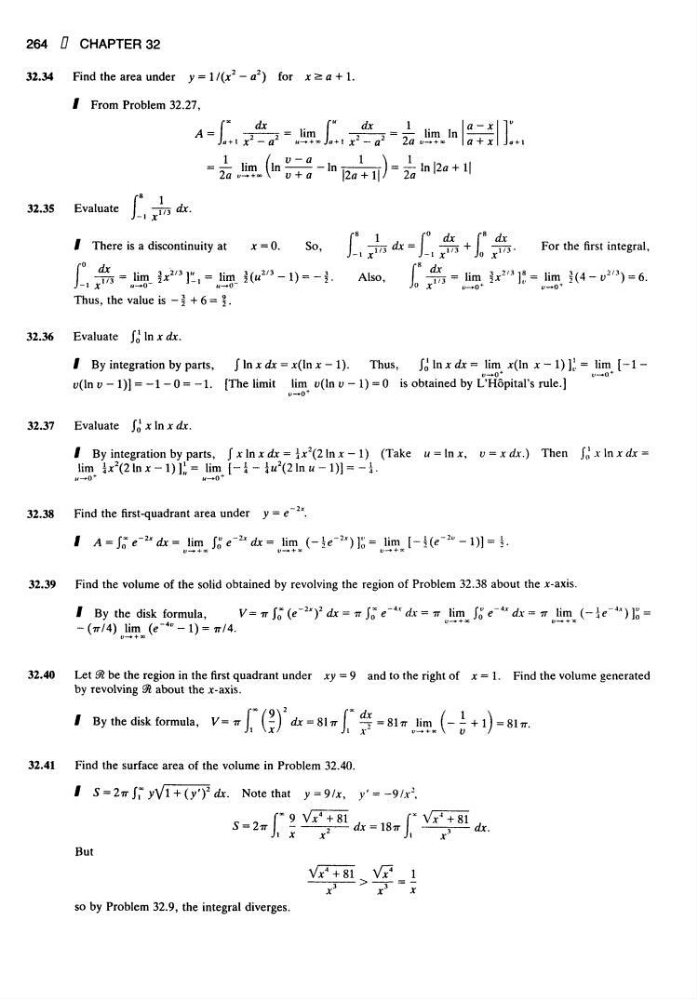
32.34 Find the area under y = 1 /(x
2 — a
2 ) for x a a + 1.
From Problem 32.27,
In
in
In
In
32.35
Evaluate
There is a discontinuity at
x = 0.
So,
For the first integral,
Also,
Thus, the value is
32.36
Evaluate
In x dx.
By integration by parts,
J \nxdx = x(\n x - 1). Thus,
lnxdx= lim *(ln x — 1) ]' = lim [-1t;(lni>-l)] = -l-0=-l. [The limit lim u(lny-l)=0 is obtained by L'Hopital's rule.]
32.37
Evaluate
x In x dx.
By integration by parts,
(Take u = In x, v = x dx.) Then
.v In x dx =
x\nxdx = \x\2\nx-l)
32.38
Find the first-quadrant area under y - e ''.
32.39 Find the volume of the solid obtained by revolving the region of Problem 32.38 about the jc-axis.
By the disk formula,
32.40
Let S? be the region in the first quadrant under xy = 9 and to the right of jc=l. Find the volume generated
by revolving 91 about the *-axis.
By the disk formula,
32.41
Find the surface area of the volume in Problem 32.40.
Note that y = 9/x, y' = ~9/x
1 ,
But
so by Problem 32.9, the integral diverges.
CHAPTER 32
32.34 Find the area under y = 1 /(x
2 — a
2 ) for x a a + 1.
From Problem 32.27,
In
in
In
In
32.35
Evaluate
There is a discontinuity at
x = 0.
So,
For the first integral,
Also,
Thus, the value is
32.36
Evaluate
In x dx.
By integration by parts,
J \nxdx = x(\n x - 1). Thus,
lnxdx= lim *(ln x — 1) ]' = lim [-1t;(lni>-l)] = -l-0=-l. [The limit lim u(lny-l)=0 is obtained by L'Hopital's rule.]
32.37
Evaluate
x In x dx.
By integration by parts,
(Take u = In x, v = x dx.) Then
.v In x dx =
x\nxdx = \x\2\nx-l)
32.38
Find the first-quadrant area under y - e ''.
32.39 Find the volume of the solid obtained by revolving the region of Problem 32.38 about the jc-axis.
By the disk formula,
32.40
Let S? be the region in the first quadrant under xy = 9 and to the right of jc=l. Find the volume generated
by revolving 91 about the *-axis.
By the disk formula,
32.41
Find the surface area of the volume in Problem 32.40.
Note that y = 9/x, y' = ~9/x
1 ,
But
so by Problem 32.9, the integral diverges.