

INTEGRALS FOR SURFACE AREA, WORK, CENTROIDS
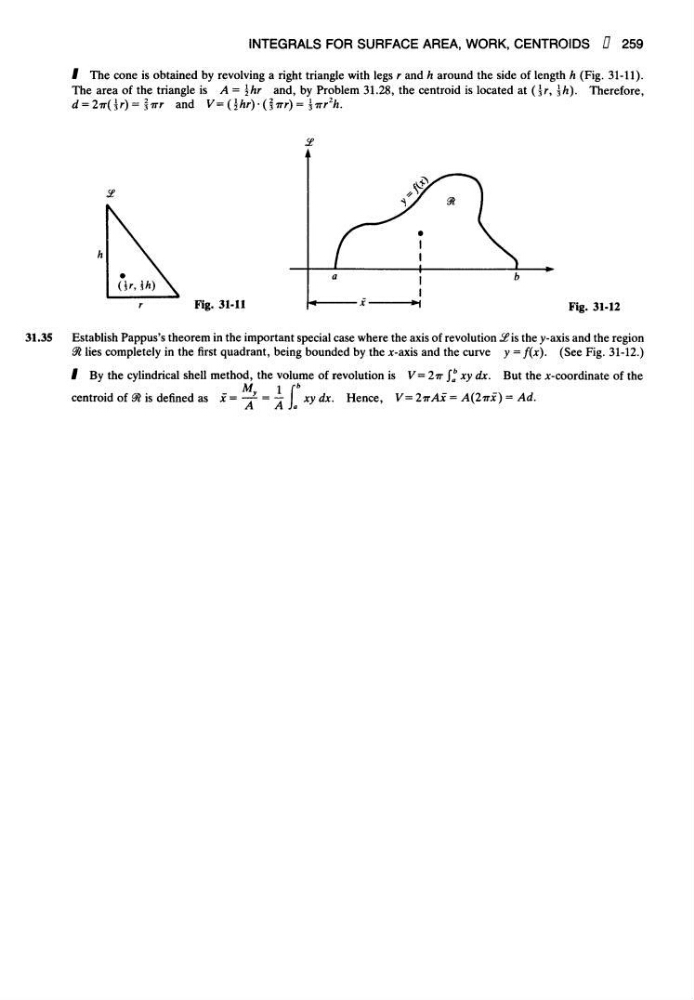
f The cone is obtained by revolving a right triangle with legs r and h around the side of length h (Fig. 31-11).
The area of the triangle is A = \hr and, by Problem 31.28, the centroid is located at (j/% 3/1). Therefore,
d = 2ir(^r)=ltrr and V= (\hr)-(lirr) = \vr
2 h.
Fig. 31-11
Fig. 31-12
31.35
Establish Pappus's theorem in the important special case where the axis of revolution !£ is the y-axis and the region
31 lies completely in the first quadrant, being bounded by the Jt-axis and the curve y = f(x). (See Fig. 31-12.)
centroid of 31 is defined as x =
xy dx. Hence, V= 2irAx = A(2irx) = Ad.
V= 2tr J* xy dx. But the JE-coordinate of the
259
By the cylindrical shell method, the volume of revolution is
f The cone is obtained by revolving a right triangle with legs r and h around the side of length h (Fig. 31-11).
The area of the triangle is A = \hr and, by Problem 31.28, the centroid is located at (j/% 3/1). Therefore,
d = 2ir(^r)=ltrr and V= (\hr)-(lirr) = \vr
2 h.
Fig. 31-11
Fig. 31-12
31.35
Establish Pappus's theorem in the important special case where the axis of revolution !£ is the y-axis and the region
31 lies completely in the first quadrant, being bounded by the Jt-axis and the curve y = f(x). (See Fig. 31-12.)
centroid of 31 is defined as x =
xy dx. Hence, V= 2irAx = A(2irx) = Ad.
V= 2tr J* xy dx. But the JE-coordinate of the
259
By the cylindrical shell method, the volume of revolution is