

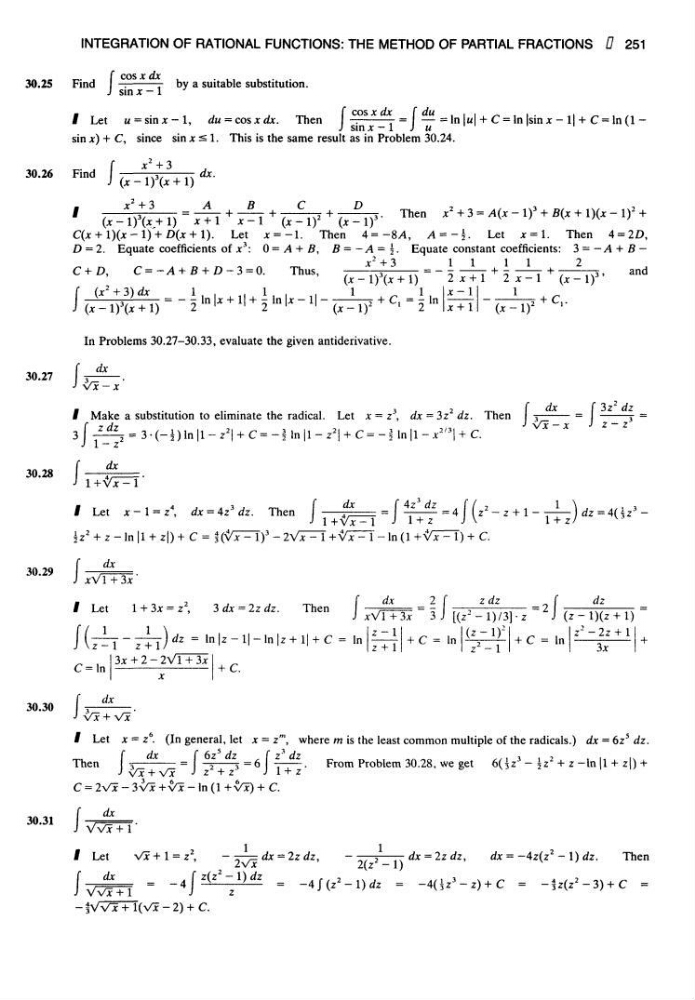
30.25
INTEGRATION OF RATIONAL FUNCTIONS: THE METHOD OF PARTIAL FRACTIONS
30.26
Find
30.27
30.28
30.29
30.30
30.31
and
In Problems 30.27-30.33, evaluate the given antiderivative.
Then
Let
In I
251
Find
by a suitable substitution.
Let M=sinx — 1, du = cos x dx. Then
This is the same result as in Problem 30.24.
Equate coefficients of x : 0 = A + B, B = -A = \•
Then 4= -8 A, A = -\.
Then x
2 + 3 = A(x - I)
3 + B(x + l)(x - I)
2 +
Then 4 = 2D,
Let x-l.
Equate constant coefficients: 3 = — A + B —
Thus,
In
In
In
Let * = -!.
Then
Let x = z
3
, dx = 3z
2 dz
Make a substitution to eliminate the radical.
In
In
In
Let x - 1 = z
4
, dx = 4z
3 dz. Then
In
In
Let
1 + 3x = z ,
3 rfx = 2z rfz.
In
In
In
In
In
Let x = z6. (Jn general, let x = z"', where m is the least common multiple of the radicals.)dx=6z5dz.
From Problem 30.28, we get
In
Then
Then
= In |u| + C = In |sin jc - 1| + C = In (1 -
rfw
u
sin A:) + C, since sin * s 1.
C(;t + l)(x - 1) + D(x + 1).
C+D,
C=-A +B + D-3 = Q.
In
= -4j(z
2 -l)dz = -4(b
3 -z)+C = -|z(z
2 -3) + C =
dx = 2z dz,
dx = -4z(z
2 - 1) dz.
dx = 2z dz,
VI + 1 = z
2
,
D=2.
INTEGRATION OF RATIONAL FUNCTIONS: THE METHOD OF PARTIAL FRACTIONS
30.26
Find
30.27
30.28
30.29
30.30
30.31
and
In Problems 30.27-30.33, evaluate the given antiderivative.
Then
Let
In I
251
Find
by a suitable substitution.
Let M=sinx — 1, du = cos x dx. Then
This is the same result as in Problem 30.24.
Equate coefficients of x : 0 = A + B, B = -A = \•
Then 4= -8 A, A = -\.
Then x
2 + 3 = A(x - I)
3 + B(x + l)(x - I)
2 +
Then 4 = 2D,
Let x-l.
Equate constant coefficients: 3 = — A + B —
Thus,
In
In
In
Let * = -!.
Then
Let x = z
3
, dx = 3z
2 dz
Make a substitution to eliminate the radical.
In
In
In
Let x - 1 = z
4
, dx = 4z
3 dz. Then
In
In
Let
1 + 3x = z ,
3 rfx = 2z rfz.
In
In
In
In
In
Let x = z6. (Jn general, let x = z"', where m is the least common multiple of the radicals.)dx=6z5dz.
From Problem 30.28, we get
In
Then
Then
= In |u| + C = In |sin jc - 1| + C = In (1 -
rfw
u
sin A:) + C, since sin * s 1.
C(;t + l)(x - 1) + D(x + 1).
C+D,
C=-A +B + D-3 = Q.
In
= -4j(z
2 -l)dz = -4(b
3 -z)+C = -|z(z
2 -3) + C =
dx = 2z dz,
dx = -4z(z
2 - 1) dz.
dx = 2z dz,
VI + 1 = z
2
,
D=2.