

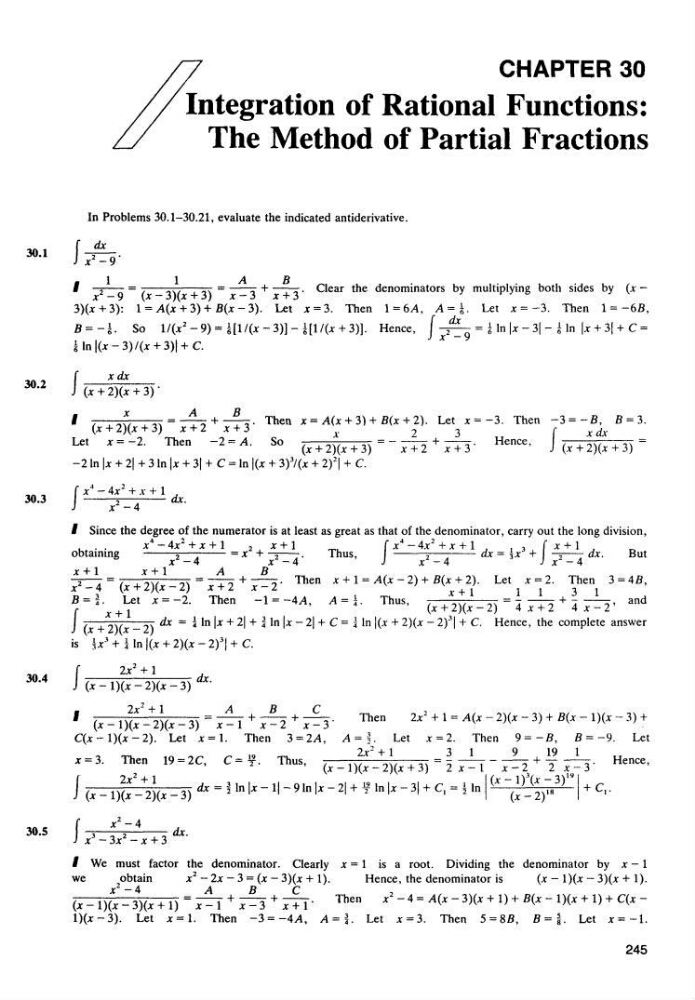
30.1
CHAPTER 30
Integration of Rational Functions:
The Method of Partial Fractions
In Problems 30.1-30.21, evaluate the indicated antiderivative.
Clear the denominators by multiplying both sides by (x -
Then 1 = 6A, A=i.
= 4ln|jc-3|-4In |x+3|+C=
30.2
Then x = A(x + 3) + B(x + 2). Let jc=-3. Then -3=-B, B = 3.
Hence,
Let A: = -2.
30.3
Then
So
Since the degree of the numerator is at least as great as that of the denominator, carry out the long division,
But
obtaining
Thus,
Then jc + 1 = A(x -2) + B(;t + 2). Let jc = 2. Then 3 = 4B,
and
Hence, the complete answer
Then -1 = -4A, A = \. Thus,
is
Let x = -2.
In K* + 2)(x - 2)
3 | -t- C.
30.4
Then
Then
Thus,
Then
Let
Hence,
Then 9=-B, B = -9.
Let x = 2.
Let
30.5
We must factor the denominator. Clearly x = 1 is a root. Dividing the denominator by x -1
we
obtain
Then
x
2 - 4 = A(x - 3)(x + 1) + fi(;c - l)(x + 1) + C(x -
Hence, the denominator is
(x — l)(x — 3)(jc + 1).
245
Then
Let x = -3. Then 1 = -6B,
3)(x + 3): l = AO + 3)+B(.r-3). Let x = 3.
*=-J. So l/(*
2 -9)=J[l/(*-3)]-J[l/(^ + 3)].
iln|(JC-3)/(x + 3)| + C.
-2 = y4.
-2 In |JT + 2| + 3 In |jc + 3| + C = In |(x + 3)
3
/(x + 2)
2 | + C.
ln|(jc + 2)(A:-2)
3 | + C.
2^
2 + 1 = A(A: -2)(x - 3) + B(^ - l)(x - 3) +
x = 3.
C(*-!)(*-2).
19 = 2C, C=f.
3 = 2/1, X=§.
^ = 1.
dr = § In |x - 1| - 9 In |^ - 2| + ¥ In |^ - 3| + C, = ^ln
+ C,.
l)(x-3). Let JK = I. Then -3=-4A, A=\. Let jt = 3. Then 5 = 8B, B=|. Let x=-l.
x
2 -2x-3 = (x-3)(x+l).
Hence,
B=3/4.
In
In
In
CHAPTER 30
Integration of Rational Functions:
The Method of Partial Fractions
In Problems 30.1-30.21, evaluate the indicated antiderivative.
Clear the denominators by multiplying both sides by (x -
Then 1 = 6A, A=i.
= 4ln|jc-3|-4In |x+3|+C=
30.2
Then x = A(x + 3) + B(x + 2). Let jc=-3. Then -3=-B, B = 3.
Hence,
Let A: = -2.
30.3
Then
So
Since the degree of the numerator is at least as great as that of the denominator, carry out the long division,
But
obtaining
Thus,
Then jc + 1 = A(x -2) + B(;t + 2). Let jc = 2. Then 3 = 4B,
and
Hence, the complete answer
Then -1 = -4A, A = \. Thus,
is
Let x = -2.
In K* + 2)(x - 2)
3 | -t- C.
30.4
Then
Then
Thus,
Then
Let
Hence,
Then 9=-B, B = -9.
Let x = 2.
Let
30.5
We must factor the denominator. Clearly x = 1 is a root. Dividing the denominator by x -1
we
obtain
Then
x
2 - 4 = A(x - 3)(x + 1) + fi(;c - l)(x + 1) + C(x -
Hence, the denominator is
(x — l)(x — 3)(jc + 1).
245
Then
Let x = -3. Then 1 = -6B,
3)(x + 3): l = AO + 3)+B(.r-3). Let x = 3.
*=-J. So l/(*
2 -9)=J[l/(*-3)]-J[l/(^ + 3)].
iln|(JC-3)/(x + 3)| + C.
-2 = y4.
-2 In |JT + 2| + 3 In |jc + 3| + C = In |(x + 3)
3
/(x + 2)
2 | + C.
ln|(jc + 2)(A:-2)
3 | + C.
2^
2 + 1 = A(A: -2)(x - 3) + B(^ - l)(x - 3) +
x = 3.
C(*-!)(*-2).
19 = 2C, C=f.
3 = 2/1, X=§.
^ = 1.
dr = § In |x - 1| - 9 In |^ - 2| + ¥ In |^ - 3| + C, = ^ln
+ C,.
l)(x-3). Let JK = I. Then -3=-4A, A=\. Let jt = 3. Then 5 = 8B, B=|. Let x=-l.
x
2 -2x-3 = (x-3)(x+l).
Hence,
B=3/4.
In
In
In