

LINES
3.69
3.70
3.71
3.72
3.73
The slopes are both 2. Hence, the lines are parallel.
4*-2y=7 and 2* + 4y = l.
The slope of the first line is 2 and the slope of the second line is - \. Since the product of the slopes is —1, the
lines are perpendicular.
Ix + 7>y = 6 and 3* + ly = 14.
The slope of the first line is -1 and the slope of the second line is - j. Since the slopes are not equal and their
product is not — 1, the lines are neither parallel nor perpendicular.
Temperature is usually measured either in Fahrenheit or in Celsius degrees. The relation between Fahrenheit
and Celsius temperatures is given by a linear equation. The freezing point of water is 0° Celsius or 32°
Fahrenheit, and the boiling point of water is 100° Celsius or 212° Fahrenheit. Find an equation giving Fahrenheit
temperature y in terms of Celsius temperature *.
Since the equation is linear, we can write it as y — mx + b. From the information about the freezing point
of water, we see that b=32. From the information about the boiling point, we have 212= 100m +32,
180= 100m, m=\. So, y = f* + 32.
Problems 3.72-3.74 concern a triangle with vertices A(l, 2), B(8, 0), and C(5, 3).
Find an equation of the median from A to the midpoint of BC.
The midpoint M of BC is ((8 + 5)/2, (0 +3)/2) = (¥, 1). So, the slope of AM is (2 -§)/(!-¥) = - nHence, the equation has the form y = — n* + b. Since A is on the line, 2— -fa + b, fc = ff • Thus, the
equation is .y = - A* + ff, or * + lly=23.
Find an equation of the altitude from B to AC.
The slope of ACis (3 - 2)1(5 - 1) = \. Hence, the slope of the altitude is the negative reciprocal -4. So,
the desired equation has the form y = — 4x + b. Since B is on the line, 0 = —32 + b, b = 32. So, the
equation is y = -4* + 32.
Find an equation of the perpendicular bisector of AB.
The slope of AB is (2 —0)/(1 — 8) =-f. Hence, the slope of the desired line is the negative reciprocal \.
The line passes through the midpoint M of AB: M - ( \, 1). The equation has the form y = \x + b. Since
M is on the line, 1 = 5 • f + b, b = -™. Thus, the equation is y = |* - f, or 14* - 4y = 59.
Highroad Car Rental charges $30 per day and ISij: per mile for a car, while Lovvroad charges $33 per day and 12ij:
per mile for the same kind of car. If you expect to drive x miles per day, for what values of x would it cost less to
rent the car from Highroad?
The daily cost from Highroad is 3000 + 15* cents, and the daily cost from Lowroad is 3300 + 12*. Then
3000 + 15* < 3300 + 12*, 3*<300, *<100.
Using coordinates, prove that a parallelogram with perpendicular diagonals is a rhombus.
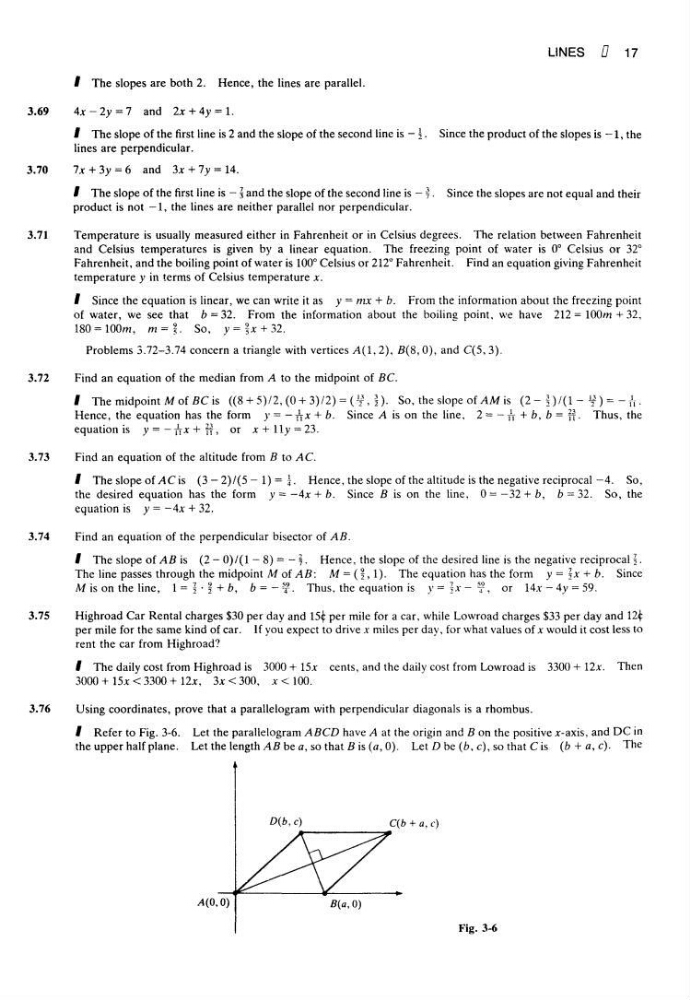
Refer to Fig. 3-6. Let the parallelogram ABCD have A at the origin and B on the positive *-axis, and DC in
the upper half plane. Let the length AB be a, so that Bis (a, 0). Let D be (b, c), so that Cis (b + a,c). The
3.74
3.75
3.76
Fig. 3-6
17
Download
from Wow! eBook
3.69
3.70
3.71
3.72
3.73
The slopes are both 2. Hence, the lines are parallel.
4*-2y=7 and 2* + 4y = l.
The slope of the first line is 2 and the slope of the second line is - \. Since the product of the slopes is —1, the
lines are perpendicular.
Ix + 7>y = 6 and 3* + ly = 14.
The slope of the first line is -1 and the slope of the second line is - j. Since the slopes are not equal and their
product is not — 1, the lines are neither parallel nor perpendicular.
Temperature is usually measured either in Fahrenheit or in Celsius degrees. The relation between Fahrenheit
and Celsius temperatures is given by a linear equation. The freezing point of water is 0° Celsius or 32°
Fahrenheit, and the boiling point of water is 100° Celsius or 212° Fahrenheit. Find an equation giving Fahrenheit
temperature y in terms of Celsius temperature *.
Since the equation is linear, we can write it as y — mx + b. From the information about the freezing point
of water, we see that b=32. From the information about the boiling point, we have 212= 100m +32,
180= 100m, m=\. So, y = f* + 32.
Problems 3.72-3.74 concern a triangle with vertices A(l, 2), B(8, 0), and C(5, 3).
Find an equation of the median from A to the midpoint of BC.
The midpoint M of BC is ((8 + 5)/2, (0 +3)/2) = (¥, 1). So, the slope of AM is (2 -§)/(!-¥) = - nHence, the equation has the form y = — n* + b. Since A is on the line, 2— -fa + b, fc = ff • Thus, the
equation is .y = - A* + ff, or * + lly=23.
Find an equation of the altitude from B to AC.
The slope of ACis (3 - 2)1(5 - 1) = \. Hence, the slope of the altitude is the negative reciprocal -4. So,
the desired equation has the form y = — 4x + b. Since B is on the line, 0 = —32 + b, b = 32. So, the
equation is y = -4* + 32.
Find an equation of the perpendicular bisector of AB.
The slope of AB is (2 —0)/(1 — 8) =-f. Hence, the slope of the desired line is the negative reciprocal \.
The line passes through the midpoint M of AB: M - ( \, 1). The equation has the form y = \x + b. Since
M is on the line, 1 = 5 • f + b, b = -™. Thus, the equation is y = |* - f, or 14* - 4y = 59.
Highroad Car Rental charges $30 per day and ISij: per mile for a car, while Lovvroad charges $33 per day and 12ij:
per mile for the same kind of car. If you expect to drive x miles per day, for what values of x would it cost less to
rent the car from Highroad?
The daily cost from Highroad is 3000 + 15* cents, and the daily cost from Lowroad is 3300 + 12*. Then
3000 + 15* < 3300 + 12*, 3*<300, *<100.
Using coordinates, prove that a parallelogram with perpendicular diagonals is a rhombus.
Refer to Fig. 3-6. Let the parallelogram ABCD have A at the origin and B on the positive *-axis, and DC in
the upper half plane. Let the length AB be a, so that Bis (a, 0). Let D be (b, c), so that Cis (b + a,c). The
3.74
3.75
3.76
Fig. 3-6
17
Download
from Wow! eBook