

230
CHAPTER 27
27.76
27.77
27.78
27.79
27.80
Fig. 27-10
Fig. 27-8
Fig. 27-9
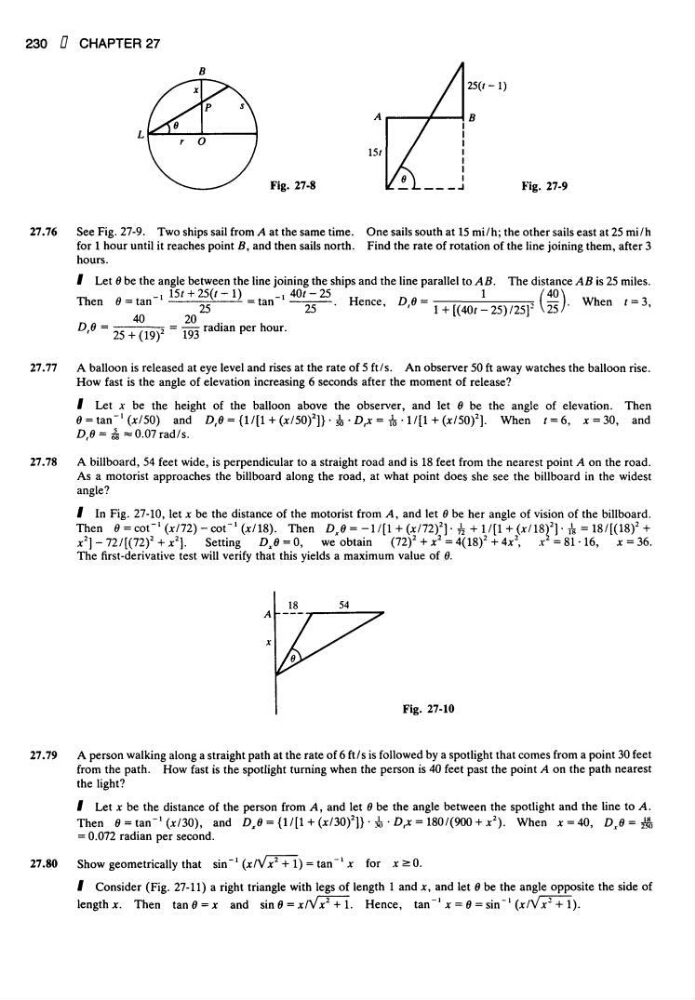
See Fig. 27-9. Two ships sail from A at the same time. One sails south at 15 mi/h; the other sails east at 25 mi/h
for 1 hour until it reaches point B, and then sails north. Find the rate of rotation of the line joining them, after 3
hours.
Lei be the angle between the line joining the ships and the line parallel to AB. The distance AB is 25 miles.
When t = 3,
Hence,
radian per hour.
Then
A balloon is released at eye level and rises at the rate of 5 ft/s. An observer 50 ft away watches the balloon rise
How fast is the angle of elevation increasing 6 seconds after the moment of release?
A billboard, 54 feet wide, is perpendicular to a straight road and is 18 feet from the nearest point A on the road.
As a motorist approaches the billboard along the road, at what point does she see the billboard in the widest
angle?
A person walking along a straight path at the rate of 6 ft/s is followed by a spotlight that comes from a point 30 feet
from the path. How fast is the spotlight turning when the person is 40 feet past the point A on the path nearest
the light?
Let x be the distance of the person from A, and let 6 be the angle between the spotlight and the line to A.
D,x = 180/(900 + ;f
2 ). When * = 40,
0.072 radian per second.
Then 6 = tan" (x/30), and D,6 = {1/[1 + (*/30r]} •
Show geometrically that
Consider (Fig. 27-11) a right triangle with legs of length 1 and x, and let 6 be the angle opposite the side of
length*. Then tan0 = * and sin0 = x/V;t2 +1. Hence, tan '* = 0 = sin ' (xNx2 +1)
sin'
l rje/Vy + l) = tarr'* for x>0.
In Fig. 27-10, let x be the distance of the motorist from A, and let 0 be her angle of vision of the billboard.
Then 0 = cot'
1 (x/72) -cot"
1 (jc/18). Then D,0 = -1/[1 + (x/72)
2 ] • £ + 1/[1 + (x/18)
2 ] • ^ = 18/[(18)
2 +
x
2 ]-72/[(72)
2 + x
2 }. Setting 0,0 = 0, we obtain
(72)
2 + x
2 =4(18)
2 +4x
2 , .v
2 = 81-16, x = 36.
The first-derivative test will verify that this yields a maximum value of 6.
Let x be the height of the balloon above the observer, and let 6 be the angle of elevation. Then
0 = tan "'(AT/50) and D,6 ={!/[! +(x/5Q)
2 ]} • £j • D,x =-&-l/[l +(x/SQ)
2 ]. When f = 6, jc=30, and
D,e= gb=0.07rad/s.
CHAPTER 27
27.76
27.77
27.78
27.79
27.80
Fig. 27-10
Fig. 27-8
Fig. 27-9
See Fig. 27-9. Two ships sail from A at the same time. One sails south at 15 mi/h; the other sails east at 25 mi/h
for 1 hour until it reaches point B, and then sails north. Find the rate of rotation of the line joining them, after 3
hours.
Lei be the angle between the line joining the ships and the line parallel to AB. The distance AB is 25 miles.
When t = 3,
Hence,
radian per hour.
Then
A balloon is released at eye level and rises at the rate of 5 ft/s. An observer 50 ft away watches the balloon rise
How fast is the angle of elevation increasing 6 seconds after the moment of release?
A billboard, 54 feet wide, is perpendicular to a straight road and is 18 feet from the nearest point A on the road.
As a motorist approaches the billboard along the road, at what point does she see the billboard in the widest
angle?
A person walking along a straight path at the rate of 6 ft/s is followed by a spotlight that comes from a point 30 feet
from the path. How fast is the spotlight turning when the person is 40 feet past the point A on the path nearest
the light?
Let x be the distance of the person from A, and let 6 be the angle between the spotlight and the line to A.
D,x = 180/(900 + ;f
2 ). When * = 40,
0.072 radian per second.
Then 6 = tan" (x/30), and D,6 = {1/[1 + (*/30r]} •
Show geometrically that
Consider (Fig. 27-11) a right triangle with legs of length 1 and x, and let 6 be the angle opposite the side of
length*. Then tan0 = * and sin0 = x/V;t2 +1. Hence, tan '* = 0 = sin ' (xNx2 +1)
sin'
l rje/Vy + l) = tarr'* for x>0.
In Fig. 27-10, let x be the distance of the motorist from A, and let 0 be her angle of vision of the billboard.
Then 0 = cot'
1 (x/72) -cot"
1 (jc/18). Then D,0 = -1/[1 + (x/72)
2 ] • £ + 1/[1 + (x/18)
2 ] • ^ = 18/[(18)
2 +
x
2 ]-72/[(72)
2 + x
2 }. Setting 0,0 = 0, we obtain
(72)
2 + x
2 =4(18)
2 +4x
2 , .v
2 = 81-16, x = 36.
The first-derivative test will verify that this yields a maximum value of 6.
Let x be the height of the balloon above the observer, and let 6 be the angle of elevation. Then
0 = tan "'(AT/50) and D,6 ={!/[! +(x/5Q)
2 ]} • £j • D,x =-&-l/[l +(x/SQ)
2 ]. When f = 6, jc=30, and
D,e= gb=0.07rad/s.