

228
CHAPTER 27
27.64
27.6'
27.66
27.67
27.68
27.69
Use integration to show that the circumference of a circle of radius r is 2 TIT.
Find the arc length of the part of the circle x + y
2 = r
2 in the first quadrant and multiply it by 4. Since
y = Vr2-x\ y' = -x/Vr2-x2 and (y')2 = x2/(r2 - x2). So 1 +(y1)2 = 1+x2/(r2 - x2) = (r2 ~ x2 +
x
2 )/(r
2 - x
2 ) = r
2 /(r
2 - x
2 ). Thus,
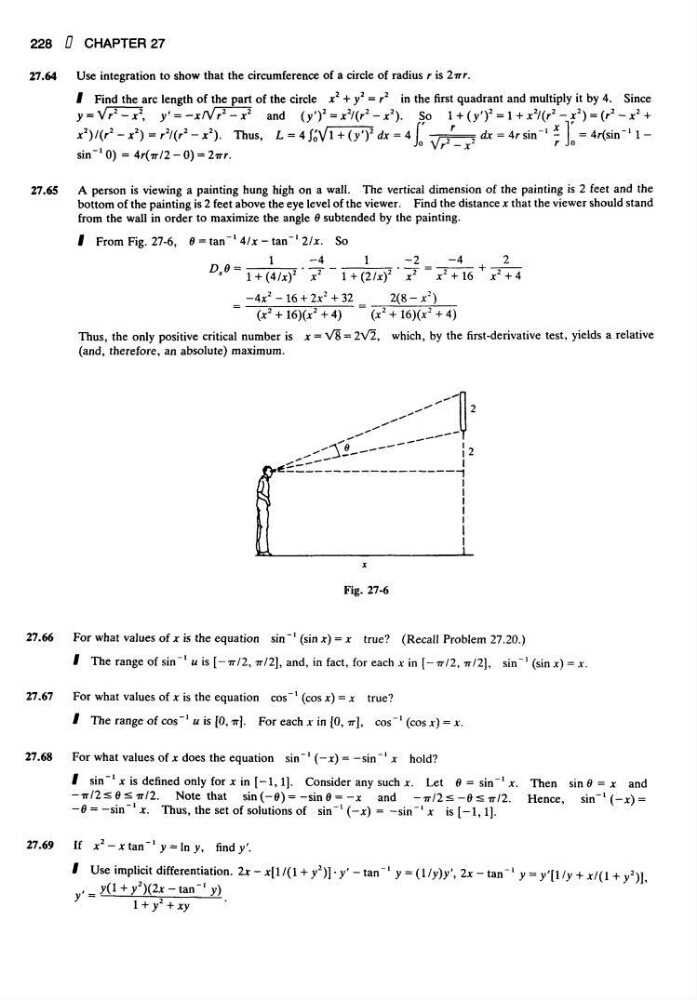
A person is viewing a painting hung high on a wall. The vertical dimension of the painting is 2 feet and the
bottom of the painting is 2 feet above the eye level of the viewer. Find the distance x that the viewer should stand
from the wall in order to maximize the angle 6 subtended by the painting.
Thus, the only positive critical number is
(and, therefore, an absolute) maximum.
which, by the first-derivative test, yields a relative
From Fig. 27-6, 8 - tan ' 4/x - tan~' 2/x. So
For what values of x is the equation sin ' (sin x) = x true? (Recall Problem 27.20.)
The range of sin ' u is [-Tr/2, Tr/2], and, in fact, for each x in f-ir/2, Tr/21, sin ' (sin*) = x.
For what values of x is the equation cos ' (cos x) = x true?
The range of cos ' « is [0, IT]. For each x in fO, TT], cos ' (cos x) = x.
For what values of x does the equation sin ' (-x) = -sin ' x hold?
Use implicit differentiation. 2x - x[ll(\ + y2)}-y' - tan'1 y = (1/y)/, 2x - tan'1 y = y'[\ly + xl(\ + y2)]
If x2 -x tan ly = lny, find y'.
sin ' x is defined only for x in [-1,1]. Consider any such x. Let 0 = sin
1 x. Then sin 6 = x and
-ir/2se^ir/2.
Note that sin (-6) = -sin 6 = -x and -Tr/2<-0s ir/2. Hence, sin~
1 (-A:) =
-0 = -sin ' x. Thus, the set of solutions of sin'
1 (-x) = -sin'
1 x is [-1,1].
Fig. 27-6
sin'
1 *)) = 4r(tr/2 - 0) = 2irr.
CHAPTER 27
27.64
27.6'
27.66
27.67
27.68
27.69
Use integration to show that the circumference of a circle of radius r is 2 TIT.
Find the arc length of the part of the circle x + y
2 = r
2 in the first quadrant and multiply it by 4. Since
y = Vr2-x\ y' = -x/Vr2-x2 and (y')2 = x2/(r2 - x2). So 1 +(y1)2 = 1+x2/(r2 - x2) = (r2 ~ x2 +
x
2 )/(r
2 - x
2 ) = r
2 /(r
2 - x
2 ). Thus,
A person is viewing a painting hung high on a wall. The vertical dimension of the painting is 2 feet and the
bottom of the painting is 2 feet above the eye level of the viewer. Find the distance x that the viewer should stand
from the wall in order to maximize the angle 6 subtended by the painting.
Thus, the only positive critical number is
(and, therefore, an absolute) maximum.
which, by the first-derivative test, yields a relative
From Fig. 27-6, 8 - tan ' 4/x - tan~' 2/x. So
For what values of x is the equation sin ' (sin x) = x true? (Recall Problem 27.20.)
The range of sin ' u is [-Tr/2, Tr/2], and, in fact, for each x in f-ir/2, Tr/21, sin ' (sin*) = x.
For what values of x is the equation cos ' (cos x) = x true?
The range of cos ' « is [0, IT]. For each x in fO, TT], cos ' (cos x) = x.
For what values of x does the equation sin ' (-x) = -sin ' x hold?
Use implicit differentiation. 2x - x[ll(\ + y2)}-y' - tan'1 y = (1/y)/, 2x - tan'1 y = y'[\ly + xl(\ + y2)]
If x2 -x tan ly = lny, find y'.
sin ' x is defined only for x in [-1,1]. Consider any such x. Let 0 = sin
1 x. Then sin 6 = x and
-ir/2se^ir/2.
Note that sin (-6) = -sin 6 = -x and -Tr/2<-0s ir/2. Hence, sin~
1 (-A:) =
-0 = -sin ' x. Thus, the set of solutions of sin'
1 (-x) = -sin'
1 x is [-1,1].
Fig. 27-6
sin'
1 *)) = 4r(tr/2 - 0) = 2irr.