

INVERSE TRIGONOMETRIC FUNCTIONS.
223
27.24
27.25
27.26
27.27
27.28
27.29
27.30
27.31
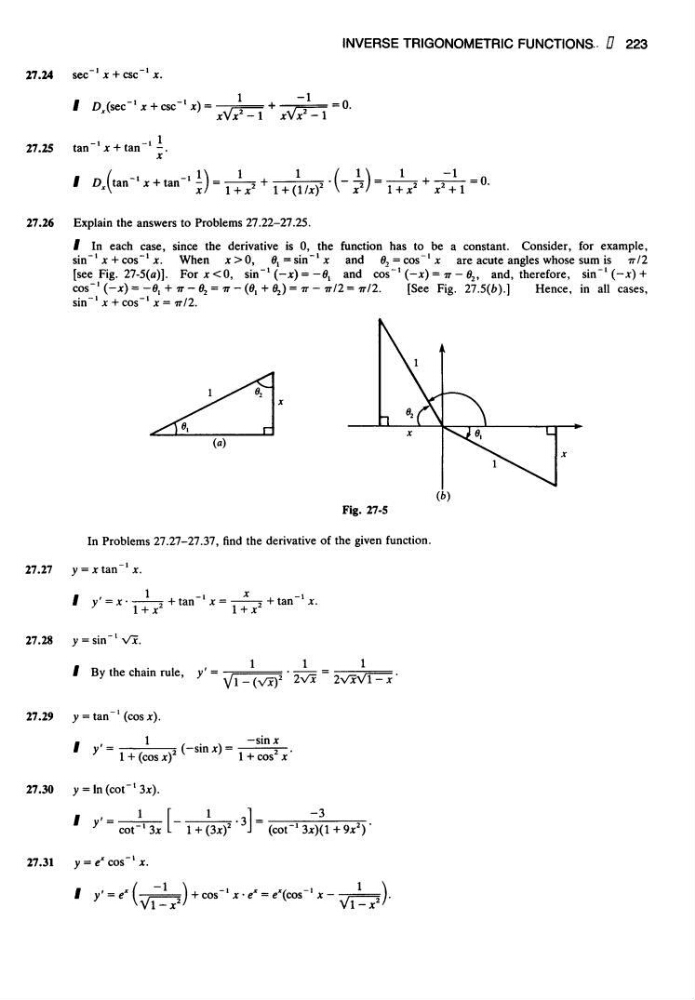
Explain the answers to Problems 27.22-27.25
In each case, since the derivative is 0, the function has to be a constant. Consider, for example,
sin"
1 x + cos~' x. When x>0, 8 l =sin~
l x and 0 2 = cos~
l x are acute angles whose sum is irl2
[see Fig. 27-5(a)]. For*<0, sin'
1 (-*)= -$ l and cos~' (-x) = u- - 0 2 , and, therefore, sin'
1 (-AT) +
cos~'(-Ac)=-e, + 7r-0 2 = 7r-(0, + 0 2 ) = 7r-77-/2=7r/2.
[See Fig. 27.5(i>).]
Hence, in all cases,
sin"
1 x + cos"
1 x = ir/2.
In Problems 27.27-27.37, find the derivative of the given function.
Fig. 27-5
By the chain rule,
y = tan ' (cos x).
y = \n (cot ' 3*).
y = e* cos ' x.
y = sin ' Vx.
y = x tan jc.
sec
J A: + esc
] x.
tan
T A: + tan
1
223
27.24
27.25
27.26
27.27
27.28
27.29
27.30
27.31
Explain the answers to Problems 27.22-27.25
In each case, since the derivative is 0, the function has to be a constant. Consider, for example,
sin"
1 x + cos~' x. When x>0, 8 l =sin~
l x and 0 2 = cos~
l x are acute angles whose sum is irl2
[see Fig. 27-5(a)]. For*<0, sin'
1 (-*)= -$ l and cos~' (-x) = u- - 0 2 , and, therefore, sin'
1 (-AT) +
cos~'(-Ac)=-e, + 7r-0 2 = 7r-(0, + 0 2 ) = 7r-77-/2=7r/2.
[See Fig. 27.5(i>).]
Hence, in all cases,
sin"
1 x + cos"
1 x = ir/2.
In Problems 27.27-27.37, find the derivative of the given function.
Fig. 27-5
By the chain rule,
y = tan ' (cos x).
y = \n (cot ' 3*).
y = e* cos ' x.
y = sin ' Vx.
y = x tan jc.
sec
J A: + esc
] x.
tan
T A: + tan
1