

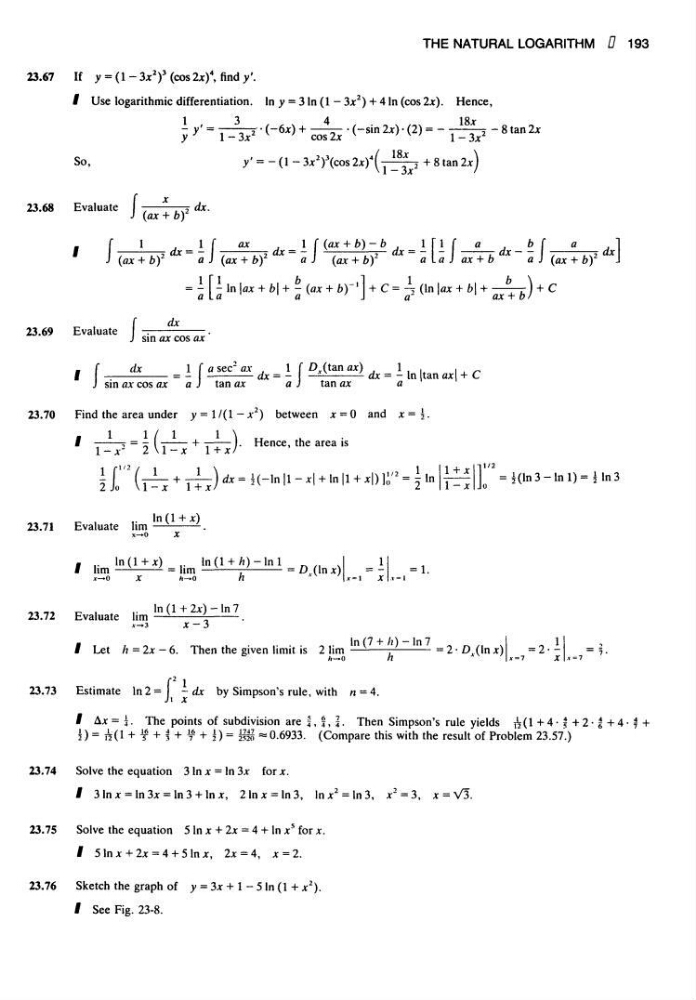
THE NATURAL LOGARITHM 0 193
So,
23.68 Evaluate
23.69
Evaluate
23.71
Evaluate
23.72
Evaluate
23.75
Solve the equation 5 In x + 2x = 4 + In x
5 for x.
5In x + 2x = 4 + 5 Inx, 2x = 4, x=2.
23.76
Sketch the graph of y = 3x + 1 - 5 In (1 + x
2 ).
See Fig. 23-8.
23.74
Solve the equation 3 In x = In 3* for x.
3 In x = In 3x = In 3 + In x, 2 In x = In 3, In x
2 = In 3, x
2 = 3, x = VI.
The points of subdivision are
Then Simpson's rule yields
(Compare this with the result of Problem 23.57.)
23.73 Estimate In 2 =
by Simpson's rule, with n = 4.
Let h=2x-f,. Then the given limit is
23.67
If y = (1 - 3x
2 )
3 (cos 2x)\ find y'.
Use logarithmic differentiation. In y = 3 In (1 - 3x
2 ) + 4 In (cos 2x). Hence,
In
In
In
In
In
In
23.70 find the area under
between
and
Hence, the area is
In
So,
23.68 Evaluate
23.69
Evaluate
23.71
Evaluate
23.72
Evaluate
23.75
Solve the equation 5 In x + 2x = 4 + In x
5 for x.
5In x + 2x = 4 + 5 Inx, 2x = 4, x=2.
23.76
Sketch the graph of y = 3x + 1 - 5 In (1 + x
2 ).
See Fig. 23-8.
23.74
Solve the equation 3 In x = In 3* for x.
3 In x = In 3x = In 3 + In x, 2 In x = In 3, In x
2 = In 3, x
2 = 3, x = VI.
The points of subdivision are
Then Simpson's rule yields
(Compare this with the result of Problem 23.57.)
23.73 Estimate In 2 =
by Simpson's rule, with n = 4.
Let h=2x-f,. Then the given limit is
23.67
If y = (1 - 3x
2 )
3 (cos 2x)\ find y'.
Use logarithmic differentiation. In y = 3 In (1 - 3x
2 ) + 4 In (cos 2x). Hence,
In
In
In
In
In
In
23.70 find the area under
between
and
Hence, the area is
In