

CHAPTER 22
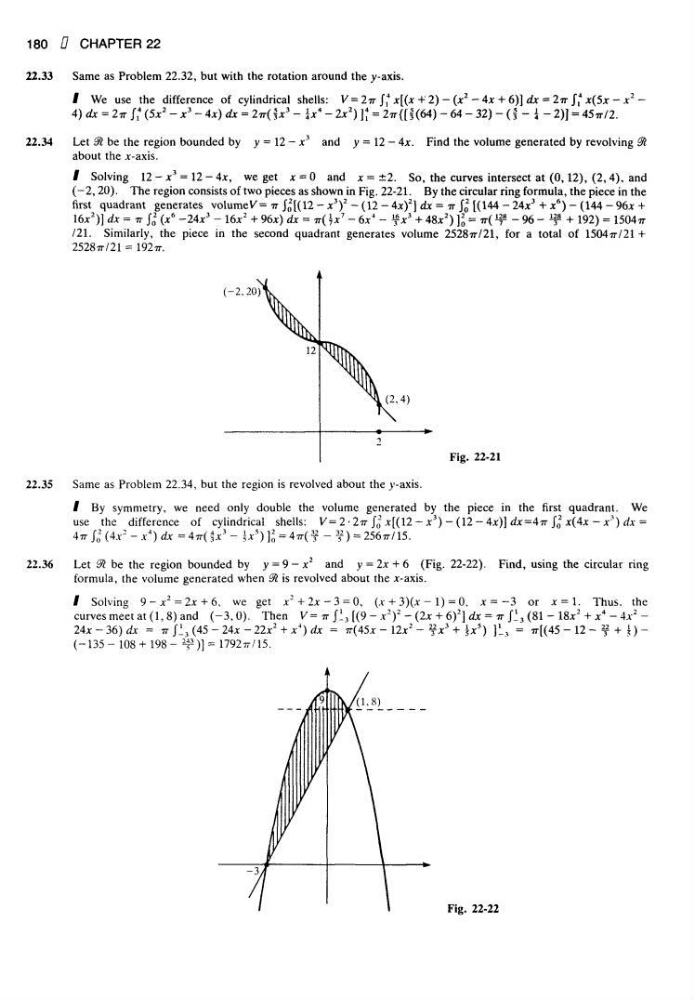
Fig. 22-21
22.35
Same as Problem 22.34, but the region is revolved about the y-axis.
Fig. 22-22
180
22.33
Same as Problem 22.32, but with the rotation around the y-axis.
22.34
Let 9? be the region bounded by y = 12- x
3 and y = 12 — 4x. Find the volume generated by revolving 91
about the jt-axis.
22.36
Let &i be the region bounded by y = 9 - x
2
and y = 2x + 6 (Fig. 22-22). Find, using the circular ring
formula, the volume generated when 2fl is revolved about the x-axis.
Solving 9 - x
2 =2*+ 6, we get x
2 + 2*-3 = 0, (.v + 3)(* - 1) = 0, x = -3 or x = l. Thus, the
curves meet at (1,8) and (-3,0). Then V= 77 J13 [(9 - x2)2 - (2x + 6)2] dx = 77 J13 (81 - 18*2 + x* - 4x2 -
24;t - 36) (it = 77 J13 (45 - 24x - 22x2 + *4) rf* = 77(45* - 12x2 - f x3 + ^5) ]!_, = 7r[(45 - 12 - f + i) -
(-135- 108 + 1981
?)] = 179277/15.
By symmetry, we need only double the volume generated by the piece in the first quadrant. We
use the difference of cylindrical shells: V= 2-277 J
2 x[(l2 - jc
3 ) - (12- 4x)] dx=4Tt J
2 x(4x - x
3 ) dx =
477 Jj (4.V2 - .V4) dx = 477(|X3 - i.V5) ]' = 47T(f - f ) = 25677/15.
Solving 12 - x3 = 12 - 4x, we get x = 0 and x = ±2. So, the curves intersect at (0,12), (2, 4), and
(-2,20). The region consists of two pieces as shown in Fig. 22-21. By the circular ring formula, the piece in the
first quadrant generates volumeV= TT J 0
2 [(12-x
3 )
2 -(12 -4x)
2 ] dx = TT J 0
2 [(144 -24jc
3 + x
6 ) - (144 -96* +
16*2)] dx = 77 J2 (x6 -24x3 - 16*2 + 96*) dx = ir( $x7 - 6x4 - ^x3 + 48x2) ]2 = *r( ^ - 96 - ^ + 192) = 150477
/21. Similarly, the piece in the second quadrant generates volume 252877/21, for a total of 150477/21 +
252877/21 = 19277.
We use the difference of cylindrical shells: V=277 J,4 x[(x + 2) - (x2 -4x + 6)] dx = 2ir J,4 x(5x - x2 -
4) dx = 277 j\4 (5*2 - x3 - 4x) dx = 2ir( §*3 - \x* - 2x2) ]* = 27r{[f (64) - 64 - 32) - (f - \ - 2)] = 4577/2.
Fig. 22-21
22.35
Same as Problem 22.34, but the region is revolved about the y-axis.
Fig. 22-22
180
22.33
Same as Problem 22.32, but with the rotation around the y-axis.
22.34
Let 9? be the region bounded by y = 12- x
3 and y = 12 — 4x. Find the volume generated by revolving 91
about the jt-axis.
22.36
Let &i be the region bounded by y = 9 - x
2
and y = 2x + 6 (Fig. 22-22). Find, using the circular ring
formula, the volume generated when 2fl is revolved about the x-axis.
Solving 9 - x
2 =2*+ 6, we get x
2 + 2*-3 = 0, (.v + 3)(* - 1) = 0, x = -3 or x = l. Thus, the
curves meet at (1,8) and (-3,0). Then V= 77 J13 [(9 - x2)2 - (2x + 6)2] dx = 77 J13 (81 - 18*2 + x* - 4x2 -
24;t - 36) (it = 77 J13 (45 - 24x - 22x2 + *4) rf* = 77(45* - 12x2 - f x3 + ^5) ]!_, = 7r[(45 - 12 - f + i) -
(-135- 108 + 1981
?)] = 179277/15.
By symmetry, we need only double the volume generated by the piece in the first quadrant. We
use the difference of cylindrical shells: V= 2-277 J
2 x[(l2 - jc
3 ) - (12- 4x)] dx=4Tt J
2 x(4x - x
3 ) dx =
477 Jj (4.V2 - .V4) dx = 477(|X3 - i.V5) ]' = 47T(f - f ) = 25677/15.
Solving 12 - x3 = 12 - 4x, we get x = 0 and x = ±2. So, the curves intersect at (0,12), (2, 4), and
(-2,20). The region consists of two pieces as shown in Fig. 22-21. By the circular ring formula, the piece in the
first quadrant generates volumeV= TT J 0
2 [(12-x
3 )
2 -(12 -4x)
2 ] dx = TT J 0
2 [(144 -24jc
3 + x
6 ) - (144 -96* +
16*2)] dx = 77 J2 (x6 -24x3 - 16*2 + 96*) dx = ir( $x7 - 6x4 - ^x3 + 48x2) ]2 = *r( ^ - 96 - ^ + 192) = 150477
/21. Similarly, the piece in the second quadrant generates volume 252877/21, for a total of 150477/21 +
252877/21 = 19277.
We use the difference of cylindrical shells: V=277 J,4 x[(x + 2) - (x2 -4x + 6)] dx = 2ir J,4 x(5x - x2 -
4) dx = 277 j\4 (5*2 - x3 - 4x) dx = 2ir( §*3 - \x* - 2x2) ]* = 27r{[f (64) - 64 - 32) - (f - \ - 2)] = 4577/2.