

178
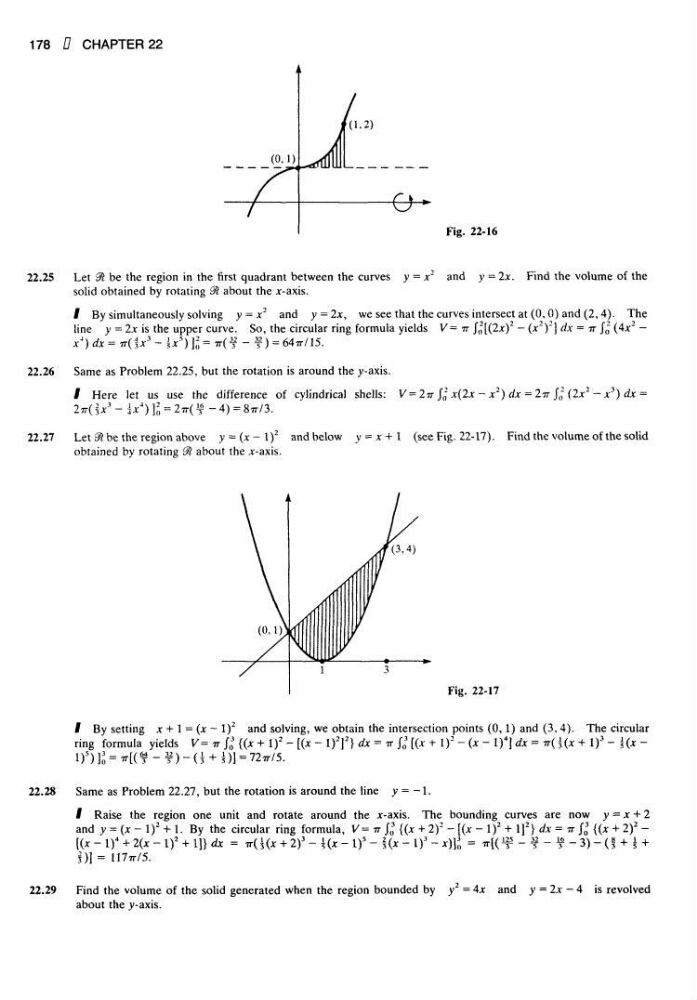
Fig. 22-16
22.25 Let 91 be the region in the first quadrant between the curves y = x
2
and y = 1x. Find the volume of the
solid obtained by rotating 3? about the jc-axis.
By simultaneously solving y = x
2
and y = 2x, we see that the curves intersect at (0,0) and (2,4). The
line y = 2x is the upper curve. So, the circular ring formula yields V= -n Jo[(2*)
2 - (x~)~] dx = ir $„ (4x
2 —
x
4 ) dx = ir(tx
3 - ±x
5 ) ]
2 = TT(¥ - f) = 6477/15.
22.26
Same as Problem 22.25, but the rotation is around the y-axis.
Here let us use the difference of cylindrical shells: V—2-n J 0
2 x(2x — x
2 ) dx =2ir Jj (2x~ — x*) dx =
27r(f.r'-^
4 )]^ = 27r(¥-4) = 87r/3.
22.27
Let 3? be the region above y = (x - I)
2
and below y = x + 1 (see Fig. 22-17). Find the volume of the solid
obtained by rotating SI about the ;t-axis.
Fig. 22-17
22.28
Same as Problem 22.27, but the rotation is around the line y = -I.
22.29
Find the volume of the solid generated when the region bounded by y
2 = 4* and y = 2x - 4 is revolved
about the y-axis.
CHAPTER 22
Raise the region one unit and rotate around the x-axis. The bounding curves are now y = x 4- 2
and y = (x - I)
2 + 1. By the circular ring formula, V= TT J
3 {(x + 2)' - [(x - I)
2 + I]
2 } dx = TT /
3 {(x + 2)
2 -
(( X -iy + 2(x-iy + i]}dx = 7rO(* + 2)
3
-u*-i)
5
-f(*-i)
3
-*))o = ^[(
i
f
5
-¥-¥-3)-n + 5 +
3)1 = 1177T/5.
By setting x + 1 = (x — I)
2 and solving, we obtain the intersection points (0,1) and (3,4). The circular
ring formula yields V= TT | 0
3 {(x + I)
2 - [(x - I)
2 ]
2 } dx = ir J 0
3 [(x + if - (x - I)
4 ] dx = IT( \(x + I)
3 - $(x -
I)
5 ) ]2 = »K¥-¥)-(i + i)] = 72^/5.
Fig. 22-16
22.25 Let 91 be the region in the first quadrant between the curves y = x
2
and y = 1x. Find the volume of the
solid obtained by rotating 3? about the jc-axis.
By simultaneously solving y = x
2
and y = 2x, we see that the curves intersect at (0,0) and (2,4). The
line y = 2x is the upper curve. So, the circular ring formula yields V= -n Jo[(2*)
2 - (x~)~] dx = ir $„ (4x
2 —
x
4 ) dx = ir(tx
3 - ±x
5 ) ]
2 = TT(¥ - f) = 6477/15.
22.26
Same as Problem 22.25, but the rotation is around the y-axis.
Here let us use the difference of cylindrical shells: V—2-n J 0
2 x(2x — x
2 ) dx =2ir Jj (2x~ — x*) dx =
27r(f.r'-^
4 )]^ = 27r(¥-4) = 87r/3.
22.27
Let 3? be the region above y = (x - I)
2
and below y = x + 1 (see Fig. 22-17). Find the volume of the solid
obtained by rotating SI about the ;t-axis.
Fig. 22-17
22.28
Same as Problem 22.27, but the rotation is around the line y = -I.
22.29
Find the volume of the solid generated when the region bounded by y
2 = 4* and y = 2x - 4 is revolved
about the y-axis.
CHAPTER 22
Raise the region one unit and rotate around the x-axis. The bounding curves are now y = x 4- 2
and y = (x - I)
2 + 1. By the circular ring formula, V= TT J
3 {(x + 2)' - [(x - I)
2 + I]
2 } dx = TT /
3 {(x + 2)
2 -
(( X -iy + 2(x-iy + i]}dx = 7rO(* + 2)
3
-u*-i)
5
-f(*-i)
3
-*))o = ^[(
i
f
5
-¥-¥-3)-n + 5 +
3)1 = 1177T/5.
By setting x + 1 = (x — I)
2 and solving, we obtain the intersection points (0,1) and (3,4). The circular
ring formula yields V= TT | 0
3 {(x + I)
2 - [(x - I)
2 ]
2 } dx = ir J 0
3 [(x + if - (x - I)
4 ] dx = IT( \(x + I)
3 - $(x -
I)
5 ) ]2 = »K¥-¥)-(i + i)] = 72^/5.