

176
Fig. 22-12
Fig. 22-13
CHAPTER 22
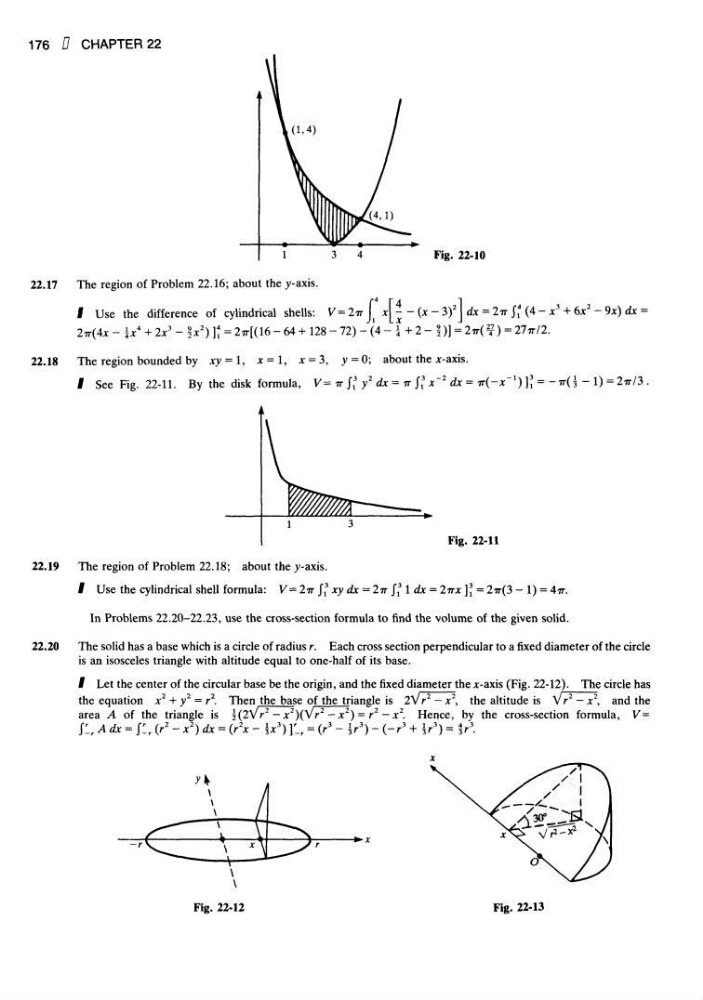
Fig. 22-10
22.17
The region of Problem 22.16; about the y-axis.
Use the difference of cylindrical shells:
22.18
The region bounded by xy = l, x = l, * = 3, v=0; about the x-axis.
See Fig. 22-11. By the disk formula,
Fig. 22-11
22.19
The region of Problem 22.18; about the y-axis.
Use the cylindrical shell formula:
In Problems 22.20-22.23, use the cross-section formula to find the volume of the given solid.
22.20
The solid has a base which is a circle of radius r. Each cross section perpendicular to a fixed diameter of the circle
is an isosceles triangle with altitude equal to one-half of its base.
Let the center of the circular base be the origin, and the fixed diameter the x-axis (Fig. 22-12). The circle has
the eauation x
2 + v
2 = r
2 . Then the base of the trianele is
the altitude is
and the
area A of the trianele is
Hence, by the cross-section formula,
Fig. 22-12
Fig. 22-13
CHAPTER 22
Fig. 22-10
22.17
The region of Problem 22.16; about the y-axis.
Use the difference of cylindrical shells:
22.18
The region bounded by xy = l, x = l, * = 3, v=0; about the x-axis.
See Fig. 22-11. By the disk formula,
Fig. 22-11
22.19
The region of Problem 22.18; about the y-axis.
Use the cylindrical shell formula:
In Problems 22.20-22.23, use the cross-section formula to find the volume of the given solid.
22.20
The solid has a base which is a circle of radius r. Each cross section perpendicular to a fixed diameter of the circle
is an isosceles triangle with altitude equal to one-half of its base.
Let the center of the circular base be the origin, and the fixed diameter the x-axis (Fig. 22-12). The circle has
the eauation x
2 + v
2 = r
2 . Then the base of the trianele is
the altitude is
and the
area A of the trianele is
Hence, by the cross-section formula,