

168
CHAPTER 21
21.24
Find the area of the region between the jc-axis and y = (x — I)
3 from x = 0 to x = 2.
Fig. 21-19
Fig. 21-20
21.25
Find the area bounded by the curves y = 3x
2 — 2x and y = 1 — 4x.
21.26
Find the area of the region bounded by the curves y = x
2 — 4x and x + y = 0.
Fig. 21-21
Fig. 21-22
21.27
Find the area of the bounded region between the curve y = x
3 — 6x
2 + 8x and the x-axis.
y = x
3 - 6x
2 + 8x = x(x
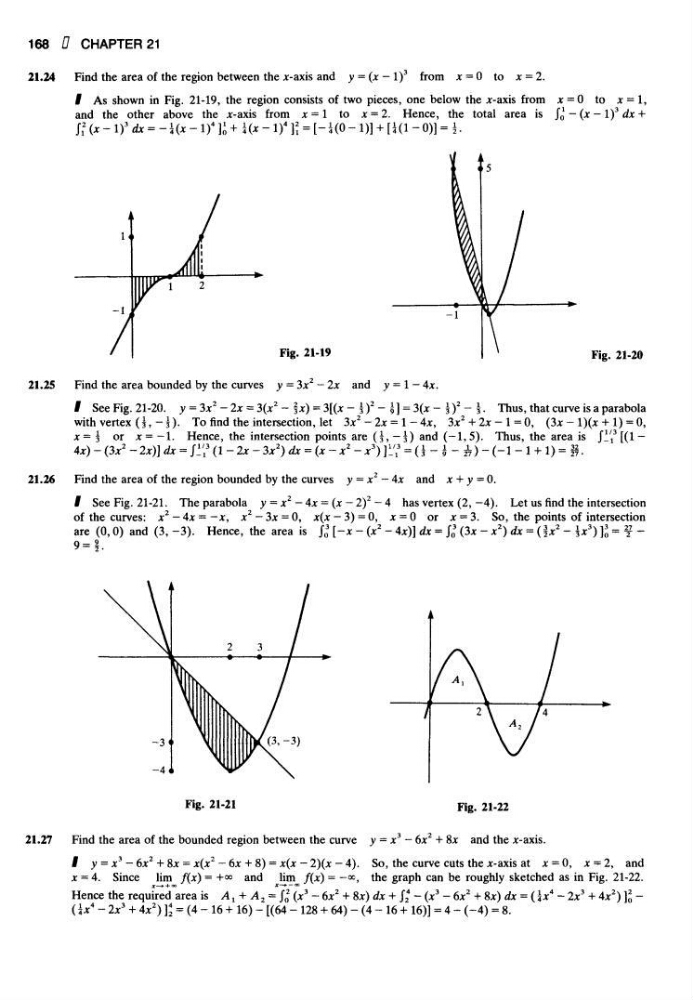
2 - 6x + 8) = x(x - 2)(x - 4). So, the curve cuts the x-axis at x = 0, x = 2, and
x = 4. Since Km f(x) = +°° and lim f(x) = —<*, the graph can be roughly sketched as in Fig. 21-22.
Hence the required area is A, + A2 = Jo (x3 - 6x2 + 8x) dx + J2 - (x3 - 6x2 + 8x)dx = ( \x4 - 2x3 + 4x2) ]„ -
( \x4 - 2x3 + 4x2) ]42 = (4 - 16 + 16) - [(64 - 128 + 64) - (4 - 16 + 16)] = 4 - (-4) = 8.
See Fig. 21-20. y = 3x2 - 2x = 3(x2 - \x) = 3[(* - \)2 - 5] = 3(x - |)2 - \. Thus, that curve is a parabola
with vertex (i,-j)- To find the intersection, let 3x2 - 2x = 1 - 4x, 3x2 + 2x - 1 = 0, (3x - l)(x + 1) = 0,
x= j or x=—\. Hence, the intersection points are (5, —3) and (—1,5). Thus, the area is Jlj3 [(1 —
4X)-(3XX)]dx = S1-?(l-2x-3x2)dX = (X-X)]^ = (li-%-lf)-(-l-l + l)=%.
See Fig. 21-21. The parabola y = x
2 - 4x = (x - 2)
2 - 4 has vertex (2, -4). Let us find the intersection
of the curves: x
2 — 4x = —x, x
2 — 3x = 0, x(x — 3) = 0, x = 0 or x = 3. So, the points of intersection
are (0,0) and (3, -3). Hence, the area is J 0
3 [-x - (x
2 - 4x)] dx = J 0
3 (3* - x
2 ) dx = (|x
2 - 3 x
3 ) ]
3 = ¥ -
9=|.
As shown in Fig. 21-19, the region consists of two pieces, one below the *-axis from x = Q to x = 1,
and the other above the jc-axis from x — 1 to x = 2. Hence, the total area is Jo — (x — I)
3 dx +
; 1
2
(^-i)
3
dx = -Ux-i)
4
]o+U^-i)
4
]i = [-Uo-i)] + [i(i-o)] = i.
CHAPTER 21
21.24
Find the area of the region between the jc-axis and y = (x — I)
3 from x = 0 to x = 2.
Fig. 21-19
Fig. 21-20
21.25
Find the area bounded by the curves y = 3x
2 — 2x and y = 1 — 4x.
21.26
Find the area of the region bounded by the curves y = x
2 — 4x and x + y = 0.
Fig. 21-21
Fig. 21-22
21.27
Find the area of the bounded region between the curve y = x
3 — 6x
2 + 8x and the x-axis.
y = x
3 - 6x
2 + 8x = x(x
2 - 6x + 8) = x(x - 2)(x - 4). So, the curve cuts the x-axis at x = 0, x = 2, and
x = 4. Since Km f(x) = +°° and lim f(x) = —<*, the graph can be roughly sketched as in Fig. 21-22.
Hence the required area is A, + A2 = Jo (x3 - 6x2 + 8x) dx + J2 - (x3 - 6x2 + 8x)dx = ( \x4 - 2x3 + 4x2) ]„ -
( \x4 - 2x3 + 4x2) ]42 = (4 - 16 + 16) - [(64 - 128 + 64) - (4 - 16 + 16)] = 4 - (-4) = 8.
See Fig. 21-20. y = 3x2 - 2x = 3(x2 - \x) = 3[(* - \)2 - 5] = 3(x - |)2 - \. Thus, that curve is a parabola
with vertex (i,-j)- To find the intersection, let 3x2 - 2x = 1 - 4x, 3x2 + 2x - 1 = 0, (3x - l)(x + 1) = 0,
x= j or x=—\. Hence, the intersection points are (5, —3) and (—1,5). Thus, the area is Jlj3 [(1 —
4X)-(3XX)]dx = S1-?(l-2x-3x2)dX = (X-X)]^ = (li-%-lf)-(-l-l + l)=%.
See Fig. 21-21. The parabola y = x
2 - 4x = (x - 2)
2 - 4 has vertex (2, -4). Let us find the intersection
of the curves: x
2 — 4x = —x, x
2 — 3x = 0, x(x — 3) = 0, x = 0 or x = 3. So, the points of intersection
are (0,0) and (3, -3). Hence, the area is J 0
3 [-x - (x
2 - 4x)] dx = J 0
3 (3* - x
2 ) dx = (|x
2 - 3 x
3 ) ]
3 = ¥ -
9=|.
As shown in Fig. 21-19, the region consists of two pieces, one below the *-axis from x = Q to x = 1,
and the other above the jc-axis from x — 1 to x = 2. Hence, the total area is Jo — (x — I)
3 dx +
; 1
2
(^-i)
3
dx = -Ux-i)
4
]o+U^-i)
4
]i = [-Uo-i)] + [i(i-o)] = i.