

158
CHAPTER 20
20.59 If g is continuous, which of the following integrals are equal?
Let M = x — 1, du = dx.
Then
Then
Thus, all three integrals are equal to each other.
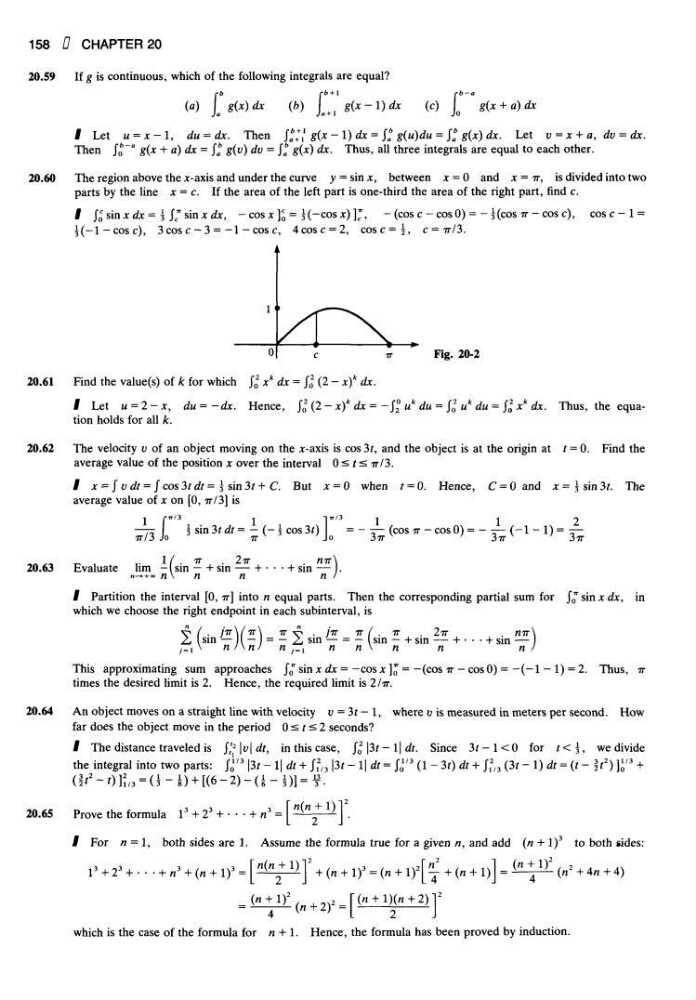
20.60 The region above the x-axis and under the curve y = sinjc, between x = 0 and x = IT, is divided into two
parts by the line x = c. If the area of the left part is one-third the area of the right part, find c.
Fig. 20-2
20.61 Find the value(s) of k for which
Let u — 2 — x, du = —dx
tion holds for all k.
Hence,
Thus, the equa20.62 The velocity v of an object moving on the x-axis is cos 3t, and the object is at the origin at t — 0. Find the
average value of the position x over the interval 0 < t < Tr/3.
average value of x on [0, Tr/3] is
But x = 0 when t = 0. Hence, C = 0 and x = % sin 3t. The
20.63 Evaluate
Partition the interval [0, IT] into n equal parts. Then the corresponding partial sum for
in
which we choose the right endpoint in each subinterval, is
This approximating sum approaches
Thus, 77
times the desired limit is 2. Hence, the required limit is 2lir.
20.64 An object moves on a straight line with velocity v=3t — 1, where v is measured in meters per second. How
far does the object move in the period 0 < t •& 2 seconds?
The distance traveled is
in this case,
Since
for
we divide
the integral into two parts:
20.65
Prove the formula I
3 + 2
3 + • • • + n
3 =
For n = l, both sides are 1. Assume the formula true for a given n, and add (« +1)
3 to both sides:
which is the case of the formula for n + 1. Hence, the formula has been proved by induction.
Let v = x + a, dv = dx.
(«)
(b)
(c)
g(x -1) dx
g(x + a) dx
g« dx
g(x -l)dx = g(u)du = g(x) dx.
g(x + a)dx = g(v) dv = g(x) dx.
sin x dx = 5 sin x dx, — cos x = j(-cosx)
— (cos c — cos0) = - j(cos TT - cos c), cos c - 1 =
i(-l-cosc), 3cose-3 =-1-cose, 4cose = 2, cose =5, c=7r/3.
x
k dx = (2 - x)
k dx.
(2-x)
k dx=u"du = u
k du = x
k dx.
sinxdx= -cos* ]" = -(cos IT -cosO) = -(-1 - 1) = 2.
sin x dx,
x = vdt = cos 3t dt = sin 3t + C.
CHAPTER 20
20.59 If g is continuous, which of the following integrals are equal?
Let M = x — 1, du = dx.
Then
Then
Thus, all three integrals are equal to each other.
20.60 The region above the x-axis and under the curve y = sinjc, between x = 0 and x = IT, is divided into two
parts by the line x = c. If the area of the left part is one-third the area of the right part, find c.
Fig. 20-2
20.61 Find the value(s) of k for which
Let u — 2 — x, du = —dx
tion holds for all k.
Hence,
Thus, the equa20.62 The velocity v of an object moving on the x-axis is cos 3t, and the object is at the origin at t — 0. Find the
average value of the position x over the interval 0 < t < Tr/3.
average value of x on [0, Tr/3] is
But x = 0 when t = 0. Hence, C = 0 and x = % sin 3t. The
20.63 Evaluate
Partition the interval [0, IT] into n equal parts. Then the corresponding partial sum for
in
which we choose the right endpoint in each subinterval, is
This approximating sum approaches
Thus, 77
times the desired limit is 2. Hence, the required limit is 2lir.
20.64 An object moves on a straight line with velocity v=3t — 1, where v is measured in meters per second. How
far does the object move in the period 0 < t •& 2 seconds?
The distance traveled is
in this case,
Since
for
we divide
the integral into two parts:
20.65
Prove the formula I
3 + 2
3 + • • • + n
3 =
For n = l, both sides are 1. Assume the formula true for a given n, and add (« +1)
3 to both sides:
which is the case of the formula for n + 1. Hence, the formula has been proved by induction.
Let v = x + a, dv = dx.
(«)
(b)
(c)
g(x -1) dx
g(x + a) dx
g« dx
g(x -l)dx = g(u)du = g(x) dx.
g(x + a)dx = g(v) dv = g(x) dx.
sin x dx = 5 sin x dx, — cos x = j(-cosx)
— (cos c — cos0) = - j(cos TT - cos c), cos c - 1 =
i(-l-cosc), 3cose-3 =-1-cose, 4cose = 2, cose =5, c=7r/3.
x
k dx = (2 - x)
k dx.
(2-x)
k dx=u"du = u
k du = x
k dx.
sinxdx= -cos* ]" = -(cos IT -cosO) = -(-1 - 1) = 2.
sin x dx,
x = vdt = cos 3t dt = sin 3t + C.