

19.54
Find
ANTIDERIVATIVES (INDEFINITE INTEGRALS)
147
19.52
Evaluate
19.53
Evaluate
Let u = tan x, du = sec
2 x dx. Then
Let u = x
2 + 25, du = 2xdx. Note that x
2 = u-25. Then
19.55
Find J tan
2 0 sec
j 0 d6.
19.56
Find J cos
3 5x sin
2 5* dx.
19.57
A particle moves on a straight line with velocity v = (4 — 2r)
3
at time t. Find the distance traveled from
r = 0 to t = 3.
19.58
Find J (2*' + x)(x
4 + x
2 + 1 )
J9
A space ship is moving in a straight line at 36,000 miles per second. Suddenly it accelerates at a = I8t mi/s
2 .
Assume that the speed of light is 180,000 mi/s and that relativistic effects do not influence the velocity of the space
ship. How long does it take the ship to reach the speed of light and how far does it travel during that time?
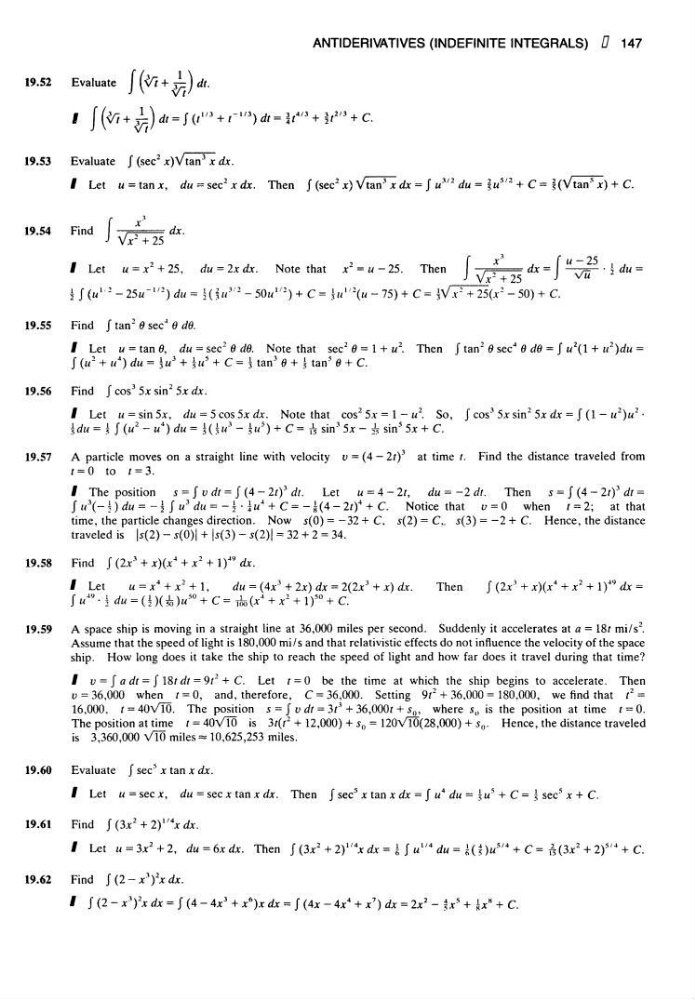
v = J a dt = J 18/ dt = 9r + C. Let r = 0 be the time at which the ship begins to accelerate. Then
y = 36,000 when t = 0, and, therefore, C = 36,000. Setting 9r + 36,000 = 180,000, we find that t
2 =
16,000, r = 40VTO. The position s = J v dt = 3f
3 + 36,000r + s 0 , where s 0 is the position at time r = 0.
The position at time t = 40VTS is 3r(r + 12,000) + s n = 120VIO(28,000) + s 0 . Hence, the distance traveled
is 3,360,000 VlO miles = 10,625,253 miles.
19.60
Evaluate J sec
5 x tan x dx.
Let M = sec x, du = sec x tan x dx. Then J sec
5 x tan x dx = J w
4 rfu = j u
5 + C = 5 sec
5 X + C.
19.61
Find J(3jc
2 + 2)
1M jc&.
Let u = 3x2+2, du = 6xdx. Then J (3*2 + 2)"4x rf* = | J M
1/4
19.62 Find J (2- x3)2xdx.
Let
W^' + JT+ 1, rfw = (4A3 + 2x) dx = 2(2x
3 + x) dx.
Then
J (2x
3 + x)(x
4 + x
2 + I)
49 dx =
J «
49 - i rf« = (i)(i )«
50 + C = Tfe(x" + x
2 + I)
50 + C.
Let u = sin 5*, du = 5 cos 5x dx. Note that cos
2 5,v = 1 — u
2 . So, J cos
3 5x sin
2 5x dx = J (1 — u
2 )u
2 •
i
s du = £ $(u
2 -u
4 )du= KV- s«
5 )+C = £sin
3 5x- ^ sin
5 5x + C.
Let w = tanfl, du = sec
2 6d6. Note that sec
2 6 = 1 + u
2 . Then J tan
2 6 sec
4 0 dfl = J w
2 (l + u
2 )du =
J (u2 + M4) du = l,u3 + ^MS + C = | tan3 0 + | tan5 0 + C.
J (2 - jc3)2:c dx = J (4 - 4x3 + X")x dx = $ (4x - 4x* + x7) dx = 2x2 - *.v5 + ^8 + C.
The position s = / i; dt = J (4 - 2t)
3 dt. Let u = 4-2t,
du=-2dt. Then s = J (4 - 2f)
3 dt =
jV(-:l)dw = -i Jw
3 Ju=-|- |M
4 + C=-|(4-2r)
4 + C. Notice that u = 0 when f = 2; at that
time, the particle changes direction. Now s(0) = -32+C, 5(2) = C,. 5(3) =-2 + C. Hence, the distance
traveled is |s(2) - s(0)| + J5(3) - s(2)\ = 32 + 2 = 34.
J (sec2 jt)Vtan3 x dx.
Find
ANTIDERIVATIVES (INDEFINITE INTEGRALS)
147
19.52
Evaluate
19.53
Evaluate
Let u = tan x, du = sec
2 x dx. Then
Let u = x
2 + 25, du = 2xdx. Note that x
2 = u-25. Then
19.55
Find J tan
2 0 sec
j 0 d6.
19.56
Find J cos
3 5x sin
2 5* dx.
19.57
A particle moves on a straight line with velocity v = (4 — 2r)
3
at time t. Find the distance traveled from
r = 0 to t = 3.
19.58
Find J (2*' + x)(x
4 + x
2 + 1 )
J9
A space ship is moving in a straight line at 36,000 miles per second. Suddenly it accelerates at a = I8t mi/s
2 .
Assume that the speed of light is 180,000 mi/s and that relativistic effects do not influence the velocity of the space
ship. How long does it take the ship to reach the speed of light and how far does it travel during that time?
v = J a dt = J 18/ dt = 9r + C. Let r = 0 be the time at which the ship begins to accelerate. Then
y = 36,000 when t = 0, and, therefore, C = 36,000. Setting 9r + 36,000 = 180,000, we find that t
2 =
16,000, r = 40VTO. The position s = J v dt = 3f
3 + 36,000r + s 0 , where s 0 is the position at time r = 0.
The position at time t = 40VTS is 3r(r + 12,000) + s n = 120VIO(28,000) + s 0 . Hence, the distance traveled
is 3,360,000 VlO miles = 10,625,253 miles.
19.60
Evaluate J sec
5 x tan x dx.
Let M = sec x, du = sec x tan x dx. Then J sec
5 x tan x dx = J w
4 rfu = j u
5 + C = 5 sec
5 X + C.
19.61
Find J(3jc
2 + 2)
1M jc&.
Let u = 3x2+2, du = 6xdx. Then J (3*2 + 2)"4x rf* = | J M
1/4
19.62 Find J (2- x3)2xdx.
Let
W^' + JT+ 1, rfw = (4A3 + 2x) dx = 2(2x
3 + x) dx.
Then
J (2x
3 + x)(x
4 + x
2 + I)
49 dx =
J «
49 - i rf« = (i)(i )«
50 + C = Tfe(x" + x
2 + I)
50 + C.
Let u = sin 5*, du = 5 cos 5x dx. Note that cos
2 5,v = 1 — u
2 . So, J cos
3 5x sin
2 5x dx = J (1 — u
2 )u
2 •
i
s du = £ $(u
2 -u
4 )du= KV- s«
5 )+C = £sin
3 5x- ^ sin
5 5x + C.
Let w = tanfl, du = sec
2 6d6. Note that sec
2 6 = 1 + u
2 . Then J tan
2 6 sec
4 0 dfl = J w
2 (l + u
2 )du =
J (u2 + M4) du = l,u3 + ^MS + C = | tan3 0 + | tan5 0 + C.
J (2 - jc3)2:c dx = J (4 - 4x3 + X")x dx = $ (4x - 4x* + x7) dx = 2x2 - *.v5 + ^8 + C.
The position s = / i; dt = J (4 - 2t)
3 dt. Let u = 4-2t,
du=-2dt. Then s = J (4 - 2f)
3 dt =
jV(-:l)dw = -i Jw
3 Ju=-|- |M
4 + C=-|(4-2r)
4 + C. Notice that u = 0 when f = 2; at that
time, the particle changes direction. Now s(0) = -32+C, 5(2) = C,. 5(3) =-2 + C. Hence, the distance
traveled is |s(2) - s(0)| + J5(3) - s(2)\ = 32 + 2 = 34.
J (sec2 jt)Vtan3 x dx.