

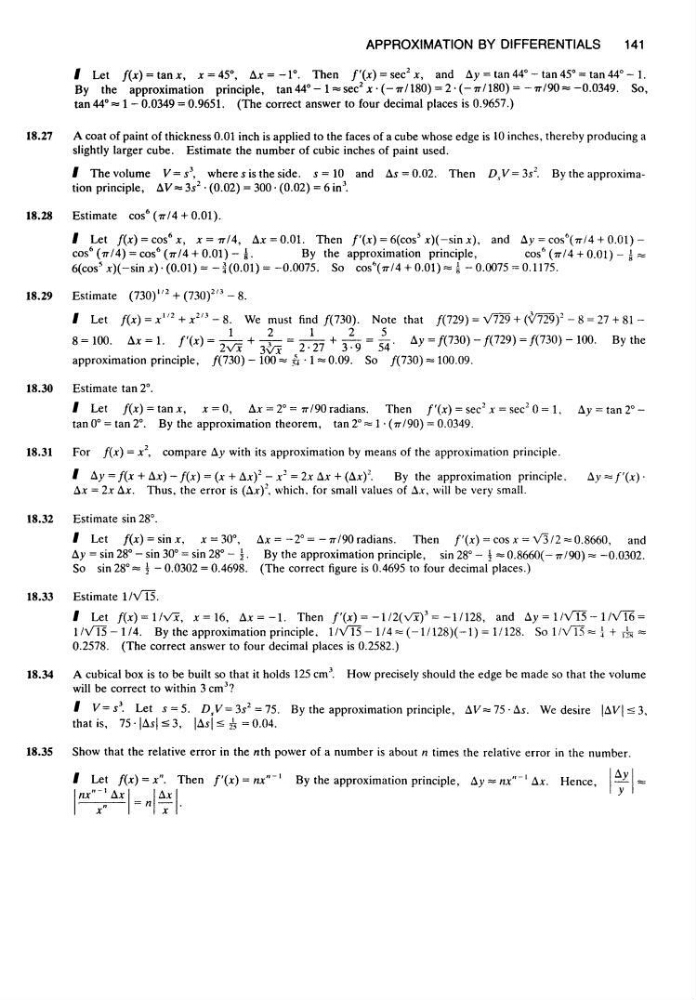
18.27
18.28
18.29
I Let f(x) = tanx, x = 45°, A*=-r. Then /'(*) = sec
2 x, and Ay = tan 44°-tan 45° = tan 44°-1.
By the approximation principle, tan44°- 1 = sec
2 x-(-irt 180) = 2- (-TJ-/ 180) = -77/90 = -0.0349. So,
tan 44° == 1 - 0.0349 = 0.9651. (The correct answer to four decimal places is 0.9657.)
APPROXIMATION BY DIFFERENTIALS
141
A coat of paint of thickness 0.01 inch is applied to the faces of a cube whose edge is 10 inches, thereby producing a
slightly larger cube. Estimate the number of cubic inches of paint used.
I The volume V=s
3 , where 5 is the side. 5=10 and As = 0.02. Then D s V=3s
2 . By the approximation principle, AV=35
2 -(0.02) = 300-(0.02) = 6in
3 .
Estimate cos
6 (77/4+ 0.01).
Let f(x) = x
l '
2 + x
2 '*-8. We must find /(730). Note that /(729) =
approximation principle, /(730) - 100 ~ £ • 1« 0.09. So /(730) = 100.09.
By the
Estimate (730)"
2 + (730)
2 '
3 - 8.
8=100. Ajt=l. /'(*) =
Ay = /(730) - /(729) = /(730) - 100.
- 8 = 27 + 81 -
By the approximation principle, Ay » nx" ' Ax. Hence,
18.30
Estimate tan 2°.
18.31
For f(x) = x
2 , compare Ay with its approximation by means of the approximation principle.
18.32
Estimate sin 28°.
18.33
Estimate 1/VT3.
18.34
18.35
A cubical box is to be built so that it holds 125 cm
3
. How precisely should the edge be made so that the volume
will be correct to within 3 cm
3 ?
Show that the relative error in the nth power of a number is about n times the relative error in the number.
Let f(x) = x". Then /'(*) = nx"'
1
Let /(A:) = cos
6 x, x = ir/4, Ax = 0.01. Then /'(-*) = 6(cos
5 x)(-sin x), and Ay =cos
6 (7r/4 + 0.01)cos6 (ir/4) = cos6 (77/4+ 0.01) - g. By the approximation principle, cos6 (ir/4 + 0.01) - | =
6(cos
5 x)(-sin X) • (0.01) = -f(0.01) = -0.0075. So cos
6 (7r/4 + 0.01)= | -0.0075 = 0.1175.
Let /(jc) = tanjt, ^ = 0, AJC = 2° = 77/90 radians. Then f'(x) = sec
2 x = sec
2 0= 1, Ay = tan 2°tan0° = tan2°. By the approximation theorem, tan2°= 1 • (Tr/90) = 0.0349.
&y ~ /(* + Ax) - /(AT) = (A- + A*)2 - x2 = 2x Ax + (A*)2. By the approximation principle. Ay =/'(*)•
A* = 2x AJC. Thus, the error is (A*)
2
, which, for small values of A.v, will be very small.
Let f(x) = \IVx, A: = 16, A;c = -l. Then f'(x) = -l/2(VI)
3 = -1/128, and Ay = 1 /VT5- 1 /Vl6 =
1/VT3-1/4. By the approximation principle, 1/VT3-1/4 = (-1/128)(-1) = 1/128. So 1/VT3= \ + ^ «
0.2578. (The correct answer to four decimal places is 0.2582.)
V=s
3 . Let s = 5. D s V=3s
2 = 75. By the approximation principle, AF=75-A5. We desire |AV|<3,
that is, 75-|A5|<3, |Ai| < £ =0.04.
Let f(x) = sin x, x = 30°, AJC = -2° =- Tr/90 radians. Then /'(*) = cos x = V3/2 ==0.8660, and
Ay = sin 28° - sin 30° = sin 28° - {. By the approximation principle, sin 28° - k = 0.8660(- 77/90) = -0.0302.
So sin 28° = | - 0.0302 = 0.4698. (The correct figure is 0.4695 to four decimal"places.)
18.28
18.29
I Let f(x) = tanx, x = 45°, A*=-r. Then /'(*) = sec
2 x, and Ay = tan 44°-tan 45° = tan 44°-1.
By the approximation principle, tan44°- 1 = sec
2 x-(-irt 180) = 2- (-TJ-/ 180) = -77/90 = -0.0349. So,
tan 44° == 1 - 0.0349 = 0.9651. (The correct answer to four decimal places is 0.9657.)
APPROXIMATION BY DIFFERENTIALS
141
A coat of paint of thickness 0.01 inch is applied to the faces of a cube whose edge is 10 inches, thereby producing a
slightly larger cube. Estimate the number of cubic inches of paint used.
I The volume V=s
3 , where 5 is the side. 5=10 and As = 0.02. Then D s V=3s
2 . By the approximation principle, AV=35
2 -(0.02) = 300-(0.02) = 6in
3 .
Estimate cos
6 (77/4+ 0.01).
Let f(x) = x
l '
2 + x
2 '*-8. We must find /(730). Note that /(729) =
approximation principle, /(730) - 100 ~ £ • 1« 0.09. So /(730) = 100.09.
By the
Estimate (730)"
2 + (730)
2 '
3 - 8.
8=100. Ajt=l. /'(*) =
Ay = /(730) - /(729) = /(730) - 100.
- 8 = 27 + 81 -
By the approximation principle, Ay » nx" ' Ax. Hence,
18.30
Estimate tan 2°.
18.31
For f(x) = x
2 , compare Ay with its approximation by means of the approximation principle.
18.32
Estimate sin 28°.
18.33
Estimate 1/VT3.
18.34
18.35
A cubical box is to be built so that it holds 125 cm
3
. How precisely should the edge be made so that the volume
will be correct to within 3 cm
3 ?
Show that the relative error in the nth power of a number is about n times the relative error in the number.
Let f(x) = x". Then /'(*) = nx"'
1
Let /(A:) = cos
6 x, x = ir/4, Ax = 0.01. Then /'(-*) = 6(cos
5 x)(-sin x), and Ay =cos
6 (7r/4 + 0.01)cos6 (ir/4) = cos6 (77/4+ 0.01) - g. By the approximation principle, cos6 (ir/4 + 0.01) - | =
6(cos
5 x)(-sin X) • (0.01) = -f(0.01) = -0.0075. So cos
6 (7r/4 + 0.01)= | -0.0075 = 0.1175.
Let /(jc) = tanjt, ^ = 0, AJC = 2° = 77/90 radians. Then f'(x) = sec
2 x = sec
2 0= 1, Ay = tan 2°tan0° = tan2°. By the approximation theorem, tan2°= 1 • (Tr/90) = 0.0349.
&y ~ /(* + Ax) - /(AT) = (A- + A*)2 - x2 = 2x Ax + (A*)2. By the approximation principle. Ay =/'(*)•
A* = 2x AJC. Thus, the error is (A*)
2
, which, for small values of A.v, will be very small.
Let f(x) = \IVx, A: = 16, A;c = -l. Then f'(x) = -l/2(VI)
3 = -1/128, and Ay = 1 /VT5- 1 /Vl6 =
1/VT3-1/4. By the approximation principle, 1/VT3-1/4 = (-1/128)(-1) = 1/128. So 1/VT3= \ + ^ «
0.2578. (The correct answer to four decimal places is 0.2582.)
V=s
3 . Let s = 5. D s V=3s
2 = 75. By the approximation principle, AF=75-A5. We desire |AV|<3,
that is, 75-|A5|<3, |Ai| < £ =0.04.
Let f(x) = sin x, x = 30°, AJC = -2° =- Tr/90 radians. Then /'(*) = cos x = V3/2 ==0.8660, and
Ay = sin 28° - sin 30° = sin 28° - {. By the approximation principle, sin 28° - k = 0.8660(- 77/90) = -0.0302.
So sin 28° = | - 0.0302 = 0.4698. (The correct figure is 0.4695 to four decimal"places.)