

APPROXIMATION BY DIFFERENTIALS
139
18.8
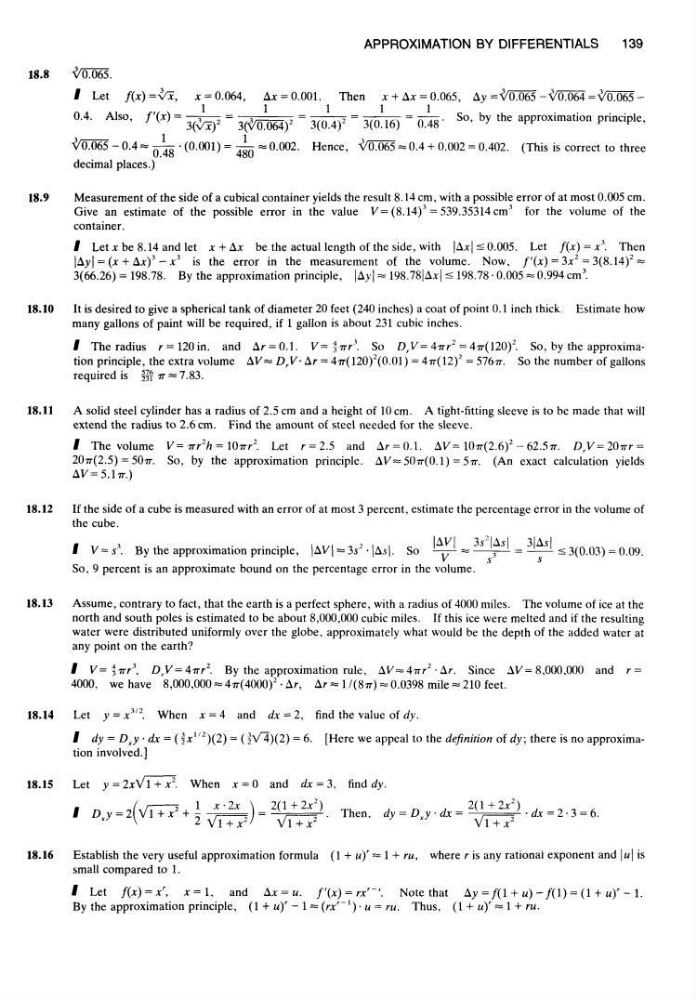
Let
0.4. Also
decimal places.)
So, by the approximation principle,
(This is correct to three
Hence,
Then
18.9
Measurement of the side of a cubical container yields the result 8.14cm, with a possible error of at most 0.005 cm.
Give an estimate of the possible error in the value V= (8.14)
3 = 539.35314cm
3
for the volume of the
container.
18.10
It is desired to give a spherical tank of diameter 20 feet (240 inches) a coat of point 0.1 inch thick. Estimate how
many gallons of paint will be required, if 1 gallon is about 231 cubic inches.
18.11
A solid steel cylinder has a radius of 2.5 cm and a height of 10 cm. A tight-fitting sleeve is to be made that will
extend the radius to 2.6cm. Find the amount of steel needed for the sleeve.
The volume
Let
and
18.12
If the side of a cube is measured with an error of at most 3 percent, estimate the percentage error in the volume of
the cube.
By the approximation principle,
So, 9 percent is an approximate bound on the percentage error in the volume.
18.13
Assume, contrary to fact, that the earth is a perfect sphere, with a radius of 4000 miles. The volume of ice at the
north and south poles is estimated to be about 8,000,000 cubic miles. If this ice were melted and if the resulting
water were distributed uniformly over the globe, approximately what would be the depth of the added water at
any point on the earth?
18.14
When
and
find the value of dy.
lion involved.]
[Here we appeal to the definition of dy; there is no approxima18.15
Let y = 2x
When
and
find dy.
Then,
18.16
Establish the very useful approximation formula (l + u)
r ~l + ru, where r is any rational exponent and u\ is
small compared to 1.
* = 0.064, A* = 0.001.
So
I V=fir/3 , D r V=4irr
2 . By the approximation rule, hV^4irr
2 • Ar. Since AV=8,000,000 and r =
4000, we have 8,000,000 « 47r(4000)
2 • Ar, Ar« l/(87r) = 0.0398 mile = 210 feet.
Let y = x *<
2 .
x = 4
dx=2,
I Let f(x) = xr, x = l, and AA: = u. f'(x) = rxr~'. Note that Ay =/(! + M) -/(I) = (1 + u)r - 1.
By the approximation principle, (1 + «)r - 1 = (rxr~1)- u = rw. Thus, (1 + u)r ~ 1 + ru.
D x y=2
x = 0
dx = 3,
dy = D x y • dx =
•dx = 2-3 = 6.
V=s\
< 3(0.03) = 0.09
I The radius r = 120in. and Ar = 0.1. V= \>nr*. So DV= 4irr
2 = 47r(120)
2 . So, by the approxima
tion principle, the extra volume AV= D r K- Ar = 47r(120)
2 (0.01) = 4rr(l2)
2 = 576-rr. So the number of gallon;
required is iff -n ~ 7.83.
I The volume V= Trr~h = lOirr . Let r = 2.5 and Ar = 0.1. AV= 107r(2.6)
2 - 62.577. D r V=207r/- =
20Tr(2.5) = 50-77. So, by the approximation principle. Al/= 5077(0.1) = 577. (An exact calculation yields
AV= 5.177.)
I Let x be 8.14 and let x + AJC be the actual length of the side, with |Ax| < 0.005. Let f(x) = x
3 . Then
|Ay| = (x + A*)
3 — x
3
is the error in the measurement of the volume. Now, f'(x) = 3x
2 = 3(8.14)
2 =
3(66.26) = 198.78. By the approximation principle, |A>>| = 198.78|Ax| < 198.78 • 0.005 - 0.994 cm
3
.
139
18.8
Let
0.4. Also
decimal places.)
So, by the approximation principle,
(This is correct to three
Hence,
Then
18.9
Measurement of the side of a cubical container yields the result 8.14cm, with a possible error of at most 0.005 cm.
Give an estimate of the possible error in the value V= (8.14)
3 = 539.35314cm
3
for the volume of the
container.
18.10
It is desired to give a spherical tank of diameter 20 feet (240 inches) a coat of point 0.1 inch thick. Estimate how
many gallons of paint will be required, if 1 gallon is about 231 cubic inches.
18.11
A solid steel cylinder has a radius of 2.5 cm and a height of 10 cm. A tight-fitting sleeve is to be made that will
extend the radius to 2.6cm. Find the amount of steel needed for the sleeve.
The volume
Let
and
18.12
If the side of a cube is measured with an error of at most 3 percent, estimate the percentage error in the volume of
the cube.
By the approximation principle,
So, 9 percent is an approximate bound on the percentage error in the volume.
18.13
Assume, contrary to fact, that the earth is a perfect sphere, with a radius of 4000 miles. The volume of ice at the
north and south poles is estimated to be about 8,000,000 cubic miles. If this ice were melted and if the resulting
water were distributed uniformly over the globe, approximately what would be the depth of the added water at
any point on the earth?
18.14
When
and
find the value of dy.
lion involved.]
[Here we appeal to the definition of dy; there is no approxima18.15
Let y = 2x
When
and
find dy.
Then,
18.16
Establish the very useful approximation formula (l + u)
r ~l + ru, where r is any rational exponent and u\ is
small compared to 1.
* = 0.064, A* = 0.001.
So
I V=fir/3 , D r V=4irr
2 . By the approximation rule, hV^4irr
2 • Ar. Since AV=8,000,000 and r =
4000, we have 8,000,000 « 47r(4000)
2 • Ar, Ar« l/(87r) = 0.0398 mile = 210 feet.
Let y = x *<
2 .
x = 4
dx=2,
I Let f(x) = xr, x = l, and AA: = u. f'(x) = rxr~'. Note that Ay =/(! + M) -/(I) = (1 + u)r - 1.
By the approximation principle, (1 + «)r - 1 = (rxr~1)- u = rw. Thus, (1 + u)r ~ 1 + ru.
D x y=2
x = 0
dx = 3,
dy = D x y • dx =
•dx = 2-3 = 6.
V=s\
< 3(0.03) = 0.09
I The radius r = 120in. and Ar = 0.1. V= \>nr*. So DV= 4irr
2 = 47r(120)
2 . So, by the approxima
tion principle, the extra volume AV= D r K- Ar = 47r(120)
2 (0.01) = 4rr(l2)
2 = 576-rr. So the number of gallon;
required is iff -n ~ 7.83.
I The volume V= Trr~h = lOirr . Let r = 2.5 and Ar = 0.1. AV= 107r(2.6)
2 - 62.577. D r V=207r/- =
20Tr(2.5) = 50-77. So, by the approximation principle. Al/= 5077(0.1) = 577. (An exact calculation yields
AV= 5.177.)
I Let x be 8.14 and let x + AJC be the actual length of the side, with |Ax| < 0.005. Let f(x) = x
3 . Then
|Ay| = (x + A*)
3 — x
3
is the error in the measurement of the volume. Now, f'(x) = 3x
2 = 3(8.14)
2 =
3(66.26) = 198.78. By the approximation principle, |A>>| = 198.78|Ax| < 198.78 • 0.005 - 0.994 cm
3
.