

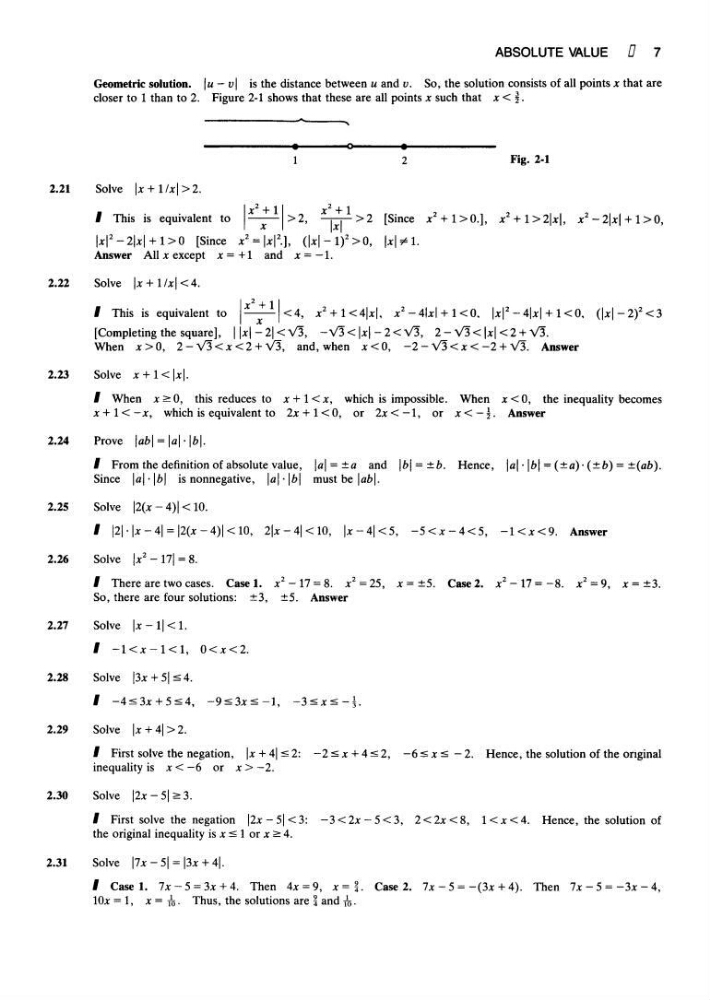
Geometric solution. \u — v\ is the distance between u and v. So, the solution consists of all points A: that are
closer to 1 than to 2. Figure 2-1 shows that these are all points x such that x < |.
|*|
2 -2W + 1>0 [Since x
2 = |x|
2
.], (|;t|-l)
2 >0, \x\*\.
Answer All x except *=+! and x = —l.
Solve \x + l/x\<4.
This is equivalent to
[Completing the square],
When x>0, 2-V3
When x^O, this reduces to x + 1
Prove |afr| = |a|-|fc|.
From the definition of absolute value, |a| = ±a and \b\ = ±b. Hence, |a| • \b\ = (±a)- (±b) = ±(ab).
Since |a|-|ft| is nonnegative, |a|-|fe| must be |ab|.
Solve |2(x-4)|<10.
|2|-|*-4| = |2(*-4)|<10, 2|*-4|<10, |x-4|<5, -5
2 - 17| = 8.
There are two cases. Case 1. x
2 -17 = 8. *
2 =25, x = ±5. Case 2. x
2 -ll=-8. x
2 = 9, x = ±3.
So, there are four solutions: ±3, ±5. Answer
Solve |jt-l|
Solve ^ + 4| > 2.
First solve the negation, \x + 4| s 2: — 2 s x + 4 < 2, — 6 s ^ < — 2. Hence, the solution of the original
inequality is x< -6 or * > — 2.
Solve |2x-5|>3.
First solve the negation \2x-5\<3: -3<2x-5<3, 2<2x<8, Kx<4. Hence, the solution of
the original inequality is x s 1 or x s 4.
Solve |7je-5| = |3* + 4|.
Case 1. 7x-5 = 3A: + 4. Then 4^ = 9, x=\. Case 2. 7^; -5 = -(3* + 4). Then 7* - 5 =-3x - 4,
WA; = 1, x = tb • Thus, the solutions are 1 and ^ •
ABSOLUTE VALUE
7
Fig. 2-1
2.21
Solve \x + l/x\>2.
This is equivalent to
2.22
2.23
2.24
2.25
2.26
2.27
2.28
2.29
2.30
2.31
-4<3A; + 5<4, -9<3*:<-l, -3
closer to 1 than to 2. Figure 2-1 shows that these are all points x such that x < |.
|*|
2 -2W + 1>0 [Since x
2 = |x|
2
.], (|;t|-l)
2 >0, \x\*\.
Answer All x except *=+! and x = —l.
Solve \x + l/x\<4.
This is equivalent to
[Completing the square],
When x>0, 2-V3
When x^O, this reduces to x + 1
Prove |afr| = |a|-|fc|.
From the definition of absolute value, |a| = ±a and \b\ = ±b. Hence, |a| • \b\ = (±a)- (±b) = ±(ab).
Since |a|-|ft| is nonnegative, |a|-|fe| must be |ab|.
Solve |2(x-4)|<10.
|2|-|*-4| = |2(*-4)|<10, 2|*-4|<10, |x-4|<5, -5
2 - 17| = 8.
There are two cases. Case 1. x
2 -17 = 8. *
2 =25, x = ±5. Case 2. x
2 -ll=-8. x
2 = 9, x = ±3.
So, there are four solutions: ±3, ±5. Answer
Solve |jt-l|
Solve ^ + 4| > 2.
First solve the negation, \x + 4| s 2: — 2 s x + 4 < 2, — 6 s ^ < — 2. Hence, the solution of the original
inequality is x< -6 or * > — 2.
Solve |2x-5|>3.
First solve the negation \2x-5\<3: -3<2x-5<3, 2<2x<8, Kx<4. Hence, the solution of
the original inequality is x s 1 or x s 4.
Solve |7je-5| = |3* + 4|.
Case 1. 7x-5 = 3A: + 4. Then 4^ = 9, x=\. Case 2. 7^; -5 = -(3* + 4). Then 7* - 5 =-3x - 4,
WA; = 1, x = tb • Thus, the solutions are 1 and ^ •
ABSOLUTE VALUE
7
Fig. 2-1
2.21
Solve \x + l/x\>2.
This is equivalent to
2.22
2.23
2.24
2.25
2.26
2.27
2.28
2.29
2.30
2.31
-4<3A; + 5<4, -9<3*:<-l, -3