

APPLIED MAXIMUM AND MINIMUM PROBLEMS D 125
16.33
16.34
16.35
16.36
I The daily income is *(250-*), since 250-* is the price at which x units are sold. The profit
G = *(250 - x) - (250 + 90*) = 250x - x
2 - 250 - 90x = 160* - x
2 - 250. Hence, D X G = 160 -2x, D
2
X G =
-2. Solving D X G = 0, we find the critical number x = 80. Since the second derivative is negative, the
unique critical number yields an absolute maximum. Notice that this maximum, taken over a continuous variable
x, is assumed for the integral value x = 80. So it certainly has to remain the maximum when x is restricted to
integral values (whole numbers of electronic components).
A gasoline station selling x gallons of fuel per month has fixed cost of $2500 and variable costs of 0.90*. The
demand function is 1.50 — 0.00002* and the station's capacity allows no more than 20,000 gallons to be sold per
month. Find the maximum profit.
I The price that x gallons can be sold at is the value of the demand function. Hence, the total income
is *(1.50- 0.00002*), and the profit G = *(1.50- 0.00002*) - 2500- 0.90* = 0.60* - 0.00002*
2 - 2500.
Hence, D X G = 0.60 - 0.00004*, and D
2 G = -0.00004. Solving D X G = 0, we find 0.60 = 0.00004*,
60,000 = 4*, x = 15,000. Since the second derivative is negative, the unique critical number * = 15,000
yields the maximum profit $2000.
Maximize the volume of a box, open at the top, which has a square base and which is composed of 600 square
inches of material.
I Let s be the side of the base and h be the height. Then V=s
2 h. We are told that 600 = s
2 + 4/w.
Hence, h = (600-s
2 )/4s. So V=s
2 [(600-s
2 )/4s] = (s/4)(600- s
2 ) = 150s - Js
3 . Then D s V=150-i*
2 ,
D
2 V=-|i. Solving D S V=0, we find 200 = s
2 , 10V2 = s. Since the second derivative is negative, this
unique critical number yields an absolute maximum. When s = 10V2, h — 5V2.
A rectangular garden is to be completely fenced in, with one side of the garden adjoining a neighbor's yard. The
neighbor has agreed to pay for half of the section of the fence that separates the plots. If the garden is to contain
432 ft
2 , find the dimensions that minimize the cost of the fence to the garden's owner.
f Let y be the length of the side adjoining the neighbor, and let * be the other dimension. Then
432 = *y, Q = xD,y + y, D x y = -y/x. The cost C = 2x + y + \y = 2* + |y. Then, D f C = 2+\(D f y) =
2+|(-y/*) and £>
2 C = -\(xD x y -y)/x
2 = -\(-y - y)/x
2 = 3y/*
2
. Setting D X C = 0, We obtain 2 =
3y/2*, 4x = 3y, y = f*, 432 = *(4*/3), 324 = *
2
, * = 18, y = 24. Since the second derivative is positive, the unique critical number * = 18 yields the absolute minimum cost.
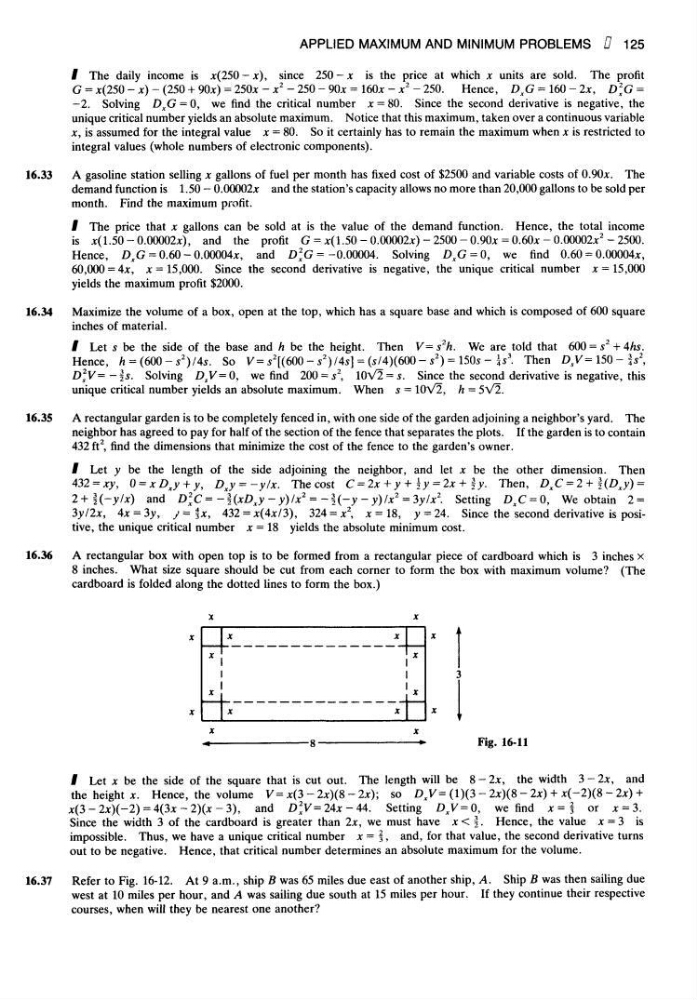
A rectangular box with open top is to be formed from a rectangular piece of cardboard which is 3 inches x
8 inches. What size square should be cut from each corner to form the box with maximum volume? (The
cardboard is folded along the dotted lines to form the box.)
Fig. 16-11
I Let * be the side of the square that is cut out. The length will be 8-2*, the width 3-2*, and
the height *. Hence, the volume V= *(3 - 2*)(8 - 2*); so D X V= (1)(3 - 2*)(8 - 2*) + *(-2)(8 - 2*)
*(3-2*)(-2) = 4(3*-2)(*-3), and D
2 V=24*-44. Setting D X V=0, we find *=| or x = 3.
Since the width 3 of the cardboard is greater than 2*, we must have *<§. Hence, the value * = 3 is
impossible. Thus, we have a unique critical number * = I, and, for that value, the second derivative turns
out to be negative. Hence, that critical number determines an absolute maximum for the volume.
16.37
Refer to Fig. 16-12. At 9 a.m., ship B was 65 miles due east of another ship, A. Ship B was then sailing due
west at 10 miles per hour, and A was sailing due south at 15 miles per hour. If they continue their respective
courses, when will they be nearest one another?
16.33
16.34
16.35
16.36
I The daily income is *(250-*), since 250-* is the price at which x units are sold. The profit
G = *(250 - x) - (250 + 90*) = 250x - x
2 - 250 - 90x = 160* - x
2 - 250. Hence, D X G = 160 -2x, D
2
X G =
-2. Solving D X G = 0, we find the critical number x = 80. Since the second derivative is negative, the
unique critical number yields an absolute maximum. Notice that this maximum, taken over a continuous variable
x, is assumed for the integral value x = 80. So it certainly has to remain the maximum when x is restricted to
integral values (whole numbers of electronic components).
A gasoline station selling x gallons of fuel per month has fixed cost of $2500 and variable costs of 0.90*. The
demand function is 1.50 — 0.00002* and the station's capacity allows no more than 20,000 gallons to be sold per
month. Find the maximum profit.
I The price that x gallons can be sold at is the value of the demand function. Hence, the total income
is *(1.50- 0.00002*), and the profit G = *(1.50- 0.00002*) - 2500- 0.90* = 0.60* - 0.00002*
2 - 2500.
Hence, D X G = 0.60 - 0.00004*, and D
2 G = -0.00004. Solving D X G = 0, we find 0.60 = 0.00004*,
60,000 = 4*, x = 15,000. Since the second derivative is negative, the unique critical number * = 15,000
yields the maximum profit $2000.
Maximize the volume of a box, open at the top, which has a square base and which is composed of 600 square
inches of material.
I Let s be the side of the base and h be the height. Then V=s
2 h. We are told that 600 = s
2 + 4/w.
Hence, h = (600-s
2 )/4s. So V=s
2 [(600-s
2 )/4s] = (s/4)(600- s
2 ) = 150s - Js
3 . Then D s V=150-i*
2 ,
D
2 V=-|i. Solving D S V=0, we find 200 = s
2 , 10V2 = s. Since the second derivative is negative, this
unique critical number yields an absolute maximum. When s = 10V2, h — 5V2.
A rectangular garden is to be completely fenced in, with one side of the garden adjoining a neighbor's yard. The
neighbor has agreed to pay for half of the section of the fence that separates the plots. If the garden is to contain
432 ft
2 , find the dimensions that minimize the cost of the fence to the garden's owner.
f Let y be the length of the side adjoining the neighbor, and let * be the other dimension. Then
432 = *y, Q = xD,y + y, D x y = -y/x. The cost C = 2x + y + \y = 2* + |y. Then, D f C = 2+\(D f y) =
2+|(-y/*) and £>
2 C = -\(xD x y -y)/x
2 = -\(-y - y)/x
2 = 3y/*
2
. Setting D X C = 0, We obtain 2 =
3y/2*, 4x = 3y, y = f*, 432 = *(4*/3), 324 = *
2
, * = 18, y = 24. Since the second derivative is positive, the unique critical number * = 18 yields the absolute minimum cost.
A rectangular box with open top is to be formed from a rectangular piece of cardboard which is 3 inches x
8 inches. What size square should be cut from each corner to form the box with maximum volume? (The
cardboard is folded along the dotted lines to form the box.)
Fig. 16-11
I Let * be the side of the square that is cut out. The length will be 8-2*, the width 3-2*, and
the height *. Hence, the volume V= *(3 - 2*)(8 - 2*); so D X V= (1)(3 - 2*)(8 - 2*) + *(-2)(8 - 2*)
*(3-2*)(-2) = 4(3*-2)(*-3), and D
2 V=24*-44. Setting D X V=0, we find *=| or x = 3.
Since the width 3 of the cardboard is greater than 2*, we must have *<§. Hence, the value * = 3 is
impossible. Thus, we have a unique critical number * = I, and, for that value, the second derivative turns
out to be negative. Hence, that critical number determines an absolute maximum for the volume.
16.37
Refer to Fig. 16-12. At 9 a.m., ship B was 65 miles due east of another ship, A. Ship B was then sailing due
west at 10 miles per hour, and A was sailing due south at 15 miles per hour. If they continue their respective
courses, when will they be nearest one another?