

122 0 CHAPTER 16
16.18
16.19
A solid steel cylinder is to be produced so that the sum of its height h and diameter 2r is to be at most 3 units.
Find the dimensions that will maximize its volume.
I We may assume that h + 2r = 3. So, 0
2 h = i7T
2
(3 -2r) = 37rr
2 -2irr*, so
D r V= 6-irr — birr
2 . Hence, the critical numbers are 0 and 1. We use the tabular method. The maximum value
TT is attained when r = 1. When r = 1, h = l.
Among all right triangles with fixed perimeter p, find the one with maximum area.
I Let the triangle A ABC have a right angle at C, and let the two sides have lengths x and y (Fig. 16-7). Then
the hypotenuse AB=p-x-y. Therefore, (p - x - y)
2 = x
2 + y
2 , so 2(p-x-y)(-l-Dty) = 2x +
2yD,y, Dxy{(p - x - y) + y] = (-p + x - y) + x, Dxy(p - x) = y - p, Dxy = (y - p)l(p - x). Now, the
area A = \xy, D X A = \(xD x y + y) = \[x(y-p)l(p -x) + y] = ${[x(y-p) + y(p - x)]/(p - x)} = \[p(y -
x)l(p-x)}.
Then, when
D X A=Q,
y = x,
and the triangle is isosceles.
Then,
( p - 2x)
2 = 2x
2 ,
p-2x = x^2, x=p/(2 + V2).
Thus, the only critical number is x = p/(2 + V2). Since
0<* we can use the tabular method.
When * = p/(2 + V2), y=p/(2 + V2),
and A = \[p(2 + V2)]
2
.
When x = Q, A = Q. When x = p/2, y = 0 and A = 0. Hence, the maximum is attained when x =
y = p/(2 + V5).
Fig. 16-7
Fig. 16-8
which eventually evaluates to ~-(c
2 /h
3 )(3s - c). When s= \c, the second derivative becomes -(c
3 /fc
3 )<0. Hence, s= |c yields a relative maximum, which by virtue of the
uniqueness of the critical number, must be an absolute maximum. When s — §c, the base 2c - 2s = f c.
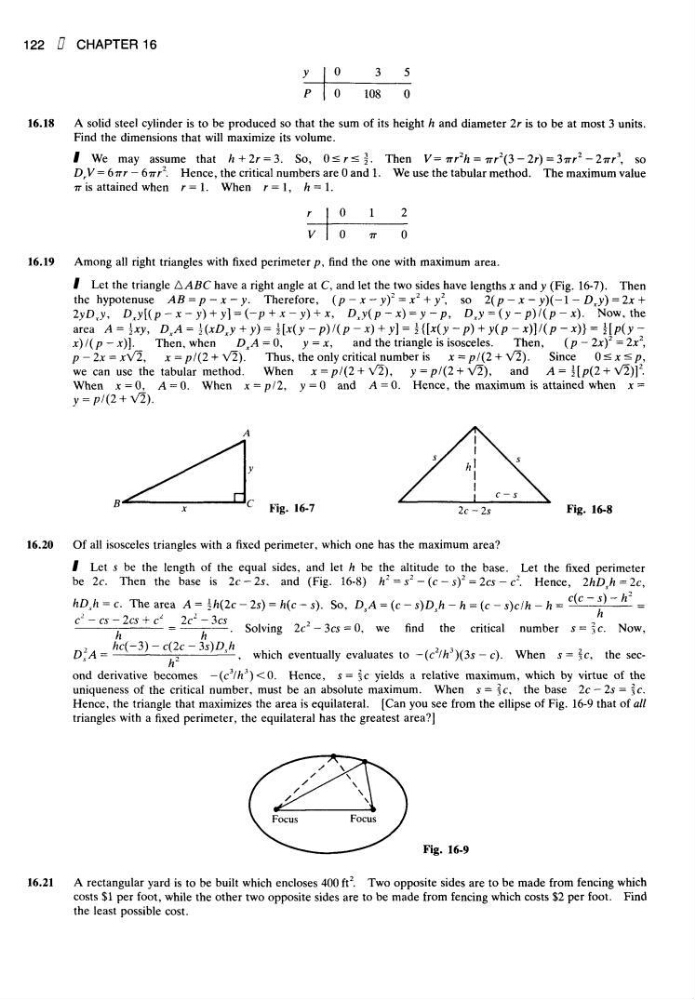
Hence, the triangle that maximizes the area is equilateral. [Can you see from the ellipse of Fig. 16-9 that of all
triangles with a fixed perimeter, the equilateral has the greatest area?]
Fig. 16-9
16.21
A rectangular yard is to be built which encloses 400 ft
2 . Two opposite sides are to be made from fencing which
costs $1 per foot, while the other two opposite sides are to be made from fencing which costs $2 per foot. Find
the least possible cost.
16.20
Of all isosceles triangles with a fixed perimeter, which one has the maximum area?
I Let s be the length of the equal sides, and let h be the altitude to the base. Let the fixed perimeter
be 2c. Then the base is 2c - 2s. and (Fig. 16-8) h
2 = s
2 - (c - s)
2 = 2cs - c
2 . Hence, 2HD h = 2c,
hD s h = c. The area A =
i
2 h(2c - 2s) = Me - s). So, D A = (c- s)D.h -h = (c- s)c!h -h =
Solving 2c
2 - 3ci = 0, we find the critical number s=lc. Now,
y
0
3
5
P
0
108
0
r
V
0
0
1
2
0
u
16.18
16.19
A solid steel cylinder is to be produced so that the sum of its height h and diameter 2r is to be at most 3 units.
Find the dimensions that will maximize its volume.
I We may assume that h + 2r = 3. So, 0
2
(3 -2r) = 37rr
2 -2irr*, so
D r V= 6-irr — birr
2 . Hence, the critical numbers are 0 and 1. We use the tabular method. The maximum value
TT is attained when r = 1. When r = 1, h = l.
Among all right triangles with fixed perimeter p, find the one with maximum area.
I Let the triangle A ABC have a right angle at C, and let the two sides have lengths x and y (Fig. 16-7). Then
the hypotenuse AB=p-x-y. Therefore, (p - x - y)
2 = x
2 + y
2 , so 2(p-x-y)(-l-Dty) = 2x +
2yD,y, Dxy{(p - x - y) + y] = (-p + x - y) + x, Dxy(p - x) = y - p, Dxy = (y - p)l(p - x). Now, the
area A = \xy, D X A = \(xD x y + y) = \[x(y-p)l(p -x) + y] = ${[x(y-p) + y(p - x)]/(p - x)} = \[p(y -
x)l(p-x)}.
Then, when
D X A=Q,
y = x,
and the triangle is isosceles.
Then,
( p - 2x)
2 = 2x
2 ,
p-2x = x^2, x=p/(2 + V2).
Thus, the only critical number is x = p/(2 + V2). Since
0<* we can use the tabular method.
When * = p/(2 + V2), y=p/(2 + V2),
and A = \[p(2 + V2)]
2
.
When x = Q, A = Q. When x = p/2, y = 0 and A = 0. Hence, the maximum is attained when x =
y = p/(2 + V5).
Fig. 16-7
Fig. 16-8
which eventually evaluates to ~-(c
2 /h
3 )(3s - c). When s= \c, the second derivative becomes -(c
3 /fc
3 )<0. Hence, s= |c yields a relative maximum, which by virtue of the
uniqueness of the critical number, must be an absolute maximum. When s — §c, the base 2c - 2s = f c.
Hence, the triangle that maximizes the area is equilateral. [Can you see from the ellipse of Fig. 16-9 that of all
triangles with a fixed perimeter, the equilateral has the greatest area?]
Fig. 16-9
16.21
A rectangular yard is to be built which encloses 400 ft
2 . Two opposite sides are to be made from fencing which
costs $1 per foot, while the other two opposite sides are to be made from fencing which costs $2 per foot. Find
the least possible cost.
16.20
Of all isosceles triangles with a fixed perimeter, which one has the maximum area?
I Let s be the length of the equal sides, and let h be the altitude to the base. Let the fixed perimeter
be 2c. Then the base is 2c - 2s. and (Fig. 16-8) h
2 = s
2 - (c - s)
2 = 2cs - c
2 . Hence, 2HD h = 2c,
hD s h = c. The area A =
i
2 h(2c - 2s) = Me - s). So, D A = (c- s)D.h -h = (c- s)c!h -h =
Solving 2c
2 - 3ci = 0, we find the critical number s=lc. Now,
y
0
3
5
P
0
108
0
r
V
0
0
1
2
0
u