

120 0 CHAPTER 16
Solving 2r
6 -(108)
2 =0 for the critical number, r = 3V2. The first-derivative test yields the case {-,+},
showing that r = 3V2 gives a relative minimum, which, by the uniqueness of the critical number, must be an
absolute minimum. When r = 3V2, h = 6.
Fig. 16-4
16.10
A rectangular bin, open at the top, is required to contain 128 cubic meters. If the bottom is to be a square, at a
cost of $2 per square meter, while the sides cost $0.50 per square meter, what dimensions will minimize the cost?
I Let s be the side of the bottom square and let h be the height. Then 128 = s
2 h. The cost (in dollars)
C = 2r+ $(4sh) = 2s
2 + 2s(U8/s
2 ) = 2s~ + 256/5, so D S C = 4s - 256/s
2 , D;C = 4 + 512/5
3
. Solving 4s256 /5
2 =0, s
3 = 64, 5 = 4. Since the second derivative is positive, the critical number 5 = 4 yields a relative
minimum, which, by the uniqueness of the critical number, is an absolute minimum. When 5 = 4, h = 8.
16.11 The selling price P of an item is 100-0.02jc dollars, where x is the number of items produced per day. If the
cost C of producing and selling x items is 40* + 15,000 dollars per day, how many items should be produced
and sold every day in order to maximize the profit?
I The total income per day is jt(100- 0.02.x). Hence the profit G = x( 100 -0.02*) - (40* + 15,000) =
60x-0.02x
2 - 15,000, and D A G = 60-0.04* and D
2 G =-0.04. Hence, the unique critical number is
the solution of 60 — 0.04x = 0, x = 1500. Since the second derivative is negative, this yields a relative
maximum, which, by the uniqueness of the critical number, is an absolute maximum.
16.12
Find the point(s) on the graph of 3*
2 + \0xy + 3_y
2 = 9 closest to the origin.
I It suffices to minimize u = x
2 + y', the square of the distance from the origin. By implicit differentiation,
D s u = 2x + 2yD J[ y and 6x + W(xD t y + y) + dyD x y = 0. From the second equation, D v v = -(3x + 5y)l
(5x + 3y), and, then, substituting in the first equation, D x u = 2x + 2y[~(3x + 5y)/(5x + 3y)]. Setting
D r «=0, x(5x + 3y) - y(3x + 5y) - 0, 5(x
2 - y
2 ) = 0, x
2 = y
2 , x-±y. Substituting in the equation of the
graph, 6*
2 ± 10*
2 = 9. Hence, we have the + sign, and 16*
2 = 9, jc = ± f and _y=±|. Thus, the two
points closest to the origin are (j, j) and (-1, -1).
16.13
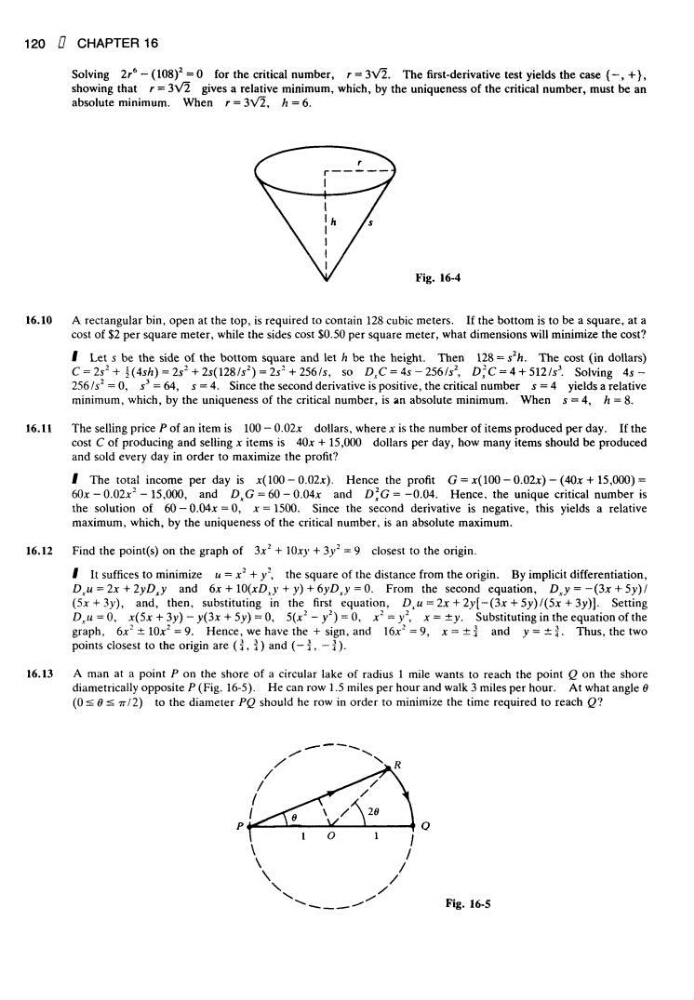
A man at a point P on the shore of a circular lake of radius 1 mile wants to reach the point Q on the shore
diametrically opposite P (Fig. 16-5). He can row 1.5 miles per hour and walk 3 miles per hour. At what angle 0
(0< 0 ^ 7T/2) to the diameter PQ should he row in order to minimize the time required to reach Ql
Fig. 16-5
Solving 2r
6 -(108)
2 =0 for the critical number, r = 3V2. The first-derivative test yields the case {-,+},
showing that r = 3V2 gives a relative minimum, which, by the uniqueness of the critical number, must be an
absolute minimum. When r = 3V2, h = 6.
Fig. 16-4
16.10
A rectangular bin, open at the top, is required to contain 128 cubic meters. If the bottom is to be a square, at a
cost of $2 per square meter, while the sides cost $0.50 per square meter, what dimensions will minimize the cost?
I Let s be the side of the bottom square and let h be the height. Then 128 = s
2 h. The cost (in dollars)
C = 2r+ $(4sh) = 2s
2 + 2s(U8/s
2 ) = 2s~ + 256/5, so D S C = 4s - 256/s
2 , D;C = 4 + 512/5
3
. Solving 4s256 /5
2 =0, s
3 = 64, 5 = 4. Since the second derivative is positive, the critical number 5 = 4 yields a relative
minimum, which, by the uniqueness of the critical number, is an absolute minimum. When 5 = 4, h = 8.
16.11 The selling price P of an item is 100-0.02jc dollars, where x is the number of items produced per day. If the
cost C of producing and selling x items is 40* + 15,000 dollars per day, how many items should be produced
and sold every day in order to maximize the profit?
I The total income per day is jt(100- 0.02.x). Hence the profit G = x( 100 -0.02*) - (40* + 15,000) =
60x-0.02x
2 - 15,000, and D A G = 60-0.04* and D
2 G =-0.04. Hence, the unique critical number is
the solution of 60 — 0.04x = 0, x = 1500. Since the second derivative is negative, this yields a relative
maximum, which, by the uniqueness of the critical number, is an absolute maximum.
16.12
Find the point(s) on the graph of 3*
2 + \0xy + 3_y
2 = 9 closest to the origin.
I It suffices to minimize u = x
2 + y', the square of the distance from the origin. By implicit differentiation,
D s u = 2x + 2yD J[ y and 6x + W(xD t y + y) + dyD x y = 0. From the second equation, D v v = -(3x + 5y)l
(5x + 3y), and, then, substituting in the first equation, D x u = 2x + 2y[~(3x + 5y)/(5x + 3y)]. Setting
D r «=0, x(5x + 3y) - y(3x + 5y) - 0, 5(x
2 - y
2 ) = 0, x
2 = y
2 , x-±y. Substituting in the equation of the
graph, 6*
2 ± 10*
2 = 9. Hence, we have the + sign, and 16*
2 = 9, jc = ± f and _y=±|. Thus, the two
points closest to the origin are (j, j) and (-1, -1).
16.13
A man at a point P on the shore of a circular lake of radius 1 mile wants to reach the point Q on the shore
diametrically opposite P (Fig. 16-5). He can row 1.5 miles per hour and walk 3 miles per hour. At what angle 0
(0< 0 ^ 7T/2) to the diameter PQ should he row in order to minimize the time required to reach Ql
Fig. 16-5