

CHAPTER 16
Applied Maximum and
Minimum Problems
16.1
A rectangular field is to be fenced in so that the resulting area is c square units. Find the dimensions of that field
(if any) for which the perimeter is a minimum, and the dimensions (if any) for which the perimeter is a maximum.
I Let f be the length and w the width. Then f w = c. The perimeter p = 2( + 2w = 2( + 2c/f. ( can be
any positive number. D(p = 2-2c/f2, and D2ep=4c/f3. Hence, solving 2-2c/f2 = 0, we see that
f = Vc is a critical number. The second derivative is positive, and, therefore, there is a relative minimum at
t = Vc. Since that is the only critical number and the function 2f + 2c/f is continuous for all positive f,
there is an absolute minimum at f = Vc. (If p achieved a still smaller value at some other point f 0 , there would
have to be a relative maximum at some point between Vc and f 0 , yielding another critical number.) When
( = Vc, w = Vc. Thus, for a fixed area, the square is the rectangle with the smallest perimeter. Notice that
the perimeter does not achieve a maximum, since p = 2f + 2c//—» +00 as f—»+00.
16.2
Find the point(s) on the parabola 2x = y
2
closest to the point (1,0).
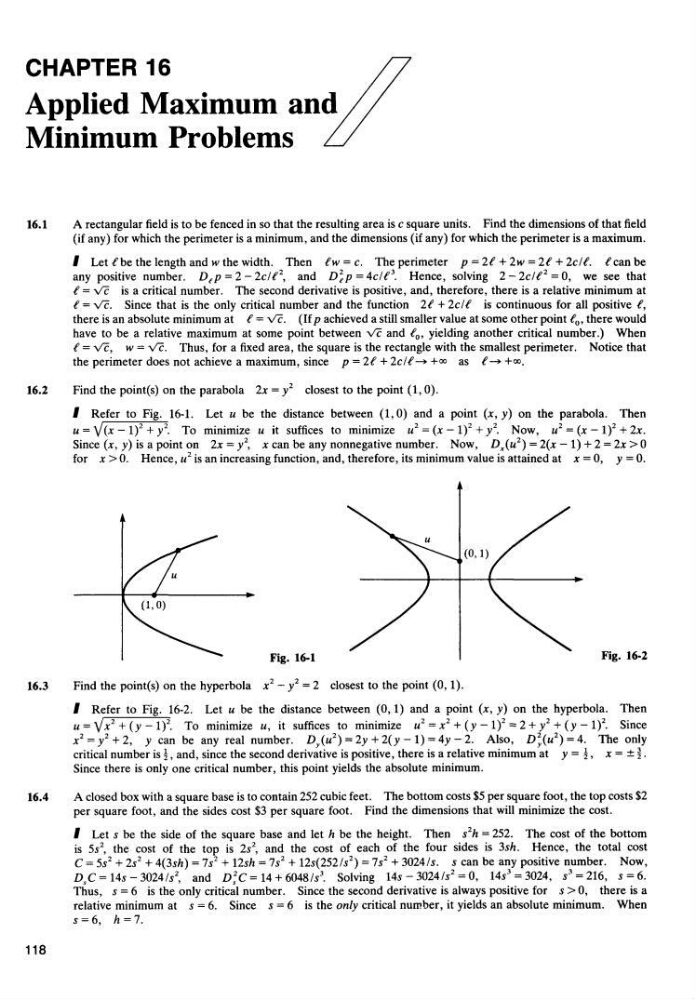
I Refer to Fig. 16-1. Let u be the distance between (1,0) and a point (x, y) on the parabola. Then
u = V(* - I)
2 + y
2 . To minimize u it suffices to minimize u
2 = (x - I)
2 + y
2 . Now, u
2 = (x - I)
2 + 2x.
Since (x, y) is a point on 2x = y
2 , x can be any nonnegative number. Now, D x (u
2 ) = 2(x - 1) + 2 = 2x > 0
for *>0. Hence, u
2 is an increasing function, and, therefore, its minimum value is attained at x = 0, y = 0.
16.3
16.4
118
Find the point(s) on the hyperbola x
2 -y
2 = 2 closest to the point (0,1).
I Refer to Fig. 16-2. Let u be the distance between (0,1) and a point (x, y) on the hyperbola. Then
M = V*
2 + (.y ~!)
2 -
To minimize M, it suffices to minimize u
2 = x
2 + (y - I)
2 = 2 + y
2 + (y - I)
2 . Since
*
2 = y
2 + 2, y can be any real number. D y (u
2 ) = 2y + 2(y - 1) = 4y -2. Also, D
2 (M
2 ) = 4. The only
critical number is |, and, since the second derivative is positive, there is a relative minimum at y = \, x=±\.
Since there is only one critical number, this point yields the absolute minimum.
A closed box with a square base is to contain 252 cubic feet. The bottom costs $5 per square foot, the top costs $2
per square foot, and the sides cost $3 per square foot. Find the dimensions that will minimize the cost.
I Let s be the side of the square base and let h be the height. Then s
2 h = 252. The cost of the bottom
is 5s
2
, the cost of the top is 2s
2
, and the cost of each of the four sides is 3sh. Hence, the total cost
C = 5s
2 + 2s
2 + 4(3sfc) = 7s
2 + I2sh = 7s
2 + 12s(252/s
2 ) = 7s
2 + 3024/s. s can be any positive number. Now,
DsC = 14s- 3024/s2, and D2C= 14 +6048/s3. Solving 14s - 3024/s2 = 0, 14s3 = 3024, s3 = 216, s = 6.
Thus, s = 6 is the only critical number. Since the second derivative is always positive for s>0, there is a
relative minimum at s = 6. Since s = 6 is the only critical number, it yields an absolute minimum. When
s = 6, h =1.
Fig. 16-1
Fig. 16-2
Applied Maximum and
Minimum Problems
16.1
A rectangular field is to be fenced in so that the resulting area is c square units. Find the dimensions of that field
(if any) for which the perimeter is a minimum, and the dimensions (if any) for which the perimeter is a maximum.
I Let f be the length and w the width. Then f w = c. The perimeter p = 2( + 2w = 2( + 2c/f. ( can be
any positive number. D(p = 2-2c/f2, and D2ep=4c/f3. Hence, solving 2-2c/f2 = 0, we see that
f = Vc is a critical number. The second derivative is positive, and, therefore, there is a relative minimum at
t = Vc. Since that is the only critical number and the function 2f + 2c/f is continuous for all positive f,
there is an absolute minimum at f = Vc. (If p achieved a still smaller value at some other point f 0 , there would
have to be a relative maximum at some point between Vc and f 0 , yielding another critical number.) When
( = Vc, w = Vc. Thus, for a fixed area, the square is the rectangle with the smallest perimeter. Notice that
the perimeter does not achieve a maximum, since p = 2f + 2c//—» +00 as f—»+00.
16.2
Find the point(s) on the parabola 2x = y
2
closest to the point (1,0).
I Refer to Fig. 16-1. Let u be the distance between (1,0) and a point (x, y) on the parabola. Then
u = V(* - I)
2 + y
2 . To minimize u it suffices to minimize u
2 = (x - I)
2 + y
2 . Now, u
2 = (x - I)
2 + 2x.
Since (x, y) is a point on 2x = y
2 , x can be any nonnegative number. Now, D x (u
2 ) = 2(x - 1) + 2 = 2x > 0
for *>0. Hence, u
2 is an increasing function, and, therefore, its minimum value is attained at x = 0, y = 0.
16.3
16.4
118
Find the point(s) on the hyperbola x
2 -y
2 = 2 closest to the point (0,1).
I Refer to Fig. 16-2. Let u be the distance between (0,1) and a point (x, y) on the hyperbola. Then
M = V*
2 + (.y ~!)
2 -
To minimize M, it suffices to minimize u
2 = x
2 + (y - I)
2 = 2 + y
2 + (y - I)
2 . Since
*
2 = y
2 + 2, y can be any real number. D y (u
2 ) = 2y + 2(y - 1) = 4y -2. Also, D
2 (M
2 ) = 4. The only
critical number is |, and, since the second derivative is positive, there is a relative minimum at y = \, x=±\.
Since there is only one critical number, this point yields the absolute minimum.
A closed box with a square base is to contain 252 cubic feet. The bottom costs $5 per square foot, the top costs $2
per square foot, and the sides cost $3 per square foot. Find the dimensions that will minimize the cost.
I Let s be the side of the square base and let h be the height. Then s
2 h = 252. The cost of the bottom
is 5s
2
, the cost of the top is 2s
2
, and the cost of each of the four sides is 3sh. Hence, the total cost
C = 5s
2 + 2s
2 + 4(3sfc) = 7s
2 + I2sh = 7s
2 + 12s(252/s
2 ) = 7s
2 + 3024/s. s can be any positive number. Now,
DsC = 14s- 3024/s2, and D2C= 14 +6048/s3. Solving 14s - 3024/s2 = 0, 14s3 = 3024, s3 = 216, s = 6.
Thus, s = 6 is the only critical number. Since the second derivative is always positive for s>0, there is a
relative minimum at s = 6. Since s = 6 is the only critical number, it yields an absolute minimum. When
s = 6, h =1.
Fig. 16-1
Fig. 16-2