

Answers and Explanations 593
Answers
901–1,001
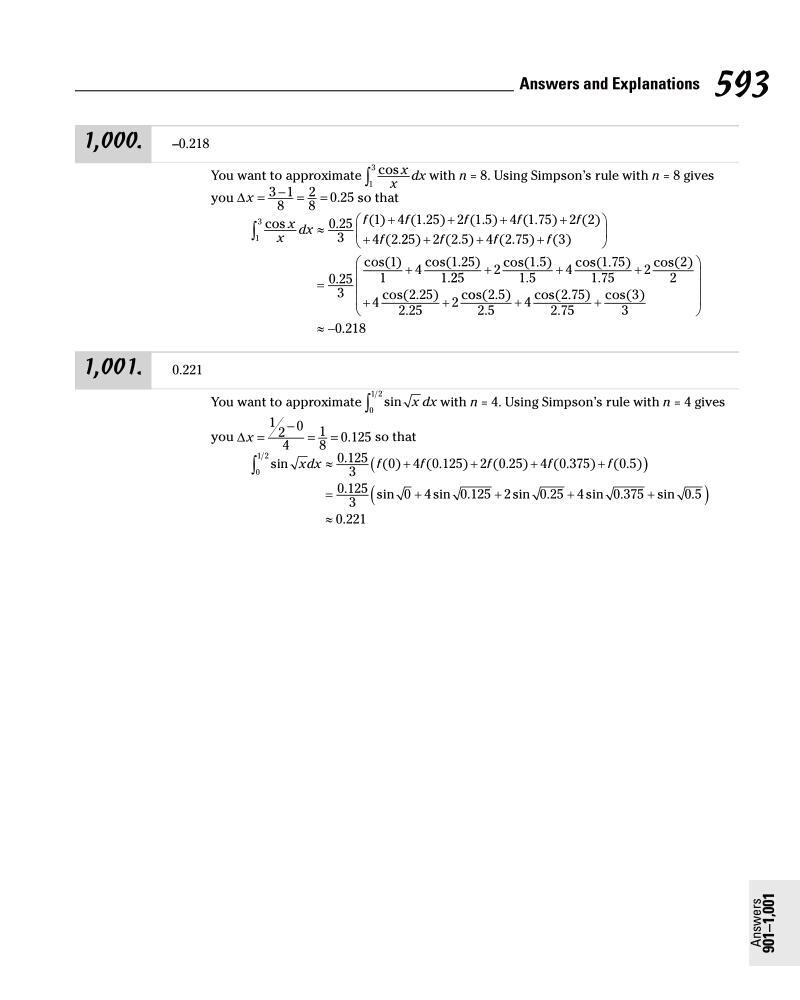
1,000. –0.218
You want to approximate cos x
x
dx
1
3
∫
with n = 8. Using Simpson’s rule with n = 8 gives
you ∆ x = − = =
3 1
8
2
8
0 25
. so that
cos
.
( )
( . )
( . )
( . )
( )
( .
x
x
dx
f
f
f
f
f
f
1
3
0 25
3
1 4 1 25 2 1 5 4 1 75 2 2
4 2
∫
≈
+
+
+
+
+
2 25 2 2 5 4 2 75
3
0 25
3
1
1
4
1 25
1
)
( . )
( . ) ( )
.
cos( )
cos( . )
.
+
+
+
=
+
f
f
f
2 25
2
1 5
1 5
4
1 75
1 75
2
2
2
4
2 25
2 25
2
+
+
+
+
+
cos( . )
.
cos( . )
.
cos( )
cos( . )
.
co os( . )
.
cos( . )
.
cos( )
.
2 5
2 5
4
2 75
2 75
3
3
0 218
+
+
≈ −
1,001. 0.221
You want to approximate
sin x dx
0
1 2
∫
with n = 4. Using Simpson’s rule with n = 4 gives
you ∆ x =
− = =
1 2
0
4
1
8
0 125
.
so that
sin
.
( )
( .
)
( . )
( .
) ( . )
xdx
f
f
f
f
f
0
1 2
0 125
3
0 4 0 125 2 0 25 4 0 375
05
∫
≈
+
+
+
+
(
) )
=
+
+
+
+
)
(
≈
0 125
3
0 4
0 125 2
025 4
0375
05
0 221
.
sin
s in .
s in .
sin .
sin .
.
Answers
901–1,001
1,000. –0.218
You want to approximate cos x
x
dx
1
3
∫
with n = 8. Using Simpson’s rule with n = 8 gives
you ∆ x = − = =
3 1
8
2
8
0 25
. so that
cos
.
( )
( . )
( . )
( . )
( )
( .
x
x
dx
f
f
f
f
f
f
1
3
0 25
3
1 4 1 25 2 1 5 4 1 75 2 2
4 2
∫
≈
+
+
+
+
+
2 25 2 2 5 4 2 75
3
0 25
3
1
1
4
1 25
1
)
( . )
( . ) ( )
.
cos( )
cos( . )
.
+
+
+
=
+
f
f
f
2 25
2
1 5
1 5
4
1 75
1 75
2
2
2
4
2 25
2 25
2
+
+
+
+
+
cos( . )
.
cos( . )
.
cos( )
cos( . )
.
co os( . )
.
cos( . )
.
cos( )
.
2 5
2 5
4
2 75
2 75
3
3
0 218
+
+
≈ −
1,001. 0.221
You want to approximate
sin x dx
0
1 2
∫
with n = 4. Using Simpson’s rule with n = 4 gives
you ∆ x =
− = =
1 2
0
4
1
8
0 125
.
so that
sin
.
( )
( .
)
( . )
( .
) ( . )
xdx
f
f
f
f
f
0
1 2
0 125
3
0 4 0 125 2 0 25 4 0 375
05
∫
≈
+
+
+
+
(
) )
=
+
+
+
+
)
(
≈
0 125
3
0 4
0 125 2
025 4
0375
05
0 221
.
sin
s in .
s in .
sin .
sin .
.