

Part II: The Answers
586
Answers
901–1,001
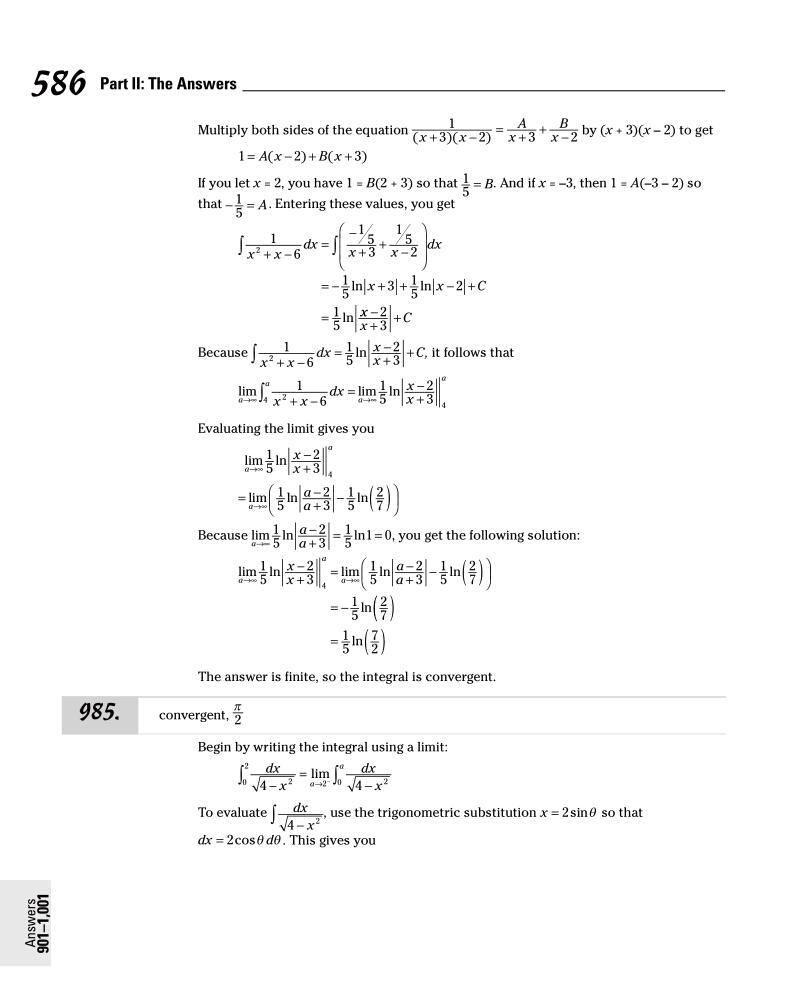
Multiply both sides of the equation
1
3
2
3
2
(
)(
)
x
x
A
x
B
x
+
−
= +
+ −
by (x + 3)(x – 2) to get
1
2
3
=
− +
+
A x
B x
(
)
(
)
If you let x = 2, you have 1 = B(2 + 3) so that 1
5
= B. And if x = –3, then 1 = A(–3 – 2) so
that − =
1
5
A. Entering these values, you get
1
6
1 5
3
1 5
2
1
5
3 1
5
2
1
5
2
x
x
dx
x
x
dx
x
x
C
+ −
=
−
+
+ −
= −
+ +
− +
=
∫
∫
ln
ln
ln x x
x
C
−
+
+
2
3
Because
1
6
1
5
2
3
2
x
x
dx
x
x
C
+ −
=
−
+
+
∫
ln
, it follows that
lim
lim ln
a
a
a
a
x
x
dx
x
x
→∞
→∞
+ −
=
−
+
∫
1
6
1
5
2
3
2
4
4
Evaluating the limit gives you
lim ln
lim ln
ln
a
a
a
x
x
a
a
→∞
→∞
−
+
=
−
+
−
( )
1
5
2
3
1
5
2
3
1
5
2
7
4
Because lim ln
ln
a
a
a
→∞
−
+
=
=
1
5
2
3
1
5
1 0, you get the following solution:
lim ln
lim ln
ln
ln
a
a
a
x
x
a
a
→∞
→∞
−
+
=
−
+
−
( )
= −
1
5
2
3
1
5
2
3
1
5
2
7
1
5
2
7
4
( ( )
=
( )
1
5
7
2
ln
The answer is finite, so the integral is convergent.
985.
convergent,
π
2
Begin by writing the integral using a limit:
dx
x
dx
x
a
a
4
4
2
0
2
2
2
0
−
=
−
∫
∫
→
−
lim
To evaluate
dx
x
4
2
−
∫
, use the trigonometric substitution x = 2 sinθ so that
dx
d
= 2cosθ θ . This gives you
586
Answers
901–1,001
Multiply both sides of the equation
1
3
2
3
2
(
)(
)
x
x
A
x
B
x
+
−
= +
+ −
by (x + 3)(x – 2) to get
1
2
3
=
− +
+
A x
B x
(
)
(
)
If you let x = 2, you have 1 = B(2 + 3) so that 1
5
= B. And if x = –3, then 1 = A(–3 – 2) so
that − =
1
5
A. Entering these values, you get
1
6
1 5
3
1 5
2
1
5
3 1
5
2
1
5
2
x
x
dx
x
x
dx
x
x
C
+ −
=
−
+
+ −
= −
+ +
− +
=
∫
∫
ln
ln
ln x x
x
C
−
+
+
2
3
Because
1
6
1
5
2
3
2
x
x
dx
x
x
C
+ −
=
−
+
+
∫
ln
, it follows that
lim
lim ln
a
a
a
a
x
x
dx
x
x
→∞
→∞
+ −
=
−
+
∫
1
6
1
5
2
3
2
4
4
Evaluating the limit gives you
lim ln
lim ln
ln
a
a
a
x
x
a
a
→∞
→∞
−
+
=
−
+
−
( )
1
5
2
3
1
5
2
3
1
5
2
7
4
Because lim ln
ln
a
a
a
→∞
−
+
=
=
1
5
2
3
1
5
1 0, you get the following solution:
lim ln
lim ln
ln
ln
a
a
a
x
x
a
a
→∞
→∞
−
+
=
−
+
−
( )
= −
1
5
2
3
1
5
2
3
1
5
2
7
1
5
2
7
4
( ( )
=
( )
1
5
7
2
ln
The answer is finite, so the integral is convergent.
985.
convergent,
π
2
Begin by writing the integral using a limit:
dx
x
dx
x
a
a
4
4
2
0
2
2
2
0
−
=
−
∫
∫
→
−
lim
To evaluate
dx
x
4
2
−
∫
, use the trigonometric substitution x = 2 sinθ so that
dx
d
= 2cosθ θ . This gives you