

Part II: The Answers
568
Answers
901–1,001
6
3
17
3
6
3
3
17 3
18
3
2
2
2
1
1
x
x
dx
x
x
+
+ −
+
(
)
=
−
∫
−
−
tan
t an
+
+
+
=
−
−
−
−
x
x
C
x
x
3
3
6
3
3
17 3
18
3
2
1
1
tan
t an
5 51
18
3
6 6 3
3 6 3
3
17 3
18
3
2
1
1
x
x
C
x
x
+
(
)
+
=
( )
( )
−
−
−
−
tan
t an
1 17
6
3
36 3
18
3
17 3
18
3
17
6
2
1
1
2
x
x
C
x
x
x
x
+
(
)
+
=
−
−
−
−
tan
t an
+ +
(
)
+
=
−
+
(
)
+
−
3
19 3
18
3
17
6
3
1
2
C
x
x
x
C
tan
958.
1
3
1 1
6
1
3
3
2 1
3
1
2
ln
ln
tan
x
x x
x
C
+ −
− + +
−
+
−
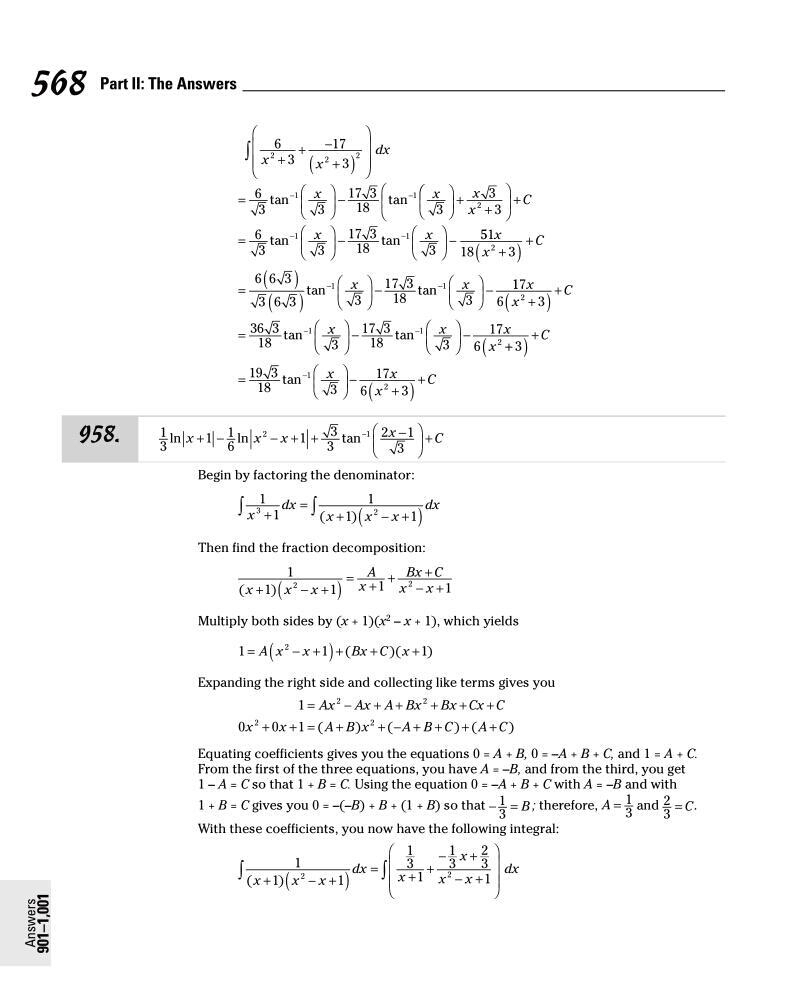
Begin by factoring the denominator:
1
1
1
1
1
3
2
x
dx
x
x x
dx
+
=
+
− +
(
)
∫
∫ ( )
Then find the fraction decomposition:
1
1
1
1
1
2
2
(
)
x
x
x
A
x
Bx C
x x
+
− +
(
)
= +
+
+
− +
Multiply both sides by (x + 1)(x
2
– x + 1), which yields
1
1
1
2
=
− +
(
) + +
+
A x
x
B x C x
(
) (
)
Expanding the right side and collecting like terms gives you
1
0
0 1
2
2
2
2
=
−
+ +
+
+
+
+
+ =
+
+ − + +
+
+
Ax
Ax A Bx Bx Cx C
x
x
A B x
A B C
A C
(
)
(
) (
)
Equating coefficients gives you the equations 0 = A + B, 0 = –A + B + C, and 1 = A + C.
From the first of the three equations, you have A = –B, and from the third, you get
1 – A = C so that 1 + B = C. Using the equation 0 = –A + B + C with A = –B and with
1 + B = C gives you 0 = –(–B) + B + (1 + B) so that − =
1
3
B ; therefore, A = 1
3
and 2
3
= C.
With these coefficients, you now have the following integral:
1
1
1
1
3
1
1
3
2
3
1
2
2
(
)
x
x
x
dx
x
x
x x
dx
+
− +
(
)
=
+
+
−
+
− +
∫
∫
568
Answers
901–1,001
6
3
17
3
6
3
3
17 3
18
3
2
2
2
1
1
x
x
dx
x
x
+
+ −
+
(
)
=
−
∫
−
−
tan
t an
+
+
+
=
−
−
−
−
x
x
C
x
x
3
3
6
3
3
17 3
18
3
2
1
1
tan
t an
5 51
18
3
6 6 3
3 6 3
3
17 3
18
3
2
1
1
x
x
C
x
x
+
(
)
+
=
( )
( )
−
−
−
−
tan
t an
1 17
6
3
36 3
18
3
17 3
18
3
17
6
2
1
1
2
x
x
C
x
x
x
x
+
(
)
+
=
−
−
−
−
tan
t an
+ +
(
)
+
=
−
+
(
)
+
−
3
19 3
18
3
17
6
3
1
2
C
x
x
x
C
tan
958.
1
3
1 1
6
1
3
3
2 1
3
1
2
ln
ln
tan
x
x x
x
C
+ −
− + +
−
+
−
Begin by factoring the denominator:
1
1
1
1
1
3
2
x
dx
x
x x
dx
+
=
+
− +
(
)
∫
∫ ( )
Then find the fraction decomposition:
1
1
1
1
1
2
2
(
)
x
x
x
A
x
Bx C
x x
+
− +
(
)
= +
+
+
− +
Multiply both sides by (x + 1)(x
2
– x + 1), which yields
1
1
1
2
=
− +
(
) + +
+
A x
x
B x C x
(
) (
)
Expanding the right side and collecting like terms gives you
1
0
0 1
2
2
2
2
=
−
+ +
+
+
+
+
+ =
+
+ − + +
+
+
Ax
Ax A Bx Bx Cx C
x
x
A B x
A B C
A C
(
)
(
) (
)
Equating coefficients gives you the equations 0 = A + B, 0 = –A + B + C, and 1 = A + C.
From the first of the three equations, you have A = –B, and from the third, you get
1 – A = C so that 1 + B = C. Using the equation 0 = –A + B + C with A = –B and with
1 + B = C gives you 0 = –(–B) + B + (1 + B) so that − =
1
3
B ; therefore, A = 1
3
and 2
3
= C.
With these coefficients, you now have the following integral:
1
1
1
1
3
1
1
3
2
3
1
2
2
(
)
x
x
x
dx
x
x
x x
dx
+
− +
(
)
=
+
+
−
+
− +
∫
∫