

Part II: The Answers
566
Answers
901–1,001
957.
19 3
18
3
17
6
3
1
2
tan
−
−
+
(
)
+
x
x
x
C
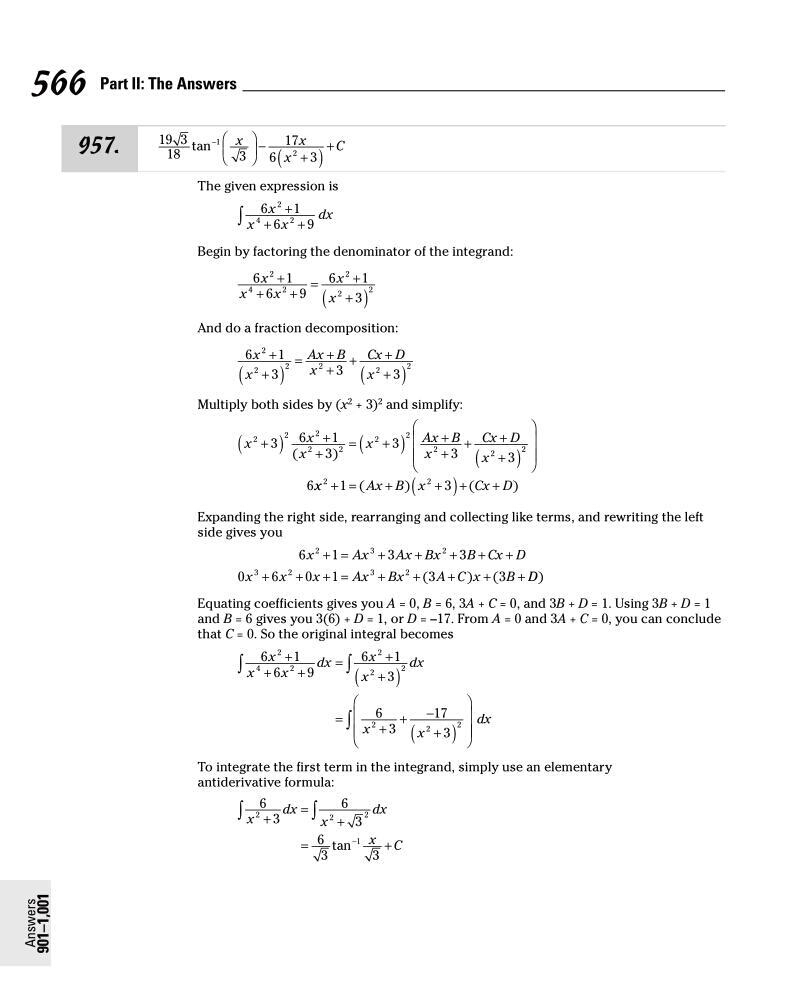
The given expression is
6
1
6
9
2
4
2
x
x
x
dx
+
+
+
∫
Begin by factoring the denominator of the integrand:
6
1
6
9
6
1
3
2
4
2
2
2
2
x
x
x
x
x
+
+
+
=
+
+
(
)
And do a fraction decomposition:
6
1
3
3
3
2
2
2
2
2
2
x
x
Ax B
x
Cx D
x
+
+
(
)
=
+
+
+
+
+
(
)
Multiply both sides by (x
2
+ 3)
2
and simplify:
x
x
x
x
Ax B
x
Cx D
x
2
2
2
2
2
2
2
2
2
2
3
6
1
3
3
3
3
6
+
(
)
+
+
=
+
(
)
+
+
+
+
+
(
)
(
)
x x
A x B x
C x D
2
2
1
3
+ =
+
+
(
) + +
(
)
(
)
Expanding the right side, rearranging and collecting like terms, and rewriting the left
side gives you
6
1
3
3
0
6
0 1
3
3
2
3
2
3
2
3
2
x
A x
Ax Bx
B Cx D
x
x
x
Ax
Bx
A C x
B
+ =
+
+
+
+
+
+
+
+ =
+
+
+
+
+
(
)
(
D D)
Equating coefficients gives you A = 0, B = 6, 3A + C = 0, and 3B + D = 1. Using 3B + D = 1
and B = 6 gives you 3(6) + D = 1, or D = –17. From A = 0 and 3A + C = 0, you can conclude
that C = 0. So the original integral becomes
6
1
6
9
6
1
3
6
3
17
3
2
4
2
2
2
2
2
2
2
x
x
x
dx
x
x
dx
x
x
+
+
+
=
+
+
(
)
=
+
+ −
+
(
)
∫
∫
∫
dx
To integrate the first term in the integrand, simply use an elementary
antiderivative formula:
6
3
6
3
6
3
3
2
2
2
1
x
dx
x
dx
x C
+
=
+
=
+
∫
∫
−
tan
566
Answers
901–1,001
957.
19 3
18
3
17
6
3
1
2
tan
−
−
+
(
)
+
x
x
x
C
The given expression is
6
1
6
9
2
4
2
x
x
x
dx
+
+
+
∫
Begin by factoring the denominator of the integrand:
6
1
6
9
6
1
3
2
4
2
2
2
2
x
x
x
x
x
+
+
+
=
+
+
(
)
And do a fraction decomposition:
6
1
3
3
3
2
2
2
2
2
2
x
x
Ax B
x
Cx D
x
+
+
(
)
=
+
+
+
+
+
(
)
Multiply both sides by (x
2
+ 3)
2
and simplify:
x
x
x
x
Ax B
x
Cx D
x
2
2
2
2
2
2
2
2
2
2
3
6
1
3
3
3
3
6
+
(
)
+
+
=
+
(
)
+
+
+
+
+
(
)
(
)
x x
A x B x
C x D
2
2
1
3
+ =
+
+
(
) + +
(
)
(
)
Expanding the right side, rearranging and collecting like terms, and rewriting the left
side gives you
6
1
3
3
0
6
0 1
3
3
2
3
2
3
2
3
2
x
A x
Ax Bx
B Cx D
x
x
x
Ax
Bx
A C x
B
+ =
+
+
+
+
+
+
+
+ =
+
+
+
+
+
(
)
(
D D)
Equating coefficients gives you A = 0, B = 6, 3A + C = 0, and 3B + D = 1. Using 3B + D = 1
and B = 6 gives you 3(6) + D = 1, or D = –17. From A = 0 and 3A + C = 0, you can conclude
that C = 0. So the original integral becomes
6
1
6
9
6
1
3
6
3
17
3
2
4
2
2
2
2
2
2
2
x
x
x
dx
x
x
dx
x
x
+
+
+
=
+
+
(
)
=
+
+ −
+
(
)
∫
∫
∫
dx
To integrate the first term in the integrand, simply use an elementary
antiderivative formula:
6
3
6
3
6
3
3
2
2
2
1
x
dx
x
dx
x C
+
=
+
=
+
∫
∫
−
tan