

Part II: The Answers
562
Answers
901–1,001
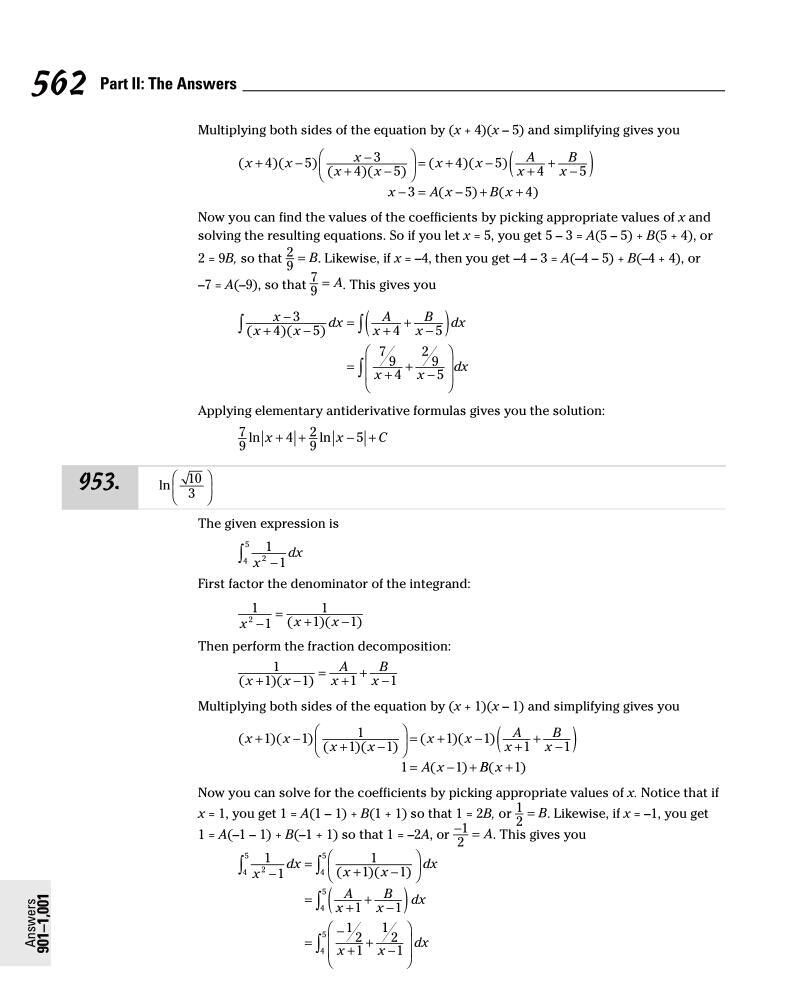
Multiplying both sides of the equation by (x + 4)(x – 5) and simplifying gives you
(
)(
) (
)(
)
(
)(
)
(
x
x
x
x
x
x
x
A
x
B
x
x
A x
+
−
−
+
−
=
+
−
+
+ −
(
)
− =
4
5
3
4
5
4
5
4
5
3
− − +
+
5
4
)
(
)
B x
Now you can find the values of the coefficients by picking appropriate values of x and
solving the resulting equations. So if you let x = 5, you get 5 – 3 = A(5 – 5) + B(5 + 4), or
2 = 9B, so that 2
9
= B. Likewise, if x = –4, then you get –4 – 3 = A(–4 – 5) + B(–4 + 4), or
–7 = A(–9), so that
7
9
= A . This gives you
x
x
x
dx
A
x
B
x
dx
x
x
dx
−
+
−
=
+
+ −
(
)
=
+
+ −
∫
∫
∫
3
4
5
4
5
7 9
4
2 9
5
(
)(
)
Applying elementary antiderivative formulas gives you the solution:
7
9
4 2
9
5
ln
ln
x
x
C
+ +
− +
953.
ln 10
3
The given expression is
1
1
2
4
5
x
dx
−
∫
First factor the denominator of the integrand:
1
1
1
1
1
2
x
x
x
−
=
+
−
(
)(
)
Then perform the fraction decomposition:
1
1
1
1
1
(
)(
)
x
x
A
x
B
x
+
−
= +
+ −
Multiplying both sides of the equation by (x + 1)(x – 1) and simplifying gives you
(
)(
) (
)(
)
(
)(
)
(
)
x
x
x
x
x
x
A
x
B
x
A x
+
−
+
−
=
+
−
+
+ −
(
)
=
− +
1
1
1
1
1
1
1
1
1
1
1 B B x
(
)
+ 1
Now you can solve for the coefficients by picking appropriate values of x. Notice that if
x = 1, you get 1 = A(1 – 1) + B(1 + 1) so that 1 = 2B, or 1
2
= B. Likewise, if x = –1, you get
1 = A(–1 – 1) + B(–1 + 1) so that 1 = –2A, or − =
1
2
A. This gives you
1
1
1
1
1
1
1
1 2
1
2
4
5
4
5
4
5
x
dx
x
x
dx
A
x
B
x
dx
x
−
=
+
−
=
+
+ −
(
)
=
−
+
+
∫
∫
∫
(
)(
)
1 1 2
1
4
5
x
dx
−
∫
562
Answers
901–1,001
Multiplying both sides of the equation by (x + 4)(x – 5) and simplifying gives you
(
)(
) (
)(
)
(
)(
)
(
x
x
x
x
x
x
x
A
x
B
x
x
A x
+
−
−
+
−
=
+
−
+
+ −
(
)
− =
4
5
3
4
5
4
5
4
5
3
− − +
+
5
4
)
(
)
B x
Now you can find the values of the coefficients by picking appropriate values of x and
solving the resulting equations. So if you let x = 5, you get 5 – 3 = A(5 – 5) + B(5 + 4), or
2 = 9B, so that 2
9
= B. Likewise, if x = –4, then you get –4 – 3 = A(–4 – 5) + B(–4 + 4), or
–7 = A(–9), so that
7
9
= A . This gives you
x
x
x
dx
A
x
B
x
dx
x
x
dx
−
+
−
=
+
+ −
(
)
=
+
+ −
∫
∫
∫
3
4
5
4
5
7 9
4
2 9
5
(
)(
)
Applying elementary antiderivative formulas gives you the solution:
7
9
4 2
9
5
ln
ln
x
x
C
+ +
− +
953.
ln 10
3
The given expression is
1
1
2
4
5
x
dx
−
∫
First factor the denominator of the integrand:
1
1
1
1
1
2
x
x
x
−
=
+
−
(
)(
)
Then perform the fraction decomposition:
1
1
1
1
1
(
)(
)
x
x
A
x
B
x
+
−
= +
+ −
Multiplying both sides of the equation by (x + 1)(x – 1) and simplifying gives you
(
)(
) (
)(
)
(
)(
)
(
)
x
x
x
x
x
x
A
x
B
x
A x
+
−
+
−
=
+
−
+
+ −
(
)
=
− +
1
1
1
1
1
1
1
1
1
1
1 B B x
(
)
+ 1
Now you can solve for the coefficients by picking appropriate values of x. Notice that if
x = 1, you get 1 = A(1 – 1) + B(1 + 1) so that 1 = 2B, or 1
2
= B. Likewise, if x = –1, you get
1 = A(–1 – 1) + B(–1 + 1) so that 1 = –2A, or − =
1
2
A. This gives you
1
1
1
1
1
1
1
1 2
1
2
4
5
4
5
4
5
x
dx
x
x
dx
A
x
B
x
dx
x
−
=
+
−
=
+
+ −
(
)
=
−
+
+
∫
∫
∫
(
)(
)
1 1 2
1
4
5
x
dx
−
∫