

Part II: The Answers
556
Answers
901–1,001
939.
−
−
(
) +
−
(
) +
16
3
16
1
5
16
2
3 2
2
5 2
x
x
C
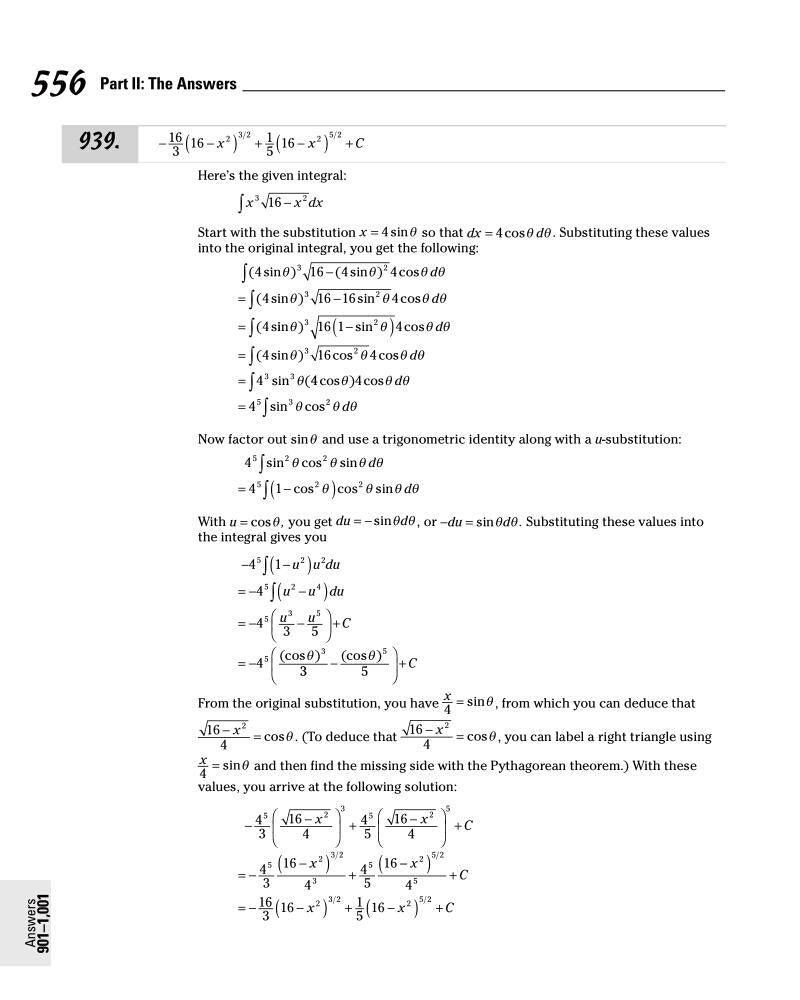
Here’s the given integral:
x
x dx
3
2
16 −
∫
Start with the substitution x = 4 sinθ so that dx
d
= 4 cosθ θ . Substituting these values
into the original integral, you get the following:
( sin )
( sin ) cos
( sin )
s in
cos
( s
4
1 6 4
4
4
1 6 16
4
4
2
3
3
2
θ
θ
θ θ
θ
θ
θ θ
−
=
−
=
∫
∫
d
d
i in )
s in
cos
( sin )
cos
cos
sin (
θ
θ
θ θ
θ
θ
θ θ
θ
3
2
3
2
3
3
16 1
4
4
1 6
4
4
−
(
)
=
=
∫
∫
d
d
4 4
4
4
5
3
2
cos ) cos
sin cos
θ
θ θ
θ
θ θ
∫
∫
=
d
d
Now factor out sinθ and use a trigonometric identity along with a u-substitution:
4
4 1
5
2
2
5
2
2
sin cos sin
cos
cos sin
θ
θ
θ θ
θ
θ
θ θ
d
d
∫
∫
=
−
(
)
With u = cosθ , you get du
d
= − sinθ θ , or − =
du
d
sinθ θ . Substituting these values into
the integral gives you
−
−
(
)
= −
−
(
)
= −
−
+
= −
∫
∫
4 1
4
4
3
5
4
5
2
2
5
2
4
5
3
5
5
3
u u du
u u du
u
u
C
(cos )
θ
3 3
5
5
−
+
(cos )
θ
C
From the original substitution, you have
x
4
= sinθ , from which you can deduce that
16
4
2
−
=
x
cosθ . (To deduce that
16
4
2
−
=
x
cosθ , you can label a right triangle using
x
4
= sinθ and then find the missing side with the Pythagorean theorem.) With these
values, you arrive at the following solution:
−
−
+
−
+
= −
−
(
) +
4
3
16
4
4
5
16
4
4
3
16
4
4
5
16
5
2
3
5
2
5
5
2
3 2
3
5
x
x
C
x
− −
(
) +
= −
−
(
) +
−
(
) +
x
C
x
x
C
2
5 2
5
2
3 2
2
5 2
4
16
3
16
1
5
16
556
Answers
901–1,001
939.
−
−
(
) +
−
(
) +
16
3
16
1
5
16
2
3 2
2
5 2
x
x
C
Here’s the given integral:
x
x dx
3
2
16 −
∫
Start with the substitution x = 4 sinθ so that dx
d
= 4 cosθ θ . Substituting these values
into the original integral, you get the following:
( sin )
( sin ) cos
( sin )
s in
cos
( s
4
1 6 4
4
4
1 6 16
4
4
2
3
3
2
θ
θ
θ θ
θ
θ
θ θ
−
=
−
=
∫
∫
d
d
i in )
s in
cos
( sin )
cos
cos
sin (
θ
θ
θ θ
θ
θ
θ θ
θ
3
2
3
2
3
3
16 1
4
4
1 6
4
4
−
(
)
=
=
∫
∫
d
d
4 4
4
4
5
3
2
cos ) cos
sin cos
θ
θ θ
θ
θ θ
∫
∫
=
d
d
Now factor out sinθ and use a trigonometric identity along with a u-substitution:
4
4 1
5
2
2
5
2
2
sin cos sin
cos
cos sin
θ
θ
θ θ
θ
θ
θ θ
d
d
∫
∫
=
−
(
)
With u = cosθ , you get du
d
= − sinθ θ , or − =
du
d
sinθ θ . Substituting these values into
the integral gives you
−
−
(
)
= −
−
(
)
= −
−
+
= −
∫
∫
4 1
4
4
3
5
4
5
2
2
5
2
4
5
3
5
5
3
u u du
u u du
u
u
C
(cos )
θ
3 3
5
5
−
+
(cos )
θ
C
From the original substitution, you have
x
4
= sinθ , from which you can deduce that
16
4
2
−
=
x
cosθ . (To deduce that
16
4
2
−
=
x
cosθ , you can label a right triangle using
x
4
= sinθ and then find the missing side with the Pythagorean theorem.) With these
values, you arrive at the following solution:
−
−
+
−
+
= −
−
(
) +
4
3
16
4
4
5
16
4
4
3
16
4
4
5
16
5
2
3
5
2
5
5
2
3 2
3
5
x
x
C
x
− −
(
) +
= −
−
(
) +
−
(
) +
x
C
x
x
C
2
5 2
5
2
3 2
2
5 2
4
16
3
16
1
5
16