

Answers and Explanations 545
Answers
901–1,001
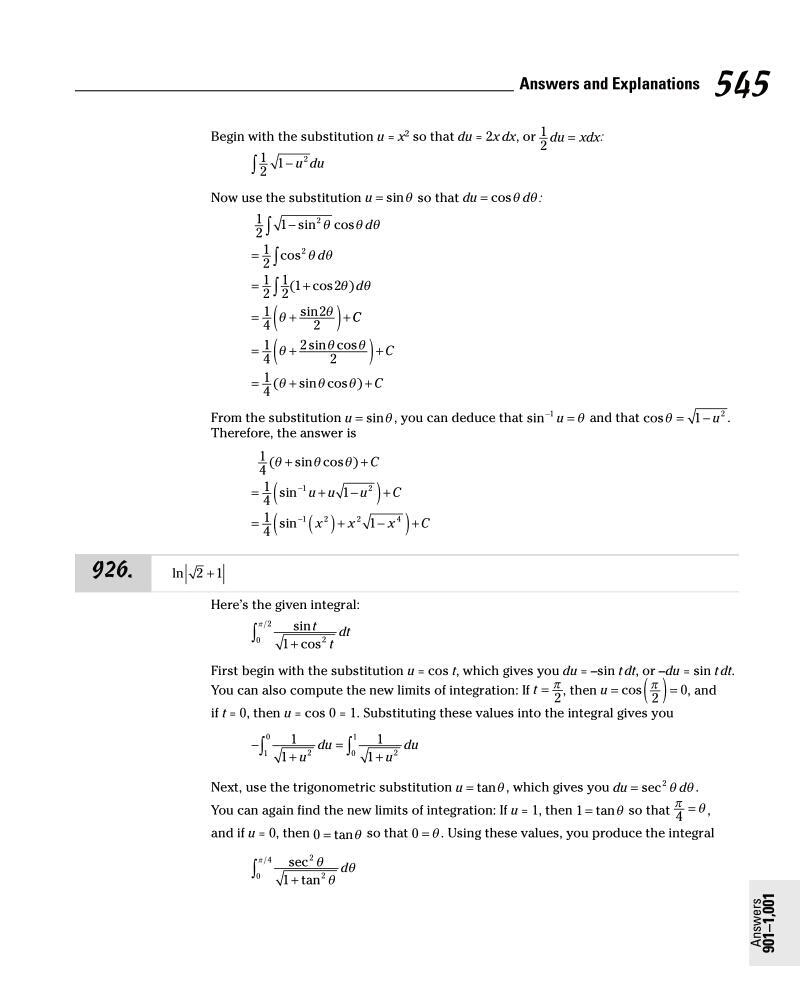
Begin with the substitution u = x
2
so that du = 2x
dx, or 1
2
du xdx
=
:
1
2
1
2
−
∫
u du
Now use the substitution u = sinθ so that du
d
= cosθ θ :
1
2
1
1
2
1
2
1
2
1
2
1
4
2
2
2
2
−
=
=
+
=
+
(
) +
∫
∫
∫
sin cos
cos
( cos )
sin
θ
θ θ
θ θ
θ θ
θ
θ
d
d
d
C C
C
C
=
+
(
) +
=
+
+
1
4
2
2
1
4
θ
θ
θ
θ
θ
θ
sin cos
(
sin cos )
From the substitution u = sinθ , you can deduce that sin
−
=
1 u θ and that cosθ = −
1
2
u .
Therefore, the answer is
1
4
1
4
1
1
4
1
1
2
1
2
2
4
(
sin cos )
sin
sin
θ
θ
θ
+
+
=
+
−
(
) +
=
( ) +
−
(
) +
−
−
C
u u
u
C
x
x
x
C
926.
ln 2 1
+
Here’s the given integral:
sin
cos
t
t
dt
1
2
0
2
+
∫
π
First begin with the substitution u = cos t, which gives you du = –sin t
dt, or –du = sin t
dt.
You can also compute the new limits of integration: If t = π
2
, then u =
( ) =
cos π
2
0, and
if t = 0, then u = cos 0 = 1. Substituting these values into the integral gives you
−
+
=
+
∫
∫
1
1
1
1
2
1
0
2
0
1
u
du
u
du
Next, use the trigonometric substitution u = tanθ , which gives you du
d
= sec
2
θ θ .
You can again find the new limits of integration: If u = 1, then 1 = tanθ so that
π θ
4
= ,
and if u = 0, then 0 = tanθ so that 0 = θ . Using these values, you produce the integral
sec
tan
2
2
0
4
1
θ
θ
θ
π
+
∫
d
Answers
901–1,001
Begin with the substitution u = x
2
so that du = 2x
dx, or 1
2
du xdx
=
:
1
2
1
2
−
∫
u du
Now use the substitution u = sinθ so that du
d
= cosθ θ :
1
2
1
1
2
1
2
1
2
1
2
1
4
2
2
2
2
−
=
=
+
=
+
(
) +
∫
∫
∫
sin cos
cos
( cos )
sin
θ
θ θ
θ θ
θ θ
θ
θ
d
d
d
C C
C
C
=
+
(
) +
=
+
+
1
4
2
2
1
4
θ
θ
θ
θ
θ
θ
sin cos
(
sin cos )
From the substitution u = sinθ , you can deduce that sin
−
=
1 u θ and that cosθ = −
1
2
u .
Therefore, the answer is
1
4
1
4
1
1
4
1
1
2
1
2
2
4
(
sin cos )
sin
sin
θ
θ
θ
+
+
=
+
−
(
) +
=
( ) +
−
(
) +
−
−
C
u u
u
C
x
x
x
C
926.
ln 2 1
+
Here’s the given integral:
sin
cos
t
t
dt
1
2
0
2
+
∫
π
First begin with the substitution u = cos t, which gives you du = –sin t
dt, or –du = sin t
dt.
You can also compute the new limits of integration: If t = π
2
, then u =
( ) =
cos π
2
0, and
if t = 0, then u = cos 0 = 1. Substituting these values into the integral gives you
−
+
=
+
∫
∫
1
1
1
1
2
1
0
2
0
1
u
du
u
du
Next, use the trigonometric substitution u = tanθ , which gives you du
d
= sec
2
θ θ .
You can again find the new limits of integration: If u = 1, then 1 = tanθ so that
π θ
4
= ,
and if u = 0, then 0 = tanθ so that 0 = θ . Using these values, you produce the integral
sec
tan
2
2
0
4
1
θ
θ
θ
π
+
∫
d