

Answers and Explanations 541
Answers
901–1,001
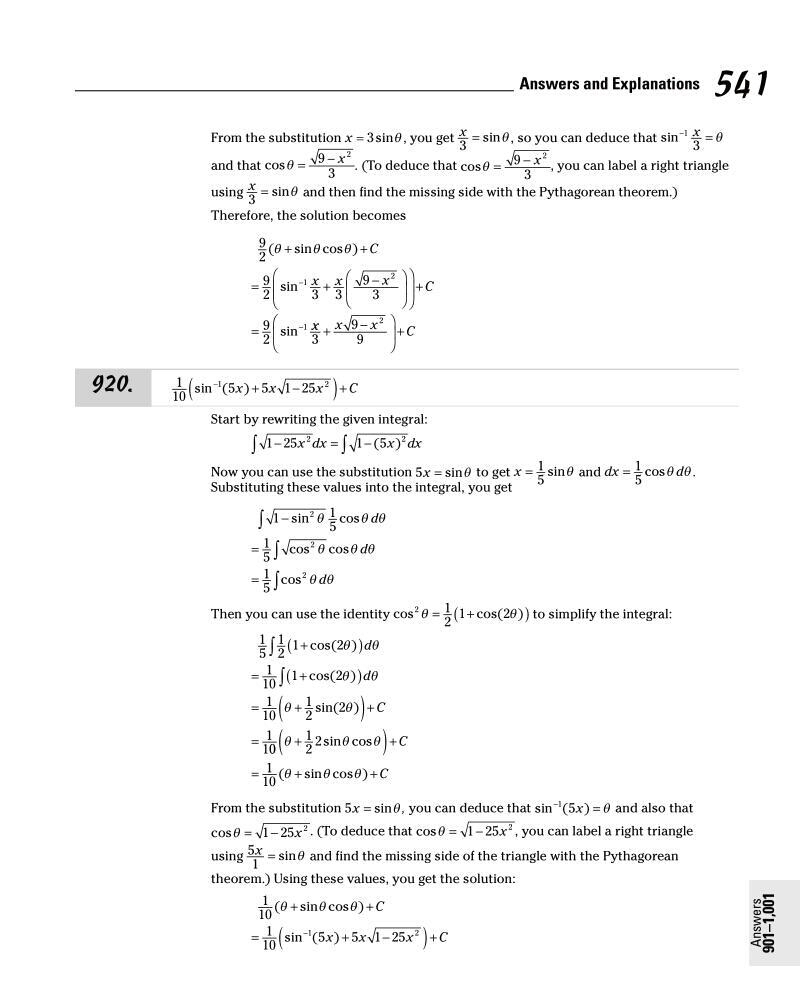
From the substitution x = 3 sinθ , you get x
3
= sinθ , so you can deduce that sin
−
=
1
3
x θ
and that cosθ =
−
9
3
2
x . (To deduce that cosθ =
−
9
3
2
x , you can label a right triangle
using x
3
= sinθ and then find the missing side with the Pythagorean theorem.)
Therefore, the solution becomes
9
2
9
2
3 3
9
3
9
2
1
2
1
(
sin cos )
sin
sin
θ
θ
θ
+
+
=
+
−
+
=
−
−
C
x x
x
C
x x x
x
C
3
9
9
2
+
−
+
920.
1
10
5
5 1 25
2
1
sin ( )
−
+
−
)
(
+
x
x
x
C
Start by rewriting the given integral:
1 25
1 5
2
2
−
=
−
∫
∫
x dx
x dx
( )
Now you can use the substitution 5x = sinθ to get x = 1
5
sinθ and dx
d
= 1
5
cosθ θ .
Substituting these values into the integral, you get
1
1
5
1
5
1
5
2
2
2
−
=
=
∫
∫
∫
sin
cos
cos cos
cos
θ
θ θ
θ
θ θ
θ θ
d
d
d
Then you can use the identity cos
c os( )
2
1
2
1
2
θ
θ
=
+
(
) to simplify the integral:
1
5
1
2
1
2
1
10
1
2
1
10
1
2
2
1
1
+
(
)
=
+
(
)
=
+
(
) +
=
∫
∫
cos( )
cos( )
sin( )
θ
θ
θ
θ
θ
θ
d
d
C
0 0
1
2
2
1
10
θ
θ
θ
θ
θ
θ
+
(
) +
=
+
+
sin cos
(
sin cos )
C
C
From the substitution 5x = sinθ , you can deduce that sin ( )
−
=
1 5x θ and also that
cosθ = −
1 25
2
x . (To deduce that cosθ = −
1 25
2
x , you can label a right triangle
using 5
1
x = sinθ and find the missing side of the triangle with the Pythagorean
theorem.) Using these values, you get the solution:
1
10
1
10
5
5 1 25
2
1
(
sin cos )
sin ( )
θ
θ
θ
+
+
=
+
−
)
(
+
−
C
x
x
x
C
Answers
901–1,001
From the substitution x = 3 sinθ , you get x
3
= sinθ , so you can deduce that sin
−
=
1
3
x θ
and that cosθ =
−
9
3
2
x . (To deduce that cosθ =
−
9
3
2
x , you can label a right triangle
using x
3
= sinθ and then find the missing side with the Pythagorean theorem.)
Therefore, the solution becomes
9
2
9
2
3 3
9
3
9
2
1
2
1
(
sin cos )
sin
sin
θ
θ
θ
+
+
=
+
−
+
=
−
−
C
x x
x
C
x x x
x
C
3
9
9
2
+
−
+
920.
1
10
5
5 1 25
2
1
sin ( )
−
+
−
)
(
+
x
x
x
C
Start by rewriting the given integral:
1 25
1 5
2
2
−
=
−
∫
∫
x dx
x dx
( )
Now you can use the substitution 5x = sinθ to get x = 1
5
sinθ and dx
d
= 1
5
cosθ θ .
Substituting these values into the integral, you get
1
1
5
1
5
1
5
2
2
2
−
=
=
∫
∫
∫
sin
cos
cos cos
cos
θ
θ θ
θ
θ θ
θ θ
d
d
d
Then you can use the identity cos
c os( )
2
1
2
1
2
θ
θ
=
+
(
) to simplify the integral:
1
5
1
2
1
2
1
10
1
2
1
10
1
2
2
1
1
+
(
)
=
+
(
)
=
+
(
) +
=
∫
∫
cos( )
cos( )
sin( )
θ
θ
θ
θ
θ
θ
d
d
C
0 0
1
2
2
1
10
θ
θ
θ
θ
θ
θ
+
(
) +
=
+
+
sin cos
(
sin cos )
C
C
From the substitution 5x = sinθ , you can deduce that sin ( )
−
=
1 5x θ and also that
cosθ = −
1 25
2
x . (To deduce that cosθ = −
1 25
2
x , you can label a right triangle
using 5
1
x = sinθ and find the missing side of the triangle with the Pythagorean
theorem.) Using these values, you get the solution:
1
10
1
10
5
5 1 25
2
1
(
sin cos )
sin ( )
θ
θ
θ
+
+
=
+
−
)
(
+
−
C
x
x
x
C