

Part II: The Answers
526
Answers
801–900
888.
1
2
1
10
5
sin
s in( )
x
x C
−
+
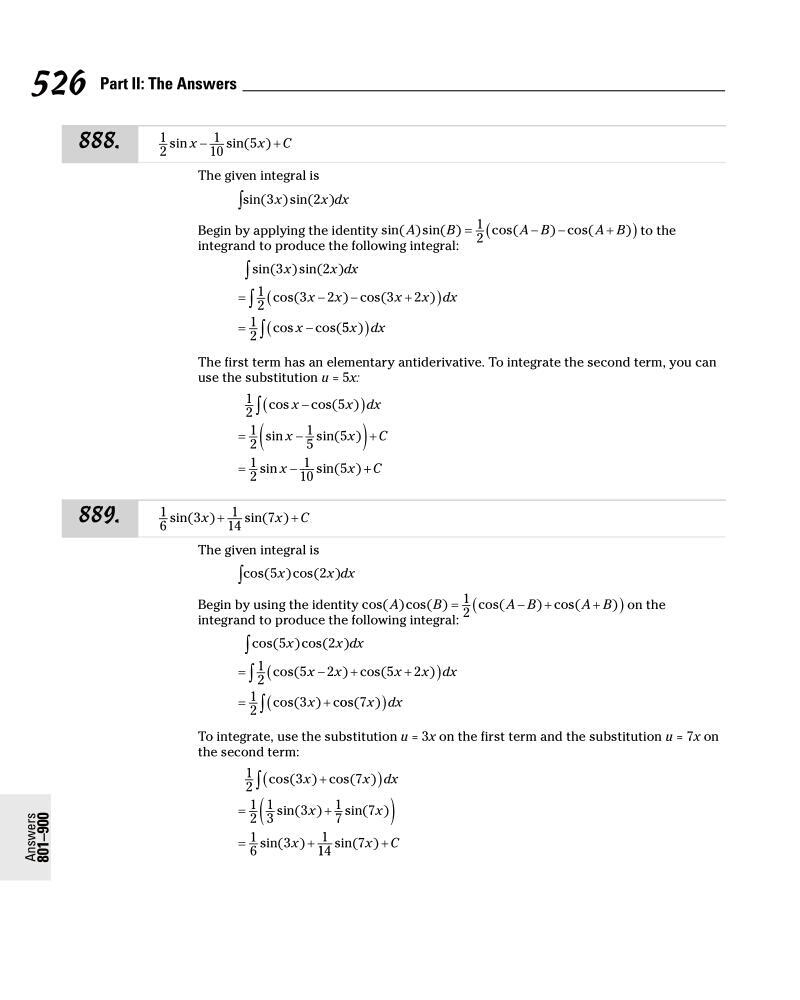
The given integral is
sin( )sin( )
3
2
x
x dx
∫
Begin by applying the identity sin( )sin( )
cos(
) cos(
)
A
B
A B
A B
=
− −
+ )
(
1
2
to the
integrand to produce the following integral:
sin( )sin( )
cos(
) cos(
)
cos
cos(
3
2
1
2
3
2
3
2
1
2
x
x dx
x
x
x
x dx
x
∫
∫
=
−
−
+
)
(
=
−
5 5x dx
)
(
)
∫
The first term has an elementary antiderivative. To integrate the second term, you can
use the substitution u = 5x:
1
2
5
1
2
1
5
5
1
2
1
10
5
cos
cos( )
sin
sin( )
sin
s in( )
x
x dx
x
x
C
x
x
−
(
)
=
−
(
) +
=
−
∫
+ + C
889.
1
6
3
1
14
7
sin( )
sin( )
x
x C
+
+
The given integral is
cos( )cos( )
5
2
x
x dx
∫
Begin by using the identity cos( )cos( )
cos(
) cos(
)
A
B
A B
A B
=
− +
+ )
(
1
2
on the
integrand to produce the following integral:
cos( )cos( )
cos(
) cos(
)
cos( ) c
5
2
1
2
5
2
5
2
1
2
3
x
x dx
x
x
x
x dx
x
∫
∫
=
−
+
+
)
(
=
+o os( )
7x dx
(
)
∫
To integrate, use the substitution u = 3x on the first term and the substitution u = 7x on
the second term:
1
2
3
7
1
2
1
3
3
1
7
7
1
6
3
1
cos( ) cos( )
sin( )
sin( )
sin( )
x
x dx
x
x
x
+
(
)
=
+
(
)
=
+
∫
1 14
7
sin( )
x C
+
526
Answers
801–900
888.
1
2
1
10
5
sin
s in( )
x
x C
−
+
The given integral is
sin( )sin( )
3
2
x
x dx
∫
Begin by applying the identity sin( )sin( )
cos(
) cos(
)
A
B
A B
A B
=
− −
+ )
(
1
2
to the
integrand to produce the following integral:
sin( )sin( )
cos(
) cos(
)
cos
cos(
3
2
1
2
3
2
3
2
1
2
x
x dx
x
x
x
x dx
x
∫
∫
=
−
−
+
)
(
=
−
5 5x dx
)
(
)
∫
The first term has an elementary antiderivative. To integrate the second term, you can
use the substitution u = 5x:
1
2
5
1
2
1
5
5
1
2
1
10
5
cos
cos( )
sin
sin( )
sin
s in( )
x
x dx
x
x
C
x
x
−
(
)
=
−
(
) +
=
−
∫
+ + C
889.
1
6
3
1
14
7
sin( )
sin( )
x
x C
+
+
The given integral is
cos( )cos( )
5
2
x
x dx
∫
Begin by using the identity cos( )cos( )
cos(
) cos(
)
A
B
A B
A B
=
− +
+ )
(
1
2
on the
integrand to produce the following integral:
cos( )cos( )
cos(
) cos(
)
cos( ) c
5
2
1
2
5
2
5
2
1
2
3
x
x dx
x
x
x
x dx
x
∫
∫
=
−
+
+
)
(
=
+o os( )
7x dx
(
)
∫
To integrate, use the substitution u = 3x on the first term and the substitution u = 7x on
the second term:
1
2
3
7
1
2
1
3
3
1
7
7
1
6
3
1
cos( ) cos( )
sin( )
sin( )
sin( )
x
x dx
x
x
x
+
(
)
=
+
(
)
=
+
∫
1 14
7
sin( )
x C
+