

Part II: The Answers
522
Answers
801–900
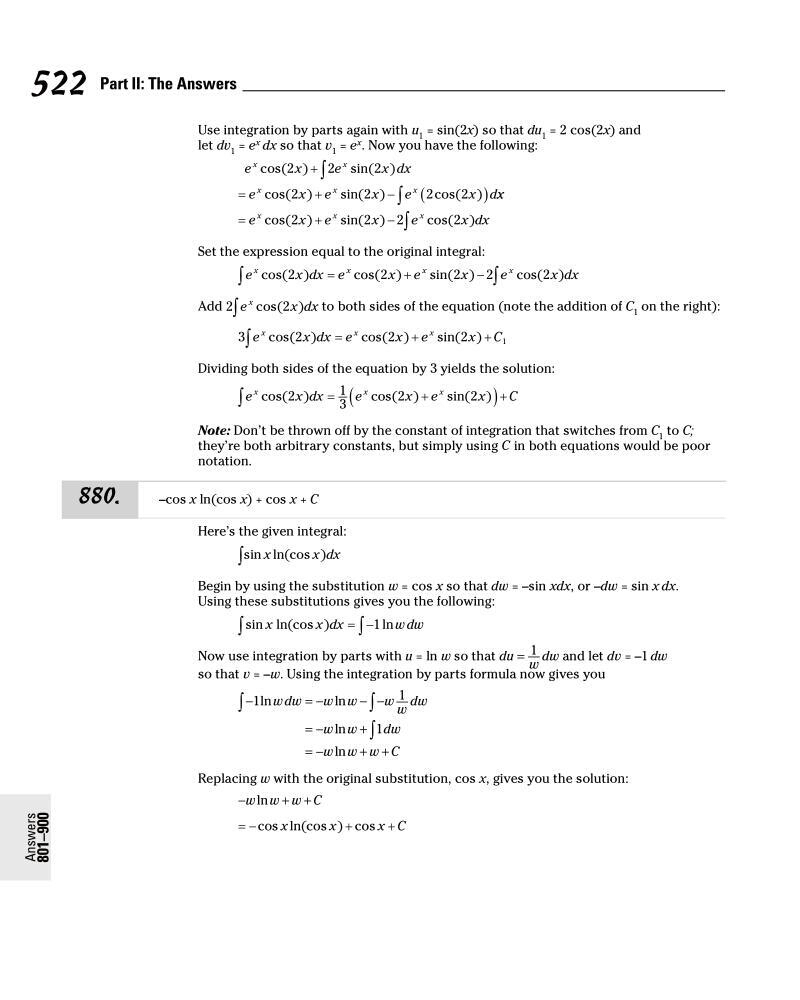
Use integration by parts again with u 1 = sin(2x) so that du 1 = 2 cos(2x) and
let dv 1 = e
x
dx so that v 1 = e
x
. Now you have the following:
e
x
e
x dx
e
x e
x
e
x d
x
x
x
x
x
cos( )
s in( )
cos( )
sin( )
cos( )
2
2
2
2
2
2
2
+
=
+
−
(
)
∫
∫
x x
e
x e
x
e
x dx
x
x
x
=
+
− ∫
cos( )
sin( )
cos( )
2
2
2
2
Set the expression equal to the original integral:
e
x dx e
x e
x
e
x dx
x
x
x
x
cos( )
c os( )
sin( )
c os( )
2
2
2
2
2
∫
∫
=
+
−
Add 2
2
e
x dx
x
∫ cos( ) to both sides of the equation (note the addition of C 1 on the right):
3
2
2
2
1
e
x dx e
x e
x C
x
x
x
cos( )
c os( )
sin( )
∫
=
+
+
Dividing both sides of the equation by 3 yields the solution:
e
x dx
e
x e
x
C
x
x
x
cos( )
c os( )
sin( )
2
1
3
2
2
∫
=
+
)
(
+
Note: Don’t be thrown off by the constant of integration that switches from C 1 to C;
they’re both arbitrary constants, but simply using C in both equations would be poor
notation.
880.
–cos x ln(cos x) + cos x + C
Here’s the given integral:
sin ln(cos )
x
x dx
∫
Begin by using the substitution w = cos x so that dw = –sin xdx, or –dw = sin x
dx.
Using these substitutions gives you the following:
sin ln(cos )
ln
x
x dx
w dw
∫
∫
= −1
Now use integration by parts with u = ln w so that du w
dw
= 1
and let dv = –1
dw
so that v = –w. Using the integration by parts formula now gives you
−
=−
− −
= −
+
= −
+ +
∫
∫
∫
1
1
1
ln
ln
ln
ln
w dw
w w
w w
dw
w w
dw
w w w C
Replacing w with the original substitution, cos x, gives you the solution:
−
+ +
w w w C
ln
= −
+
+
cos ln(cos ) cos
x
x
x C
522
Answers
801–900
Use integration by parts again with u 1 = sin(2x) so that du 1 = 2 cos(2x) and
let dv 1 = e
x
dx so that v 1 = e
x
. Now you have the following:
e
x
e
x dx
e
x e
x
e
x d
x
x
x
x
x
cos( )
s in( )
cos( )
sin( )
cos( )
2
2
2
2
2
2
2
+
=
+
−
(
)
∫
∫
x x
e
x e
x
e
x dx
x
x
x
=
+
− ∫
cos( )
sin( )
cos( )
2
2
2
2
Set the expression equal to the original integral:
e
x dx e
x e
x
e
x dx
x
x
x
x
cos( )
c os( )
sin( )
c os( )
2
2
2
2
2
∫
∫
=
+
−
Add 2
2
e
x dx
x
∫ cos( ) to both sides of the equation (note the addition of C 1 on the right):
3
2
2
2
1
e
x dx e
x e
x C
x
x
x
cos( )
c os( )
sin( )
∫
=
+
+
Dividing both sides of the equation by 3 yields the solution:
e
x dx
e
x e
x
C
x
x
x
cos( )
c os( )
sin( )
2
1
3
2
2
∫
=
+
)
(
+
Note: Don’t be thrown off by the constant of integration that switches from C 1 to C;
they’re both arbitrary constants, but simply using C in both equations would be poor
notation.
880.
–cos x ln(cos x) + cos x + C
Here’s the given integral:
sin ln(cos )
x
x dx
∫
Begin by using the substitution w = cos x so that dw = –sin xdx, or –dw = sin x
dx.
Using these substitutions gives you the following:
sin ln(cos )
ln
x
x dx
w dw
∫
∫
= −1
Now use integration by parts with u = ln w so that du w
dw
= 1
and let dv = –1
dw
so that v = –w. Using the integration by parts formula now gives you
−
=−
− −
= −
+
= −
+ +
∫
∫
∫
1
1
1
ln
ln
ln
ln
w dw
w w
w w
dw
w w
dw
w w w C
Replacing w with the original substitution, cos x, gives you the solution:
−
+ +
w w w C
ln
= −
+
+
cos ln(cos ) cos
x
x
x C