

Part II: The Answers
460
Answers
701–800
A horizontal slice of water that is Δ x meters thick and is at a distance of x i
* meters
down from the middle of the tank has a volume of 5 2 1
1 0 1
2
2
− ( )
=
− ( )
x
x
x
x
i
i
*
*
∆
∆
cubic meters. To find the weight of the water, multiply the acceleration due to gravity
(g = 9.8 m/s
2
) by the mass of the water, which equals the density of water (1,000 kg/m
3
)
times the volume:
9 8
1 000
10 1
2
3
2
3
.
,
*
m/s
k g/m
m
(
)(
)
− ( )
x
x
i
∆
The slice of water must travel a distance of 4 +
(
)
x i
* meters to reach ground level. (Note
that negative x values correspond to slices of water that are above the middle of the
tank.) Therefore, the total work required is
lim
,
,
(
)
*
*
n
i
i
i
n
x
x
x
x
x dx
→∞ =
−
(
) +
(
) − ( )
=
+
−
∑
∫
98 000 4
1
98 000 4
1
2
1
2
1
1
∆
= =
−
+
−
−
−
∫
∫
98 000
4 1
1
2
2
1
1
1
1
,
x dx
x
x dx
Notice that second integral is zero because g x
x
x
( ) =
−
1
2 is an odd function being
integrated over an interval that’s symmetric about the origin. To evaluate
98 000 4
1
2
1
1
,
−
−
∫
x dx , notice that the integral represents the area of a semicircle with
a radius of 1, so the work equals
98 000 4
1
3 92 000
1
2
196 000
615
2
1
1
2
,
,
( )
,
−
=
=
≈
−
∫
x dx
π
π J
, ,752 J
734.
20,944 ft·lb
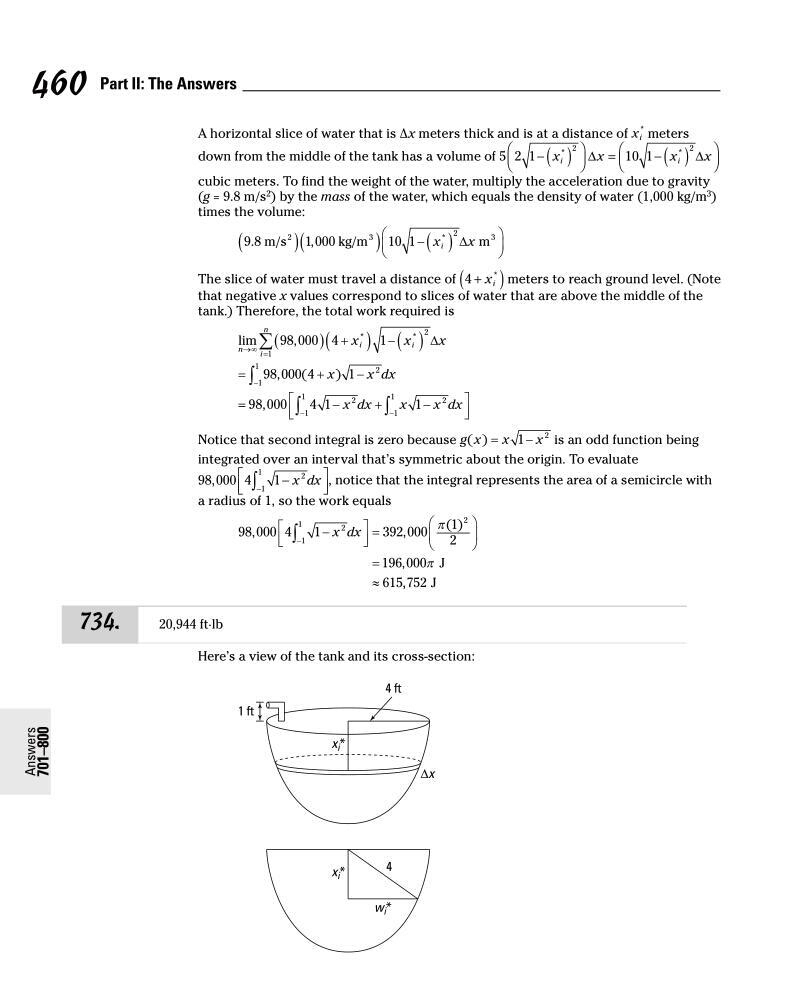
Here’s a view of the tank and its cross-section:
460
Answers
701–800
A horizontal slice of water that is Δ x meters thick and is at a distance of x i
* meters
down from the middle of the tank has a volume of 5 2 1
1 0 1
2
2
− ( )
=
− ( )
x
x
x
x
i
i
*
*
∆
∆
cubic meters. To find the weight of the water, multiply the acceleration due to gravity
(g = 9.8 m/s
2
) by the mass of the water, which equals the density of water (1,000 kg/m
3
)
times the volume:
9 8
1 000
10 1
2
3
2
3
.
,
*
m/s
k g/m
m
(
)(
)
− ( )
x
x
i
∆
The slice of water must travel a distance of 4 +
(
)
x i
* meters to reach ground level. (Note
that negative x values correspond to slices of water that are above the middle of the
tank.) Therefore, the total work required is
lim
,
,
(
)
*
*
n
i
i
i
n
x
x
x
x
x dx
→∞ =
−
(
) +
(
) − ( )
=
+
−
∑
∫
98 000 4
1
98 000 4
1
2
1
2
1
1
∆
= =
−
+
−
−
−
∫
∫
98 000
4 1
1
2
2
1
1
1
1
,
x dx
x
x dx
Notice that second integral is zero because g x
x
x
( ) =
−
1
2 is an odd function being
integrated over an interval that’s symmetric about the origin. To evaluate
98 000 4
1
2
1
1
,
−
−
∫
x dx , notice that the integral represents the area of a semicircle with
a radius of 1, so the work equals
98 000 4
1
3 92 000
1
2
196 000
615
2
1
1
2
,
,
( )
,
−
=
=
≈
−
∫
x dx
π
π J
, ,752 J
734.
20,944 ft·lb
Here’s a view of the tank and its cross-section: