

Part II: The Answers
446
Answers
701–800
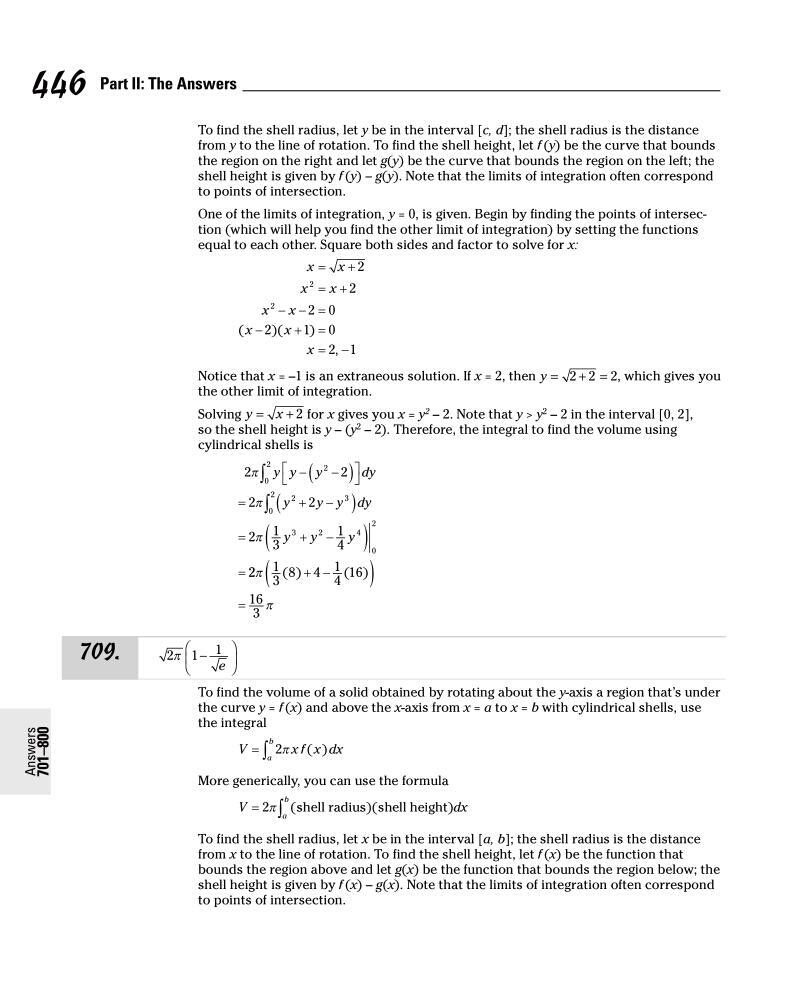
To find the shell radius, let y be in the interval [c, d]; the shell radius is the distance
from y to the line of rotation. To find the shell height, let f
(y) be the curve that bounds
the region on the right and let g(y) be the curve that bounds the region on the left; the
shell height is given by f
(y) – g(y). Note that the limits of integration often correspond
to points of intersection.
One of the limits of integration, y = 0, is given. Begin by finding the points of intersection (which will help you find the other limit of integration) by setting the functions
equal to each other. Square both sides and factor to solve for x:
x
x
x
x
x x
x
x
x
=
+
= +
− − =
−
+ =
= −
2
2
2 0
2
1 0
2 1
2
2
(
)(
)
,
Notice that x = –1 is an extraneous solution. If x = 2, then y =
+ =
2 2 2, which gives you
the other limit of integration.
Solving y
x
=
+2 for x gives you x = y
2
– 2. Note that y > y
2
– 2 in the interval [0, 2],
so the shell height is y – (y
2
– 2). Therefore, the integral to find the volume using
cylindrical shells is
2
2
2
2
2 1
3
1
4
2
0
2
2
3
0
2
3
2
4
0
2
π
π
π
y y y
d y
y
y y dy
y
y
y
−
−
(
)
=
+ −
(
)
=
+ −
(
)
=
∫
∫
2 2 1
3
8 4 1
4
16
16
3
π
π
( )
( )
+ −
(
)
=
709.
2 1 1
π −
e
To find the volume of a solid obtained by rotating about the y-axis a region that’s under
the curve y = f
(x) and above the x-axis from x = a to x = b with cylindrical shells, use
the integral
V
xf x dx
a
b
= ∫ 2π ( )
More generically, you can use the formula
d
V
x
a
b
= ∫
2π (
) (
)
shell radius shell height
To find the shell radius, let x be in the interval [a, b]; the shell radius is the distance
from x to the line of rotation. To find the shell height, let f
(x) be the function that
bounds the region above and let g(x) be the function that bounds the region below; the
shell height is given by f
(x) – g(x). Note that the limits of integration often correspond
to points of intersection.
446
Answers
701–800
To find the shell radius, let y be in the interval [c, d]; the shell radius is the distance
from y to the line of rotation. To find the shell height, let f
(y) be the curve that bounds
the region on the right and let g(y) be the curve that bounds the region on the left; the
shell height is given by f
(y) – g(y). Note that the limits of integration often correspond
to points of intersection.
One of the limits of integration, y = 0, is given. Begin by finding the points of intersection (which will help you find the other limit of integration) by setting the functions
equal to each other. Square both sides and factor to solve for x:
x
x
x
x
x x
x
x
x
=
+
= +
− − =
−
+ =
= −
2
2
2 0
2
1 0
2 1
2
2
(
)(
)
,
Notice that x = –1 is an extraneous solution. If x = 2, then y =
+ =
2 2 2, which gives you
the other limit of integration.
Solving y
x
=
+2 for x gives you x = y
2
– 2. Note that y > y
2
– 2 in the interval [0, 2],
so the shell height is y – (y
2
– 2). Therefore, the integral to find the volume using
cylindrical shells is
2
2
2
2
2 1
3
1
4
2
0
2
2
3
0
2
3
2
4
0
2
π
π
π
y y y
d y
y
y y dy
y
y
y
−
−
(
)
=
+ −
(
)
=
+ −
(
)
=
∫
∫
2 2 1
3
8 4 1
4
16
16
3
π
π
( )
( )
+ −
(
)
=
709.
2 1 1
π −
e
To find the volume of a solid obtained by rotating about the y-axis a region that’s under
the curve y = f
(x) and above the x-axis from x = a to x = b with cylindrical shells, use
the integral
V
xf x dx
a
b
= ∫ 2π ( )
More generically, you can use the formula
d
V
x
a
b
= ∫
2π (
) (
)
shell radius shell height
To find the shell radius, let x be in the interval [a, b]; the shell radius is the distance
from x to the line of rotation. To find the shell height, let f
(x) be the function that
bounds the region above and let g(x) be the function that bounds the region below; the
shell height is given by f
(x) – g(x). Note that the limits of integration often correspond
to points of intersection.